








Joanna Murray-Smith
Maria Prendergast OAM, who died in August 2025, was the original “multi-hyphenate”: a woman of such broad social commitment, intelligence and sociability that she appeared to know everyone in Melbourne and give the impression that each cause or friendship was the most important to her.
It was not until her memorial at the Kew Golf Club in October that the extent of her significance to so many was made clear, with hundreds of guests who crossed the fields of journalism, publishing, the arts, philanthropy, academia and many other disciplines.
Born Maria Bourke into a well-to-do Catholic family in Toorak, her childhood was nevertheless made difficult by physical frailty, including serious asthma which left her frequently bedridden. The silver lining was the ignition this gave to a life immersed in reading.
It was impossible to talk to Maria and not come away with a list of must-reads, although she could also be fantastically damning of writing that did not live up to expectations. Her friends would frequently receive books in the mail simply because she knew they’d like them. During COVID, other friends would receive bottles of good champagne delivered by her favourite Uber driver, George.
A great talker, Maria nevertheless excelled at listening. For many years a broadcaster and editor, she understood the value of a great story to convey a cause or an important truth and a lust for justice underscored almost every conversation she engaged in.
Educated at Genazzano Catholic girls’ college in Kew, Maria went on to study law at the University of Melbourne but never completed her degree. No doubt this was in part because by 21 she was married to Paul Prendergast, with her 1969 wedding at the London Registry Office followed by a party with John Lennon. Soon after she was the mother of two daughters, Natasha and Kristin.
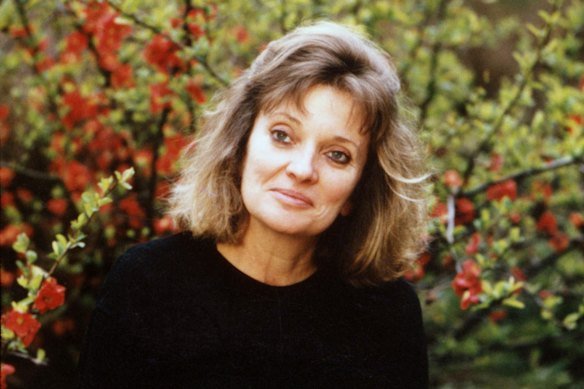
Imagining Maria in London in the swinging ’60s isn’t hard: a ravishing beauty with a mop of blond waves, almond eyes, skinny legs and a bohemian style all her own; she was a magnet for interesting people and fun times. Allergic to mediocrity, stuffiness, snobbery and hypocrisy, she said what she thought and damn the consequences – an admirable trait all the more noticeable as the world around her descended into meaningless ‘correctness’.
Having met media tycoon Kerry Packer on a plane she persuaded him to employ her, then became a career journalist and feature writer for Australian Consolidated Press (including interviewing ABBA) and continued to write for many newspapers and magazines in Australia and Britain. Her journalism ran from the political to the creative arts. In 1973, she watched the Afghan monarchy’s overthrow in Kabul from her hotel balcony. Later, she published the Australian Arts Diary with Susan McCullough, wrote the acclaimed Banks Behaving Badly and the characteristically insightful and empathetic Understanding Depression, among others.
She was a long-term member of The Fabian Society, the instigator of The Friends of The Melbourne Faculty of Music in 1976 and a member of the Deakin University Council. These were only a few of her positions with many significant organisations whose themes were recognising the value of human kindness and the arts in a healthy society. In 2007, Maria received her Order of Australia Medal for services to the arts through support for museums, galleries and cultural events and especially health care organisations.
Divorced young and deluged in interest from men, she nevertheless found her great love later in life when she married John Loder, an irascible and lovable engineer and inventor. Together, they lived in country Victoria and established not only a model for love and marriage, but a refuge for anyone in need of comfort and friendship and a venue for wonderful parties.
Maria battled both depression and a litany of physical frailties, but her natural exuberance kept her head above water. When John died in 2008 some of the light left her. She knew she could survive his death but never emerge from grief. In daily or weekly conversations with each of her friends, his name would be mentioned.
Despite this, she continued to host parties for her friends, including her infamous women-only party at Melbourne’s fortyfivedownstairs, at which a vast crowd of her female friends were waited upon by Loder and a host of male QCs and men from other lofty positions. It was a delight to see women in lively conversation only interrupted by famous men seeking to refill their champagne glasses.
The spirit of this party was fundamental “Maria”: witty, generous and subversive. Her fast and premature death was deeply shocking for all because she provided the pulsating radiance of a lighthouse to all those who knew her.
While she was highly sensitive to the injustices and failures of the world, and acknowledged them frequently, she met them as challenges to be overcome, either by action in the present or through faith in the next generation, as exemplified by her three adored grandchildren. To her grandson Sam, living in a student share-house over COVID, she would frequently send bottles of Guinness to keep his strength up, engaging with her grandchildren more as wise counsel and irreverent genie than conventional Granny.
Maria lived the kind of life that belongs to those with irrepressible zest, even or perhaps because of their proximity to suffering. Her wit, her beauty, her kindness and her intolerance for dishonesty in public life enlivened everyone around her.
She is survived by her children Kristin and Natasha, sisters Genevieve and Jane, brother Joe and grandchildren Samuel, Brigitte and Jessie.
Get the day’s breaking news, entertainment ideas and a long read to enjoy. Sign up to receive our Evening Edition newsletter.
From our partners
Read the full article here