

Opinion
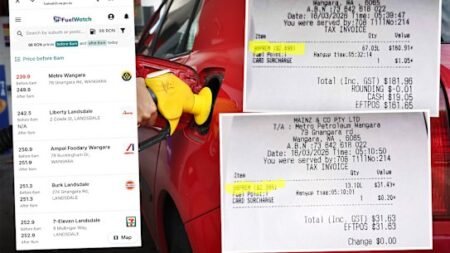
The Middle East crisis sees Australians rightly concerned about the uncertainty of future fuel supplies, and the cost of petrol and diesel. This will soon extend to aviation and shipping fuel. Whatever happens with the war from here will not make the challenges disappear. The government needs to respond with a plan that protects against future shocks, and one is available.
Some will want larger and costly fuel stockpiles; others will urge subsides, so Australia can discover and use locally sourced and refined oil. That would be extremely difficult to achieve even if, against all trends, the oil is in the ground waiting to be discovered. If it is there, it would be costly and take a long time to develop; if it was easy and inexpensive, this would have occurred already.
Further, we currently import 90 per cent of our petrol and diesel and Australia’s existing conventional oil resources are depleting and likely to run out in coming years. While untapped unconventional resources exist – shale oil, for example – they face very high production costs.
Instead, we need a plan that utilises Australia’s natural and continuing advantages, the only true way to self-reliance. The plan also needs to provide some immediate relief to motorists and households. That would involve using Australia’s abundant sun, wind and landmass, and it would require fossil fuel producers and importers to pay for the damage their products do to our environment.
The Superpower Institute’s proposed Polluter Pays Levy (PPL) would provide both the incentive to transition to green fuels – and faster than you might think – and fund relief to households and motorists. Australia’s greenhouse emissions from the transport sector have increased by about 25 per cent over the past 20 years because there is no real incentive to do otherwise.
The path to fuel security for Australia is to electrify transport as much as is economically possible, and then to use green fuels for what cannot be electrified. Green liquid fuels using green hydrogen and biomass are likely to be needed for most aviation and shipping and perhaps the largest long-haul trucks and machinery.
Producing green fuels requires combinations of sustainable carbon, such as those from waste oils and agriculture or forestry, renewable energy and green hydrogen. The combinations differ by technology, many of which are available now to make fuels chemically equivalent to fossil fuel and available to “drop in” to existing fuel tanks.
While there has been much discussion of green hydrogen as an energy source, and many setbacks for those who have tried, the real benefit of hydrogen is instead for its chemical properties as a key input into green transport fuels and, say, green iron.
Australia is probably best placed in the world to produce green transport fuels because we have some of the best solar and wind resources and the land mass needed to produce significant amounts of sustainable carbon. While the rest of the world is moving forward, at varying speeds, we are not. Many others, such as the European Union, the United States, the United Kingdom, South Korea and Singapore, are imposing green fuel mandates and providing funding and price incentives, but Australia is doing little. And what it is doing is unco-ordinated.
The cornerstone policies needed for fuel self-reliance are the PPL, which on average would raise $22 billion a year, supported by increasing mandates for using green fuels, and targeted innovation support.
Current Australian government supports for electric vehicles include federal fringe benefits tax (FBT) exemptions for eligible vehicles and various state-level incentives such as rebates, stamp duty waivers and registration discounts. These policies are costly and benefit mainly the better off, and they cannot produce the scale of transition needed nor transitional relief for motorists.
The current Middle East crisis will accelerate demand for EVs given the rising cost of fossil fuel and uncertainty about its availability. Fossil fuel vehicle owners must be worried about fuel rationing, while EV owners have no such concern. But to really promote the transition, we need more cost-effective and fairer policies. A PPL would send a clearer signal to move away from fossil fuels, and it could help fund a much larger program of charging infrastructure development, which is needed particularly to encourage renters and residents of strata dwellings to make the switch.
The PPL could fund immediate household cost-of-living support and a transition away from the current excise on petrol and diesel of 52.6 cents per litre. It would also solve the current controversy surrounding diesel fuel rebates for mining and agriculture. Those rebates are delivered because the fuel excise is seen as a road-user charge, while mining and agriculture vehicles and machinery are off-road; this makes them exempt. With a PPL, however, they would be fully captured.
The PPL accompanied by green fuel mandates would provide clear incentives and direction for the transition, as well as the funding to support households through the transition. The benefits would come quickly as the market determined the best technologies, and Australia would be better able to deal with shocks from the Middle East or elsewhere.
With an appalling crisis comes opportunity, which must now be taken.
Rod Sims is chair of the Superpower Institute. He is also Enterprise Professor at the Melbourne Institute of Applied Economic and Social Research, University of Melbourne. He chaired the Australian Competition and Consumer Commission from 2011 till 2022.
Get a note directly from our foreign correspondents on what’s making headlines around the world. Sign up for our weekly What in the World newsletter.


From our partners
Read the full article here