






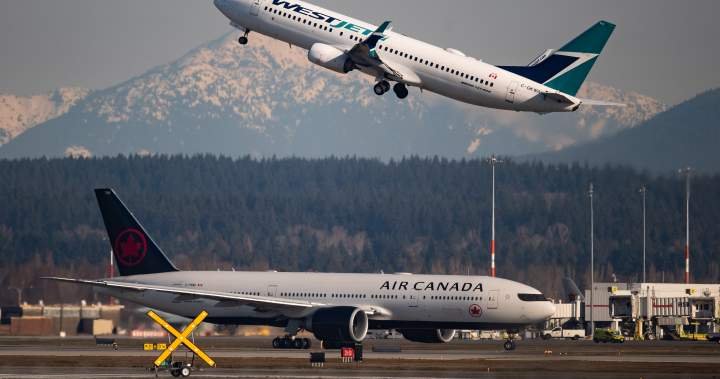
The number of safety incidents on Canadian runways is on the rise, reaching new highs in recent years even as the tally of extremely close calls levels off.
Data from the Transportation Safety Board of Canada shows that so-called runway incursions — when a plane, vehicle or person winds up on or near a runway when they shouldn’t be — hit a record 639 in 2024, the latest full year for which the watchdog has statistics.
However, the number of incidents categorized as high-risk — when there is “significant potential for collision,” according to Nav Canada — has fallen to an average of about one per year since 2018. The figures ranged higher in the preceding decade.
Safety board chairman Yoan Marier says the upward trajectory of runway incidents overall is “concerning” nonetheless, and stems partly from growing plane traffic, a shortage of air traffic controllers and increasingly complex ground operations at large airports.
“Pearson is a very complex operating environment,” Marier said of Toronto’s main airport. “There are a lot of things happening at the same time. The layout is also very complex, so pilots who are not used to operating there can have issues.”
“Even an incursion that doesn’t initially cause a risk of collision, it’s still a big deal.”
Not only is the tally of runway incidents on the rise, but so is the rate — the percentage of runway movements that see an incursion — which roughly doubled between 2010 and 2024.


Get breaking National news
Get breaking Canada news delivered to your inbox as it happens so you won’t miss a trending story.
“If traffic increases, you would expect the number of incursions to increase as well. But what’s worrying to us at the TSB is also the increasing rate,” Marier said.
He has called for better signage and lighting as well as broader uptake of technology to keep pilots and controllers more attuned to movements on the tarmac.
The issue of runway safety garnered renewed attention last month after an Air Canada Express jet plowed into a fire truck at LaGuardia Airport, killing both pilots and sending more than 40 people to hospital.
Footage shows the jet speeding along the rain-streaked strip as the truck crosses its path, veering away too late from an impact that unleashed a trail of smoke and debris as the plane skidded more than 100 metres farther, its cockpit obliterated.
While no recent collision has stemmed from a runway incursion in Canada, the risk “remains elevated until stronger defences are in place,” the safety board states on its website.
Marier stressed that flying continues to be among the safest modes of transportation and high-risk runway incidents are very rare.
“But it only takes one,” he said.
In late February, the pilot of a Cargojet freight plane conducted a “high-speed rejected takeoff” — an emergency procedure that aborts the flight at the last minute — to avoid slamming into three snowplows that were crossing a runway at the airport in Hamilton, Ont., according to a Transportation Safety Board notice last week.
The watchdog has launched an investigation into the incident.
A runway incursion can involve vehicles ranging from a fire truck to a runway sweeper on the hunt for debris to a plane that “sticks its nose a little too close to the runway,” said Benoit Gauthier, a former pilot with Air Canada.
“It usually has something to do with communication,” he said. “It’s very fragile, in my opinion.”
Safety concerns have also emerged from the ongoing dearth of air traffic controllers, a problem not unique to this country. Nav Canada, the privately run non-profit corporation responsible for training and employing the specialized staff, estimates the shortage sits at about 200 employees.
An aging workforce, rising flight activity and a timeline that can top two years to train new recruits make the problem particularly tricky.
The process to become an air traffic professional is among the longest in aviation, topped only by pilots and a few other specialized jobs. The role demands between 10 and 27 months of training. Parental leave or a move to a new airport mean months of retraining.
In 2023, the International Air Transport Association called out air traffic control organizations in North America, including Nav Canada, for staffing shortages that caused what it called “unacceptable delays and disruptions” to flights.
Read the full article here