





Prime Minister Anthony Albanese has declared the government must overhaul the NDIS to maintain its viability and ensure public support for the scheme, in an interview where he also signalled the scrapping of property tax breaks for investors could prove an antidote to the economic populism of One Nation.
In some of his strongest comments yet about the National Disability Insurance Scheme, introduced by former Labor PM Julia Gillard in 2013, Albanese opened the door to wholesale changes to the initiative in the May budget.
“The NDIS was there to assist people who have a permanent incapacity to fully participate in society – that’s something we need to value and cherish,” he said. “It’s undermined if four out of 10 kids in a class are on the NDIS.
“That wasn’t why it has that public support, and we need to make sure that we maintain public support by ensuring it’s sustainable.”
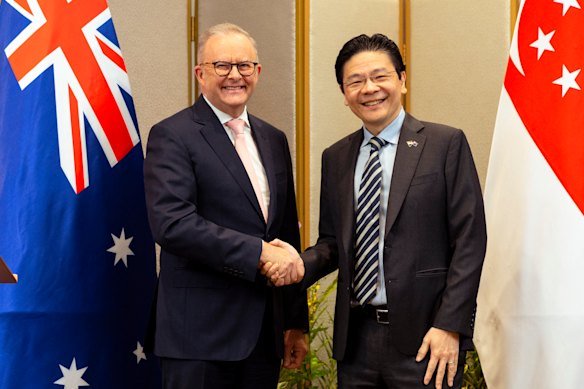
In an interview with this masthead during the return flight from a fuel diplomacy trip to Singapore, Albanese also confirmed he would extend his tour through Asia next week to meet the Sultan of Brunei on Tuesday and Malaysia’s Prime Minister Anwar Ibrahim on Wednesday in a bid to shore up supplies of fertiliser and fuel respectively.
Albanese ripped up his pre-budget schedule to prioritise the trip to Asia as his cabinet faces pressure to make long-awaited tax and productivity reforms at the same time as cutting spending at near-record levels to tame inflation.
This masthead revealed last month that Labor would bake into the budget a lower 5 per cent growth target for the NDIS. Since then, the government has welcomed a debate on structural changes such as means-testing the ballooning scheme or changing how it funds services, and registers providers. Government MPs say means-testing has been ruled out.
As of late last year, 16 per cent of six-year-old boys in Australia, many of whom were diagnosed with developmental delays or autism, were on the NDIS.
The pre-budget debate is occurring against the backdrop of a global inflation shock sparked by the war in the Middle East, and a pledge from Opposition Leader Angus Taylor to fight tax hikes.
“We’re making every effort to ensure supply, but also to deal with … prices connected with supply as well,” Albanese said, tying the success or failure of his trip to the stabilisation of fuel prices.
Australia’s paltry fuel stocks have exposed the nation’s lack of self-sufficiency during the oil shock. Public anxiety about supply chain resilience, which was not acted on after the COVID-19 pandemic, has pushed Labor to create a new “resilience” plank in the May budget. The opposition has put Labor on notice that any new reforms should not be a cover for subsidies for unviable blue-collar industries.
Albanese flagged more investment in fuel security but, importantly, he tied Chalmers’ agenda on intergenerational equity to the broader resilience program.
Another area of reform in the government’s sights is tax breaks for property investors. This masthead reported two weeks ago that Albanese had all but decided to proceed with tax reforms, which could include overhauling negative gearing and the capital gains discounts, after colleagues worried he would use the war as an excuse to go slow.
He also raised the prospect of boosting spending on incentives for state governments to achieve Labor’s 1.2 million house-building target.
“Resilience is also about economic resilience and social cohesion and making sure that young Australians understand they have a stake in the economy,” Albanese said. “And housing is obviously one of the focuses of that.”
Answering a question on scrapping tax breaks that tilt the balance against first home buyers, Albanese confirmed his government was mulling policy changes beyond housing supply, as he opened a new political battleground to fight a One Nation party surging in the polls off the back of economic and cultural disenchantment.
“The system needs to work for people. You don’t change that by rhetoric and by dividing people, which is, what is some of the populist rhetoric,” he said. “You do that by giving people a stake in the economy.”
Chalmers expressed similar sentiments at a pub event in his working-class hometown of Logan, in Brisbane, warning of the “dangerous” economic situation and its ability to make politics more caustic.
“That makes it a decisive moment for Australia, a pivotal moment where we have to decide together whether we go down the path we’ve seen in other countries; more polarising politics, more divided societies and hollowed-out economies,” he said.
“Take One Nation. At every turn and in almost every vote when they’ve had the choice between voting how communities like ours need them to or voting the way Gina Reinhart tells them to, they make the wrong choice.”
Speaking on the ABC on Sunday, Infrastructure and Transport Minister Catherine King hinted that households could receive additional support in the federal budget because of persistently high fuel prices, and that generous tax breaks for leasing an electric vehicle could be retained to encourage the uptake of EVs.
Sales of electric vehicles have surged in Australia since the US-Israeli war on Iran triggered the closure of the Strait of Hormuz and a massive spike in petrol and diesel prices at service stations.
“We’ve obviously got the tax cuts coming in on the first of July, but whether there’s need for additional measures for household and businesses, you know, they’re all things that we’re contemplating as part of the budget process,” she told the ABC’s Insiders program.
King repeatedly ducked questions about leasing tax arrangements, which waive fringe benefits tax, and which have cost the budget more than $500 million a year.
“It’s worked. It has seen uptake of electric vehicles. We, of course, do want to try and make sure there is more availability of cheaper electric vehicles for people, and that’s what the fuel efficiency standard has done,” she said.
“I’ll leave announcements around the fuel tax benefit for electric vehicles to discussions in the budget.”
Start the day with a summary of the day’s most important and interesting stories, analysis and insights. Sign up for our Morning Edition newsletter.


From our partners
Read the full article here