






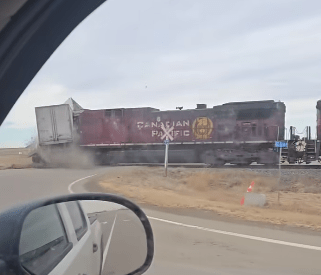
Trains are a part of Canadian heritage, linking cities from coast to coast to coast.
Currently, there are about 42,000 km of track running across Canada.
There is also a vast network of roads, meaning they will occasionally cross paths — and this is where it can be dangerous.
“In Canada in 2025, there were 160 crossing incidents and 92 trespassing incidents. That includes fatalities and injuries,” said Chris Day, the national director of Operation Lifesaver Canada.
On Tuesday afternoon, RCMP say a train was travelling westbound near Taber, Alta., when it struck a northbound semi-truck.
“Unfortunately, the train wasn’t able to stop in time, striking the back end of the semi-truck,” said Cpl. Troy Savinkoff with the Alberta RCMP.
The police investigation determined the truck had stopped before the tracks, then proceeded onto them, stopping again while the trailer was still in the way of the train.


Get breaking National news
Get breaking Canada news delivered to your inbox as it happens so you won’t miss a trending story.
“My understanding is it’s quite open, lots of fields. It’s Taber/Vauxhall area, so we’re not talking a lot of hills or anything. (The semi-truck driver) just missed it,” said Savinkoff.
The driver was ticketed with careless driving following the incident, but thankfully no injuries were reported.
While it may seem like this shouldn’t have happened, one driving expert says overall motorist behaviour has been declining for years.
“We know that statistically, across North America, driving behaviours have degraded basically since the pandemic,” said Hannah Hamilton, program manager of safe communities with the Alberta Motor Association.
She says the exact reasoning isn’t known, but entitlement could be a partial culprit.
“There’s some psychology into (the idea that) people are less community minded now — they’re thinking more about themselves.”
Hamilton says the roadway is a shared experience with everything from a two-door sedan to a multi-car train.
For Day, he’s concerned about the almost 25,000 railway crossings in Canada where people need to think about more than just themselves.
“There are a lot of places where people who may, or may not, be paying the attention they should be, can find themselves in conflict or collision with a train,” said Day.
He says the amount of annual incidents involving trains and vehicles or pedestrians has declined significantly over the past 40 years, but the five-year average has been up.
As a result, every expert says it’s important to just remember you aren’t alone on the road and paying attention is a must.
“I think the biggest message is remember that driving, whether (knowing your route) like the back of your hand or not, is an activity that requires your full attention,” said Hamilton.
Read the full article here