





Updated ,first published
The Iranian women’s soccer team have flown out of Australia in dramatic scenes, with at least one more player opting in the final moments before boarding to remain behind, while some of her teammates could be seen crying as they boarded the flight to Kuala Lumpur.
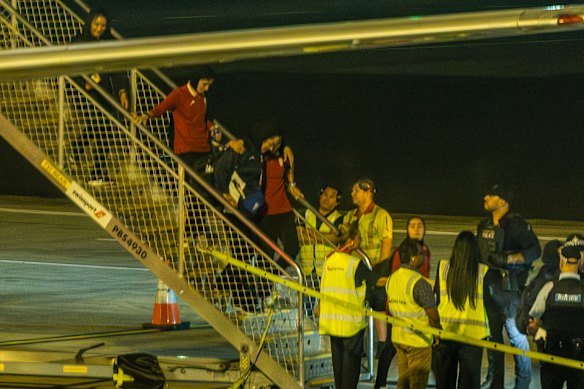
Protesters cried inside the airport as they watched the team disembark on the tarmac in Sydney on Tuesday from the Gold Coast, before clashing with Australian Federal Police as the women were put on a private bus to be taken to the international terminal.
While waiting to board their flight to Kuala Lumpur, several players interviewed by this masthead, flanked by chaperones, said they wanted to return home to be with their families despite fears for their safety and possible persecution in Iran.
At least one additional player, along with the five members already granted humanitarian visas after escaping their minders on the Gold Coast, opted right before boarding to remain in Australia. Official confirmation of how many Iranian players have stayed in Australia was being sought.
Other members of the team cried as they boarded their Malaysian-bound flight, while others could be seen reluctantly leaving the departure lounge to board the plane.
Earlier, when the team arrived in Sydney, supporters held signs and shined flashlights against the windows at the gate, as they desperately sought to make contact with the squad. Several messages, scrawled on the back of cardboard bags with blue markers, urged the players to seek assistance from the Australian government if they wished to return home. One was addressed to a particular player, 24-year-old winger Golnoosh Khosravi, reading in Farsi: “Golnoosh, your mum said to stay”.
The dramatic exit from Australia followed scenes on the Gold Coast where one player appeared to be pulled on board a bus by teammates and supporters unsuccessfully tried to block the path of a bus carrying the team, including by lying in front of the vehicle and chanting “Save our girls”. Police attempted to move them on, and the bus eventually headed for the airport with a police escort.
Prime Minister Anthony Albanese earlier on Tuesday invited more players to seek asylum in Australia as advocates urged authorities to speedily detain any regime handlers and even pleaded with airline staff to block them from flying out of the country.
The first five players who escaped have been identified as captain Zahra Ghanbari and her teammates Fatemeh Pasandideh, Zahra Sarbali, Atefeh Ramezanizadeh and Mona Hamoudi.
Albanese celebrated the five players’ escapes, saying they should feel at home in Australia.
“We’re willing to provide assistance to other women in the team, noting that this is a very delicate situation and it is up to them,” he said.
“But we say to them: ‘if you want our help, help is here and we will provide that’.”
NSW Premier Chris Minns said any of the players who defected would be “warmly welcomed” in his state, saying they would be embraced by the large Iranian diaspora.
“They are some of the most generous, loving, big-hearted people that we have,” he said.
“The Coalition worked with the government to ensure that visa options were available to all members of the Iranian women’s soccer team,” he said.
“If any coercion is occurring, authorities must come down with the full force of the law.”
Albanese said he had spoken to Donald Trump at 2am after the US president angrily complained on social media that Australia had not done enough to protect the women.
Trump’s call for Australia to offer asylum to the women came after five members of the team had already escaped and this masthead and others had reported they were being protected by police.
“We had a very positive discussion,” Albanese said of his early morning call with Trump.
“He was concerned about the Iranian women in the soccer team and their welfare and their safety if they returned home. He conveyed that to me. I was able to convey to him the action that we’d undertaken over the previous 48 hours and that five of the team had asked for assistance and had received it and were safely located.”
Albanese continued: “Assistance remains available for the other members of the team, but it, of course, is a decision for them. If they make a decision to ask for support, they will receive it.”
Human rights advocate Sara Rafiee urged police to take in any handlers for questioning and for their visas to be revoked, given the Islamic Revolutionary Guard Corps (IRGC) has been designated as a terror organisation.
This would give the players more agency to decide whether they wanted to stay in Australia or return to Iran, she said in a call supported by other Iranian-Australian community leaders.
“We are grateful to the Australian government for acting swiftly in granting visas to the five Lionesses,” she said.
“At the same time, we support calls for the government to immediately revoke the visas of any accompanying Islamic Republic officials or security personnel involved in threatening or intimidating these players, and to place them in immigration detention while their conduct and any potential links to the IRGC are investigated on national security grounds and for issuing threats and intimidation.”
Rafiee said the situation was similar to domestic violence cases in which victims are separated from their partner so they are not subjected to coercive control.
“The safety of these women must come first,” she said.
Members of the Iranian diaspora have named the official Mohammad Rahman Salari as a handler who has been supervising the players while in Australia.
Liberal frontbencher Julian Leeser said: “The government should immediately revoke the visas of any accompanying security personnel involved in threats or intimidation against these brave women, and put them in immigration detention now.”
Branding the regime in Tehran “terrorists and murderers”, Leeser said, “They have killed 30,000 of their own citizens over the last month. We must take the fears of retribution seriously.”
Leeser said every member of the team should have the opportunity to speak individually with an Australian Border Force agent or other government official and to seek asylum if they want it.
“Subject to all the normal security checks, we should offer the women of the Iranian team an alternative to returning to Iran,” he said.
Home Affairs Minister Tony Burke said the players who escaped were happy to be identified, emphasising they regarded themselves as athletes, not political activists.
Burke, who raced to Brisbane to assist the escape effort, told reporters: “There has been a lot of work that’s been going on in recent days to make sure that we had the maximum number of opportunities for these women to know that they could seek assistance if they wanted to, and to have the maximum number of opportunities to directly seek that assistance.”
He continued: “I say to the other members of the team, the same opportunity is there.
“Australia has taken the Iranian women’s soccer team into our hearts. These women are tremendously popular in Australia, but we realise they are in a terribly difficult situation with the decisions that they’re making.
“But the opportunity will continue to be there for them to talk to Australian officials if they wish to.”
Read more on the US-Israel-Iran war:
Cut through the noise of federal politics with news, views and expert analysis. Subscribers can sign up to our weekly Inside Politics newsletter.


From our partners
Read the full article here