




Updated ,first published
Singapore: Singapore has promised to do everything in its power to keep supplying Australia with more than half its petrol, as Prime Minister Anthony Albanese flags an expansion of gasfields and special deals to keep powering the wealthy city-state.
However, Prime Minister Lawrence Wong’s confident tone was coupled with a warning that exports would hold “as long as upstream supplies continue”, pointing to the prospect of lower output if Singapore could not source enough crude oil as the trajectory of the war remained uncertain.
Also complicating an energy supply agreement between the two nations was an Australian proposal to more heavily tax gas firms. Albanese played down the revenue-raising idea and said his immediate focus was on “supply, supply, supply”, but he did not rule it out. Wong suggested that more expensive Australian gas could push Singapore to look elsewhere.
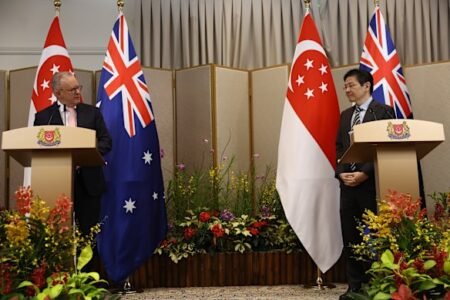
As only a few tankers pass through the Strait of Hormuz and US Vice President JD Vance heads to Pakistan for peace talks, Albanese concluded the first stage of his blitz through Asia with a joint statement with Wong, urging the US and Iran to permanently end the war.
The prime ministers also pledged to exert “maximum efforts” to continue trading large volumes of fuel and gas between the two nations.
“This is a win-win,” Albanese said at The Istana government residence in Singapore, claiming the tie-up would help farmers and the Australian economy straining under high fuel prices.
As major gas projects such as Scarborough and Beetaloo loom, Albanese hinted at “additional fields” that would “continue to provide support for Singapore”, which sources most of its LNG from Qatar and Australia.
Wong and Albanese signed a statement on energy exports that, while not legally binding, was pitched by the Australian side as significant in a context where Wong was being pursued by other world leaders for similar pledges.
“It won’t happen,” Wong said when asked about cutting exports. “We didn’t have to do so even in the darkest days of COVID, and we will not do so during this energy crisis.”
Albanese visited Jurong Island – one of the world’s largest oil refinery hubs – on Friday morning. Australia is hoping to be prioritised if Singapore’s refineries keep reducing output.
Companies have sourced more crude from the US and Africa to replace oil from the Middle East, and Wong signalled an openness to using more Russian oil despite it being a revenue source used to fund the illegal invasion of Ukraine.
Albanese upended his schedule to secure a face-to-face meeting with Wong, reflecting Australia’s lack of domestic oil reserves and reliance on others. The pair tightened the strategic relationship at a time when the US and China were exerting their muscles, talking up defence and green energy co-operation.
Petrol prices in Australia have spiked due to global price pressures and panic buying. A fuel excise cut lowered prices, but analysts warn prices will go back to normal only when the Strait of Hormuz reopens and helps stabilise the global market. Steady supply into the future from nations such as Singapore is likely to help maintain certainty in Australia among petrol retailers and industries that rely on diesel.
The leaders released a joint statement using strengthened language from an earlier in-principle agreement in March, noting the “deep reservoir of strategic trust” between the two nations.
They will start working on a new legally binding element to the nations’ free trade deal related to the trade of essential supplies. It is not clear how quickly this will be drafted and put into action, or if it will allow for clearer-cut guarantees on fuel supply. Australia was not expecting a legally binding commitment on supply during the trip.
The opposition cast immediate doubt about the Singapore deal, asking how many tankers had been secured. Opposition Leader Angus Taylor told reporters on Friday that the test for Albanese’s trip was whether fuel prices came down.
“We’ve seen in the last couple of days a sharp reduction in the price of fuel coming out of Asia,” Taylor said in Tasmania. “The terminal gate price in Singapore sets the wholesale price here in Australia; it’s come down [from] over $100 a barrel, but it hasn’t come down at the bowser here in Australia.
“The prime minister needs to take action to make sure those price reductions are being passed through … here in Australia. He’s up in Singapore. This is his chance.”
The government has been exploring the option of a new windfall tax on gas export profits to help Treasurer Jim Chalmers fund tax offsets for businesses. Albanese has sidestepped the questions at times and downplayed on other occasions over the past fortnight, but this masthead has previously reported the tax is unlikely to be included in the May budget.
“Our reputation as a reliable supplier of energy, not just to Singapore, but to other nations in the region, is a critical part of the way that Australia is perceived,” Albanese said.


From our partners
Read the full article here