


When I was a toddler, my father abandoned me for the first time. It was far from the last. My mother fell ill and my aunt and uncle were caring for me like I was their own. After my mother died, my father snatched me from them, not to reclaim me as his daughter, but to send me and my eight siblings (aged between two and 13) to Catholic orphanages while he ran off with his brother’s wife.
Later, when I was eight, the nuns and brothers learnt where he was, and sent two of my brothers, a sister and me back to him. I lived in a tent, a bush shack and, finally, a house with my siblings, new half-siblings and a terrifying stepmother until I was 13.
Then my father abandoned me once more. In my first term of high school, he declared: “There is no room for you in this house; you need to find a job and somewhere else to live.” He gave me seven days to get out.
How much these early life experiences played a part in what happened next, I can’t say for sure, but I do know that the actions and choices of vulnerable girls and young women should not be judged in isolation.
My older sister in Queensland let me live with her until I was 15, when I moved to Sydney and lived with nine girls in a boarding house. I was working three jobs, but I was in control of my life, free and happy.
Until Jamie* came along. He was a tall and handsome man, almost twice my age, who worked in the same factory as me and one of my older brothers. In my young eyes, he was a wonderful, caring man. We began a relationship. I was painfully shy and innocent to the ways of men. Jamie’s attentions were intense and I never doubted his good intentions. Three months on, Jamie said he wanted me to marry him – what else could a girl ask for?
My older brother listened closely to me rabbiting on about how wonderful a man Jamie was and finally lost his patience. He took me aside for a “big brother” talk. He had been checking up on this “Jamie character”, as he put it.
“He’s not the man you think he is. He’s a divorcee with teenage girls almost your age. But worse, his mates tell me he and his girlfriend have two small children together. He is two, no, three-timing you. You have to stop seeing him immediately.”
I was shattered. I had my own bombshell to deliver: I was carrying Jamie’s child.
When I told Jamie I was pregnant, he denied it was his, and said he didn’t want anything to do with me or my baby. That was the last time I spoke to him.
I attended the Crown Street Women’s Maternity Hospital clinic for prenatal check-ups. I began gathering tiny baby clothes, gazing lovingly at them. I made a promise to myself and my unborn child: “I will have my baby and raise it with all the love and devotion that lies within me.”
On March 23, 1971, I delivered a healthy baby girl, but the birth was horrific. She was breech. The doctors induced labour. They pushed and pulled at me with little care for what they were doing. They needed to perform an episiotomy to get her out. Terrified, drugged, and disoriented, I finally heard small baby cries in the distance. In my drugged state and thinking the worst, I called for her, but the nurses held a pillow blocking my view. Then, they took her away.
The next thing I remember is being on a bed in the maternity hallway, traumatised. I begged the nurses to bring me my child, but nothing moved them. The matron told me that as an unwed mother, without means or family support, my baby was declared a ward of the state and would be adopted.
It came as an utter shock. Never once was I informed or counselled about the doctors’ intentions. They took my baby without consideration, consultation or consent.
Left abandoned in the corridor, I was distraught. Then I heard the cruel words spoken by a passing doctor: “What is she doing here, clogging up the corridors? I have already signed her release form. Get her down to Wakehurst.”
I was taken to Lady Wakehurst Home, an annex to Crown Street Women’s Hospital, where unwed mothers could be kept out of sight of their newborn babies. Once there, the staff busily carried on my antenatal care with little regard for my grief.

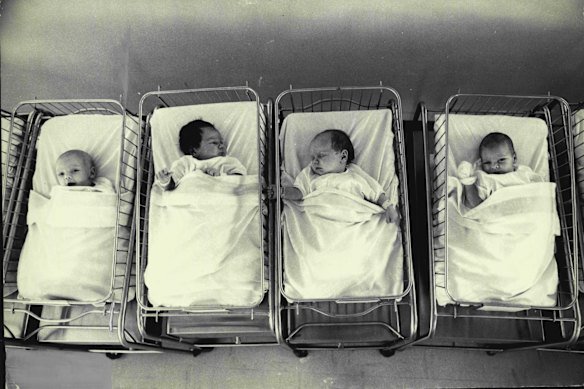
The medications I was given seemed to keep me drowsy. A young nurse told me in confidence that if I wanted to have any chance of keeping my baby to seek family support. I was informed that my release from Wakehurst was dependent upon my signature on my baby’s adoption paperwork.
A week later, after being released from Lady Wakehurst, I travelled to country NSW to visit another of my older brothers and his wife, hoping to gain family support to get back my baby. Although sympathetic to my plight, the best they could offer was to adopt my newborn, saying I could come and visit her anytime. What a crushing cruelty to see the child, but not be able to care for it myself. I said no. It was agony.
The pain of this time in my life has never left me.
Unlawful, unethical and causing lasting suffering
Forced adoptions became a common practice in Australia between 1950 and 1975. The total number of forced adoptions could be as high as 250,000.
In 1971, at least 858 babies of single mothers were adopted from Crown Street Women’s Hospital. Adoptions peaked in NSW in 1972.
A NSW inquiry in 2000 found forced adoption led to “lasting suffering for many mothers” and that “the practice of denying a mother access to her child prior to the signing of consent was unlawful”, while the failure to explain alternatives to adoption was “unethical”. Many women told the inquiry that their “consents were secured as a result of threats or coercion at the time of signing”.
Sources: Crown Street Women’s Hospital A History 1893-1983, Commonwealth Contribution to Former Forced Adoption Policies and Practices report, NSW Legislative Council Standing Committee on Social Issues, Releasing the Past: Adoption Practices 1950-1998, Amanda Rishworth speech 2023
Last year, I began assembling documentation for this story. Writing to the adoption record unit, waiting months, assembling proof, opening emails, wondering what I’d learn about that horrific experience.
Over the years, before the advent of electronic mail, the postman has delivered me a fair share of shocks: the letter that arrived from Jigsaw (the agency that helps adopted children and their biological parents find each other) telling me that after 26 years, my stolen child was looking for me; the birth certificate that made her real, but which pretended I didn’t exist (only the adoptive parents were named); the letter from her asking to meet.
It read: “I am struggling that you could give your first baby away to two complete strangers to raise me and call me their very own daughter … but I can understand now that you were a virtual orphan … with no finances or family support … Your difficult decision has given me the most cherished and wonderful life any child can ask for [but] … I feel a need within me to know about the blood that runs through my veins … I hope to hear from you soon.”
We did meet; her resemblance to Jamie was astonishing. For some reason, I hadn’t anticipated she would look so much like him. She introduced me to her children as a family friend, and we spoke about family health issues. I played with my unsuspecting grandchildren. But since then, we have rarely spoken. Never have we sat down together to discuss the full facts of her forced adoption, nor the trauma we both experienced on the day of her birth. It still pains me to think she believes I did or do not love her after carrying her close to my heart for nine months.
Last year, there was no postman, the mail was electronic, but there was another shock. Along with my record of confinement (marked UB-, meaning baby for adoption), was my prenatal clinic history record. On it was my father’s signature, giving his permission for the hospital to treat me (a minor) during my pregnancy. It is the first time in more than 50 years that I had any inkling that he knew of my predicament. He knew and said nothing, did nothing, offered nothing. Abandoned again.
Apologies
In 2012, the NSW parliament issued an apology for forced adoption saying “to those living with the ongoing grief and pain of forced adoption practices, … we are sorry”.
In 2013, prime minister Julia Gillard issued a national apology. She said: “To you, the mothers who were betrayed by a system that gave you no choice and subjected you to manipulation, mistreatment and malpractice, we apologise.”
On that terrifying day, 55 years ago this month, when my newborn was forcibly taken by the doctors at Crown Street Women’s Hospital, the young girl within me died. Even now, though I am 75 years old, my heart has neither forgiven nor forgotten. Australia, too, should never forget what was done to the many thousands of vulnerable girls and young women who suffered the abomination of forced adoptions. I have placed the precious memories of my lost child inside a treasure chest in my heart, where I visit and grieve in peace.
* Not his real name.
The author’s name has been withheld to protect her family’s privacy.
Read the full article here