







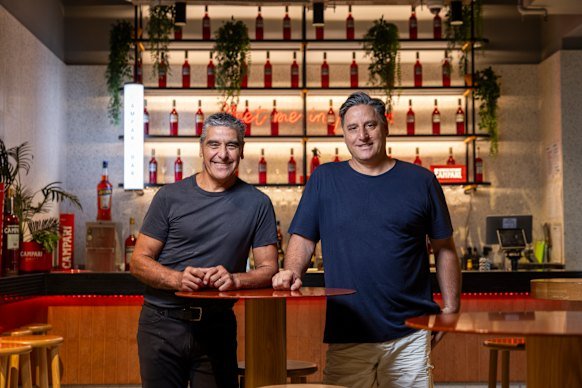
Fabio Angele walks gingerly into the domain of his little brother, Yuri. He’s here at the request of The Age to pose for a photograph for this article.
After a little delicate negotiation, Fabio has offered to make the trip from Brunetti, his cafe in Carlton, to his brother’s cafe, Brunetti, in Flinders Lane.
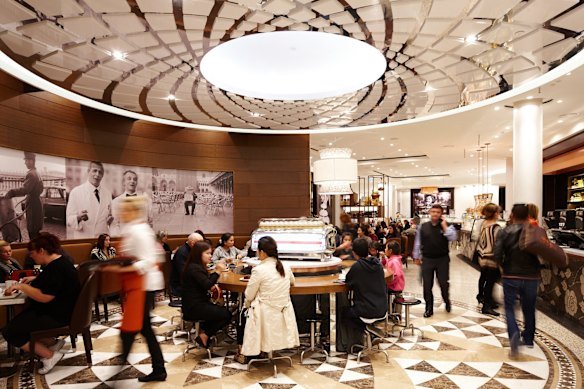
It’s a while since he’s been here and, walking in, casts a curious eye over the cakes stacked in a glass case on the left. He glances at the gelato bar and the array of focaccias, then picks his way through the vast crowd – swollen by Australian Open tourists – queuing for their morning coffee at the half-moon bar.
“It’s quieter in Carlton,” he remarks.
Brunetti represents Australian-Italian culture made real in the form of coffee and cake. To interstate visitors, these spaces simply say “Melbourne”. Most of us probably think of Brunetti’s two 1000-square-metre temples to indulgence as one entity with twin campuses.
But that hasn’t been true since 2021. Both brothers refer to the event that divided them as “the separation”. Since then, there have been two distinct businesses – Brunetti Classico in Carlton, and Brunetti Oro in the city.
Classico, under older brother Fabio, owns Carlton, plus three cafes at Melbourne Airport, one in Moonee Ponds and one in Coburg North. Yuri, the younger brother by eight years, owns Oro, with the flagship in Flinders Lane, and satellites in Brunswick, Myer in Bourke Street, Chadstone and Swanston Street. A proposed kiosk at the entrance to the new Town Hall station will depend on whether the Metro Tunnel generates enough foot traffic.
The brothers catch up at family gatherings but avoid their rival’s outlets. They have a “gentleman’s agreement” not to encroach on each other’s turf.
They have two sets of plans, two imagined futures. There are even two style guides governing Brunetti’s trademark high-quality fit-outs – an attempt to differentiate brands that, to the untrained eye, remain almost indistinguishable.
The separation took place almost five years ago, but to this day, suppliers and customers get it wrong. And until now, the brothers have never spoken publicly about the reasons behind it.
It turns out that – as some of the best feuds do – this one comes down to tensions within a big, strong-minded family.
One brother says frustration lies behind the break-up of Melbourne’s most iconic cafe chain. The other puts it down to ambition.
In many ways, Brunetti as we know it was born of a much earlier bout of Italian family dynamics.
Family patriarch Giorgio Angele grew up in Rome and came to Melbourne in 1956 in a crucial capacity – he was the pastry chef for the Italian Olympic team. When the team returned home, Giorgio stayed on and set up a tiny pastry shop in Kew.

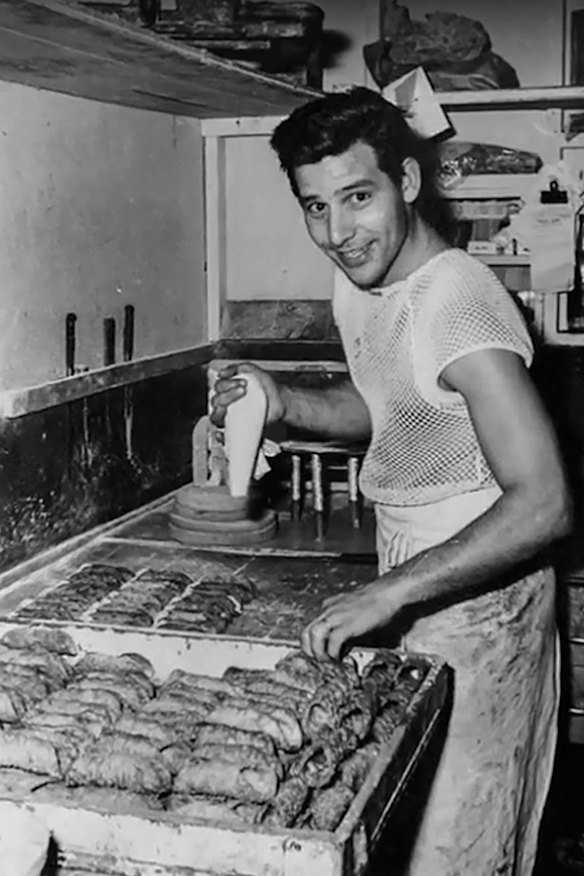
In 1950s and 1960s Australia, post-war migration made Melbourne the epicentre of a lively expatriate Italian culture. Belford Road in Kew was nowhere near that centre. Young Giorgio’s job was to churn out apple slices and meat pies for unsophisticated local tastes.
But he never stopped baking his beloved Italian pastries, and in the evenings, he’d take the uneaten leftovers on the bus to Lygon Street.
“He’d sell them to all the espresso bars – these bars were open until late at night,” says Fabio of his father. “And he would sell it to them for like 20¢, 50¢. All the immigrants were in that scene. They’d come after work. It was their social life.”
As his business grew, Giorgio married, moved his shop to Swan Street in Richmond, and started a family.
“Mum had three boys,” says Fabio, but she really wanted a girl. “So she tried again and had two boy twins. Then she said: ‘That’s enough.’”
The five Angele sons grew up among the sports fields and swimming pools of Richmond, as Giorgio in the 1970s went into wholesaling with a company called Ital Biscuits – the maker then, and now, of Melbourne’s best-known panettone.

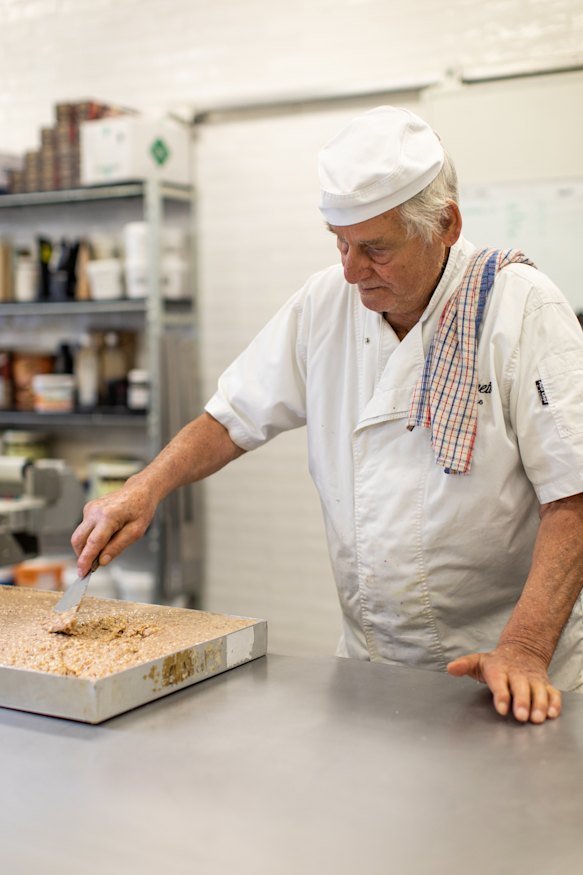
As they grew and graduated, the eldest son, Joe, became an architect, while the other four went to work at Ital. As Australia fell into recession in 1991, it was hard to support them all. Also, the business was starting to feel crowded.
“We had four of us all together there,” says Fabio, “and Dad said: ‘This ain’t going to happen’.”
Something had to give. Meanwhile, over in Carlton an opportunity to diversify was opening up. Since 1985, another pastry chef, Piero Brunetti, had been running his own eponymous cake shop out of a multi-storefront space in Faraday Street. Word reached Giorgio that Brunetti was ready to sell, so he crossed the river to the north and paid a visit.
“Within that day, with a shake of the hand, he bought the business,” Fabio says.
In a strategic family split 35 years ago – the first among the Angele brothers – brother Robert stayed on to run Ital Biscuits and Fabio assumed control of Brunetti. Yuri stayed at Ital, but by 2000, he felt his voice was not being heard.
“There are families which can unite and others that don’t,” Yuri says.
“Slowly, Yuri came over,” says Fabio, “and there were two of us.”

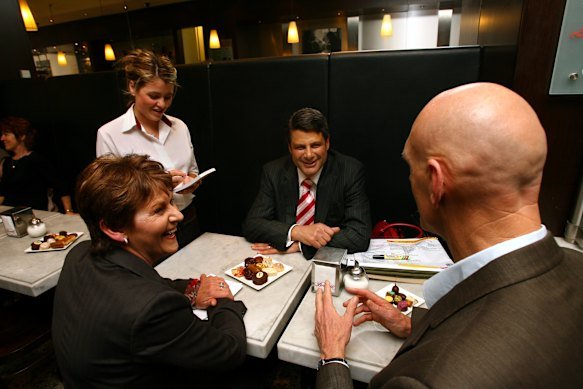
Initially, it was a happy partnership.
“Yuri used to travel a lot because he was single,” says Fabio. “He would go to all the exhibitions … to Rimini and Milano and do all the purchasing and a lot of the development stuff, and I left it to him … I hated the travelling. It’s such a long flight to Europe.”
When in Melbourne, Yuri’s task was to look after production. Fabio, meanwhile, focused on the front of house. Between them, the brothers’ partnership built Brunetti into one of Melbourne’s most recognised cafe brands.
Yuri traces the beginning of the end to 2006. Then, a major dispute arose with the Faraday Street landlord, Pauline Halperin. She demanded $107,000 more in rent per year – an almost 33 per cent hike and well over the market rate – with the threat of eviction if Brunetti did not pay up.
Fabio was furious. He signed a five-year lease in 2007 but only after fuming to The Age about his landlord, saying: “Negotiation isn’t in their vocabulary.” He started planning the family’s exit.

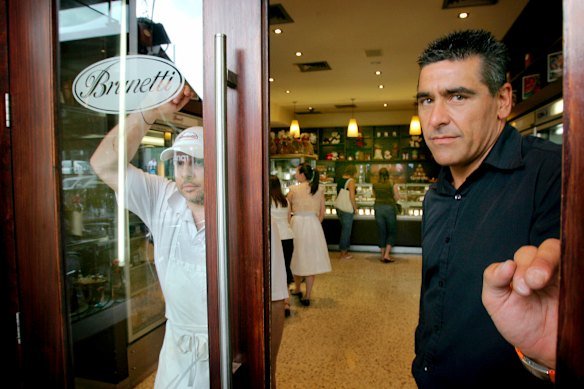
The brothers fitted out the cavernous space of the old Borders bookstore in Lygon Court at huge cost – what Yuri says was about $10 million. Yuri says now that the transition to the new site worked out well. People loved it. But at the time, he thought the rental dispute could have been handled better and the substantial risk of relocation avoided. He did not feel his concerns were being listened to.
“It could have been a disaster … [but] he [Fabio] had that vision, and we didn’t agree about it,” Yuri says. “We were 50/50 owners, but I’m still the younger brother. And that sentiment carried through.”
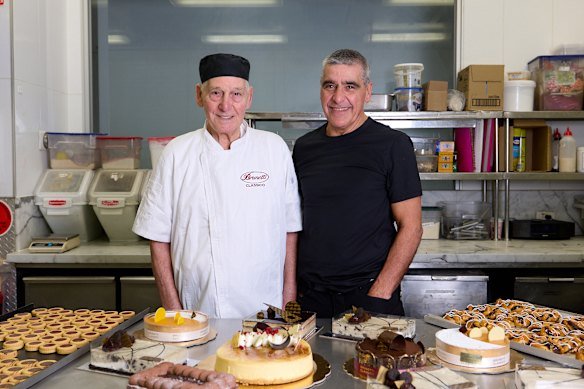
Feeding the appetites of Brunetti Classico’s customers in Carlton is a kitchen at the back. Fabio walks me through – it’s jam-packed with giant mixers, ovens, blast freezers and sinks. It’s staffed in two shifts for about 16 hours a day and, it’s fair to say, it’s cramped – at one point, we almost bump into a woman wielding huge wet dishes.
“Carlton is not ideal,” Yuri says. “It’s not efficient, it’s very costly and difficult.”
When he and Fabio were still together, Yuri was pushing to expand, but he felt the Carlton kitchen was a constraint. He wanted a dedicated production facility off-site – and a property the company owned in Coburg seemed to provide the answer.
Fabio disagreed. He wanted to stay on familiar turf.
As tensions rose, Yuri says the family put in place a four-person board to make the big decisions.
“It didn’t work,” Yuri says bluntly. In about 2020, the board decided to sell the Coburg property. He vehemently disagreed.
“We were ready to build the kitchen,” Yuri says, “but the decision went against me. I thought it was stupid. I was told to leave, be a silent partner, not be part of the business. They weren’t aggressive blow-ups, but … Coburg represented something to me, which was the future of the Brunetti. It was integral to expansion.
“Fab is a hardworking guy – he works 2am to 2pm, seven days per week. My vision was outside of that. It was expansion.”
While Yuri was looking for more, his older brother was beginning to look toward the exit – or at least, a slower life.
“Look,” Fabio tells me, “I was a certain age and I was quite happy to sort of settle down a bit … I’ve been working since the ’90s. When I first came here, I was working 18 hours a day”. He was looking to “consolidate and see if my kids want to eventually take it over and keep it going, or … to one day sell it.”
Asked what had caused the rift with his younger brother, Fabio is discreet. He tells me to ask Yuri. He allows only that it was to do with Yuri’s “ambitions”.
The differences turned out to be irreconcilable.
“I couldn’t really buy Yuri out and he couldn’t buy me out,” Fabio says. “I probably would have, if he’d asked me, but we weren’t in a position.”
For Brunetti to survive, the brothers would have to find a way to move forward – separately.
“Who am I to drag him through an expansion, out of his comfort zone?” asks Yuri. “I shouldn’t be imposing my direction on someone who hasn’t got the same vision.”
So, in 2021, as COVID decimated the hospitality industry, the brothers put a cleaver through their decades-long collaboration.
Patriarch Giorgio was “very much on Fab’s side of it”, says Yuri, tight-lipped. “Initially, Dad didn’t want us to … I’ve got a young family and it was very hard. It’s unfortunate.
“It was a bit hot at the time. It’s settled down since … I see Dad every day. We have a great relationship.” They live on different floors of the same city apartment building and Giorgio helps look after Yuri’s young children.
The brothers divided up the machinery and asked the staff to choose a brother to work for. The split was pretty even and fair, Fabio says. Yuri confirms this, but says extra costs generated by the split meant some staff had to go.
Afterwards, Yuri moved quickly to build his dream kitchen in Brunswick. It supplies all his existing cafes and has room to grow. “I’ve got 3000 square metres,” Yuri says, “Fab is working from a few hundred.”
Yuri is pursuing growth for his business, Brunetti Oro. This includes a forthcoming new store – almost the size of the Flinders Lane flagship, in a location he cannot yet name. He’s also working on a concept, Brunetti Zero, of a modular, removable shop selling packaged food in Asia.
Fabio – who completely lost his taste for coffee during an early bout of COVID, and no longer drinks it – is still working hard in Carlton. Aged 63 and nuggety fit, he still arrives for work at 2am, clad in his everyday uniform of black jeans and a tight black T-shirt. Supplying the airport cafes requires early starts, he says, and he wouldn’t have it any other way.
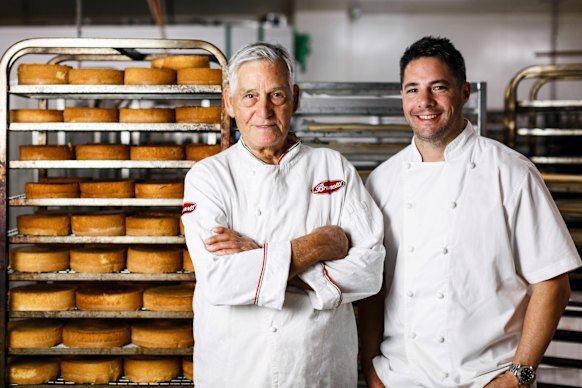
Three days a week, he’s joined in the Carlton store at 7am by patriarch Giorgio, who at 92, still loves working out the back, in the kitchen.
And what about that kitchen? Well, even Fabio has begun to recognise its limitations.

“We’ve outgrown it,” he tells me, “and we just need to probably invest in a production facility as our next main step. Then, perhaps, if opportunities come it would be easier for us because we’re pretty stretched right now.”
He’s looking at three industrial sites in various parts of Melbourne “and analysing what’s best for us”.
If the older brother sees the irony in what he’s saying, he’s not letting on.
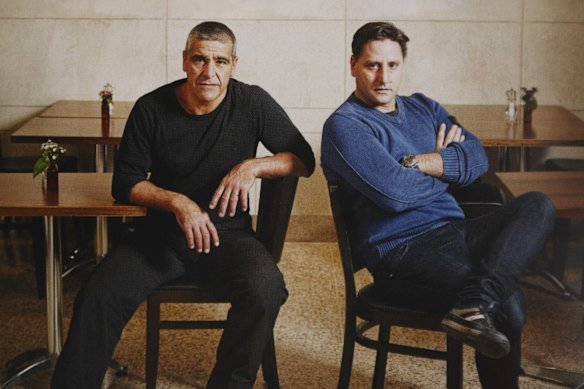
Called together at Yuri’s cafe for the photo shoot, the Angele brothers look, at times, awkward together. They don’t speak much.
Yuri’s worried he’s said something in his interview that will offend Fabio. His brother’s a great guy, he says, but “for 30 years I worked with him … and it just came to the point where I had to control my own future”.
“We’ve got about seven, eight years between us,” says older brother Fabio, “so, um, [Yuri] probably looked up to me more, not so much as a brother he socialised with … ” He hunts for the right words. “Not a father figure, but, ‘Oh, you’re old-school’. You know what I mean? ‘You’re older’.”
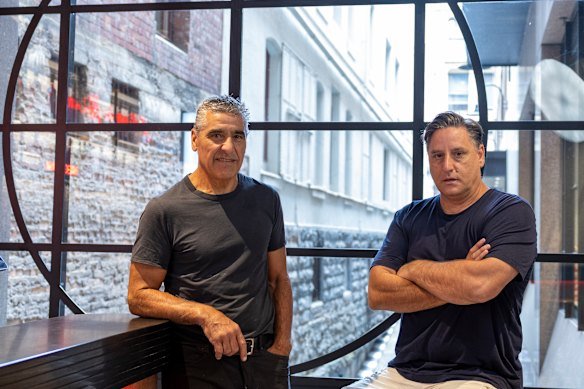
Almost five years after the separation, I ask, do they spend much time together?
“Family values,” says Fabio, “we’ve all got our families. We all meet together at my parents’ place. That still works.”
Meanwhile, the next generation is coming into play. Fabio’s son Tory recently joined Brunetti – his LinkedIn profile describes him as the chief executive officer of the Carlton operation, Classico. Yuri says that sometimes his nephew calls him to talk business, to seek advice – something he’s clearly happy about.
So finally I ask Yuri: does he ever go back to the Carlton cafe that he helped build? That, for years, was like his second home?
“I haven’t been in Carlton for a long time,” he replies quietly. “Not since the separation. I don’t know. It would bring back emotions.”
Start the day with a summary of the day’s most important and interesting stories, analysis and insights. Sign up for our Morning Edition newsletter.
Read the full article here