






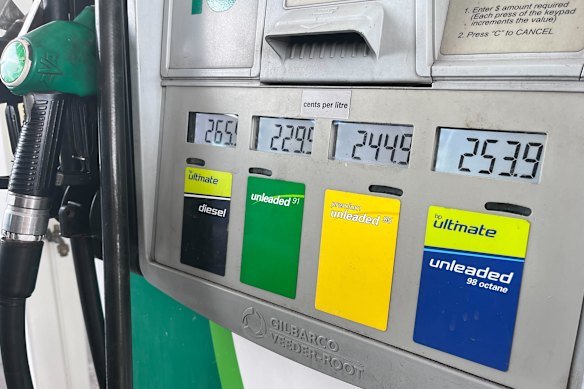
Most West Australian businesses have been impacted by the fuel crisis gripping the nation as a result of the Gulf conflict, while some in the state’s regions are debating whether it is even worth opening at all, dual surveys have revealed.
A snap survey of more than 430 businesses by the Chamber of Commerce and Industry WA, released on Thursday, revealed 82 per cent of respondents had seen an increase in supplier costs, while 45 per cent had been directly impacted by fuel shortages.
And 31 per cent described the impact on their business as “significant” or “severe”. Just 7 per cent reported no impact.
Of the respondents, which were drawn from a range of sectors, 56 per cent said they would be forced to absorb the jump in costs, while two in five said they would have to pass them on to customers.
Meanwhile, another chamber survey – this one from the Regional Chamber of Commerce and Industry of WA, also released on Thursday – found many operators were debating whether it was even worth opening as the fuel crisis continued to deepen.
In that survey, which ran over a week and received over 400 responses from businesses across agriculture, tourism and fisheries, 81 per cent of respondents said their fuel cost had gone up by nearly two-thirds in recent weeks.
The survey said many agriculture businesses were re-thinking their plans ahead of the usual April seeding program, and were either scaling back or cancelling it completely due to the uncertainty.
Just under a third of businesses said they had been forced to stand down employees due to cancelled jobs, an inability to travel or prohibitive costs.
About 40 per cent of businesses reported being impacted by cancellations for planned jobs, while some tourism businesses said they had seen a number of cancellations.
Tourism operators told the survey they were expecting their “lowest Easter numbers in over 10 years”.
“One business reported that one of their suppliers added a ‘War Time Fuel Surcharge’ on their invoice which is incredibly concerning,” the survey’s key findings said.
“RCCIWA has not seen this level of anxiety, business uncertainty and stress since the onset and first two years of COVID-19.
“This is a fast-moving issue and the escalation of the impact it is having on regional businesses and their communities is alarming.
“We are also seeing concerning patterns of behaviour in some regional areas such as stockpiling, price gouging, abusive behaviour towards service station employees and fuel theft.”
The findings echoed the Chamber of Commerce and Industry WA snap survey, which warned agricultural businesses were the hardest-hit, with 74 per cent reporting a “severe” or “significant” impact, largely due to increased costs for fuel, fertiliser, chemicals and freight.
The US war with Iran has squeezed the Strait of Hormuz, which is on Iran’s southern border, through which about one-fifth of the world’s oil is shipped.
But it’s not just a vital oil trade route. Much of the world’s fertiliser supply comes from the Gulf, and is being constrained by the conflict.
CCIWA chief executive Will Golsby said the crisis had reached into virtually every business in the state.
“We’re obviously deeply concerned about what happens if this crisis continues,” he said.
“The longer this drags on, the worse it will be for WA businesses and the broader economy.”
Golsby also flagged “significant concerns” for the health and disability care sector, which often required staff to travel across the city and state.
He predicted the hit from fuel prices on household budgets would flow through to consumer behaviour.
“Businesses in the hospitality, tourism and retail sectors are likely to be the first to see these impacts and we’ve heard from businesses in tourism that they are bracing to experience impacts over the Easter holidays,” Golsby said.
Almost half of the businesses responding to the CCIWA survey said they would reduce non-essential spending, and one in four said they would review staffing due to the fuel crisis.
Key recommendations from the RCCIWA survey included capping fuel prices for essential services and sectors, increasing fuel tax credits, providing grants to regional businesses to offset the impact, and ensuring all communication was clear and timely.
WA government promises ‘increased visibility’ on fuel stocks as more stations run dry
WA Treasurer and Deputy Premier Rita Saffioti said Energy Minister Amber-Jade Sanderson was working on improving the visibility they had of fuel stations and their stocks.
“There are a lot of different contractual arrangements out there between wholesalers, distributors, retailers, that, from a government perspective, wasn’t something that was entirely visible,” she said.
“So that’s the work of the fuel group to work with distributors, retailers, suppliers and wholesalers to see how we can get greater visibility, to make sure we can support regional WA in certain towns where there are shortages.”
Saffioti said the government did not plan to raise the state’s fuel supply emergency level to amber yet – but it would continue to monitor the situation.
Federal Energy Minister Chris Bowen revealed on Thursday that 40 WA fuel stations had run out of diesel, while 14 have no unleaded fuel.
Bowen revealed the figures as part of his daily update on the state of the fuel market across Australia.
The average price of unleaded petrol in Perth was 258 cents per litre on Thursday, according to Fuelwatch, with the cheapest station being Chidlow Growers Mart Liquor Store, which was selling unleaded for 230 cents per litre.
Diesel’s average reached 309 cents per litre in the metro region, having broken the 300-cents barrier when prices jumped on Wednesday.
In WA’s north, iron ore miner Fenix Resources is taking steps to reduce non-essential activity at its mining and haulage operations, due to constraints on diesel supply.
The company has warned that constraints to diesel supply due to the Iran war are starting to impact operations across Australia’s mining sector.
Meanwhile, federal Employment Minister Amanda Rishworth told the ABC the government was “not at the stage to direct people to work from home”.
“There is work to be done if and when – depending on the length of this crisis – where we look at other measures,” she said.
“But at the moment we are not directing people to work from home. But that doesn’t mean people shouldn’t sit down, if working from home works for them and employers, to come to those agreements.”
with Alexander Darling, Bloomberg
Start the day with a summary of the day’s most important and interesting stories, analysis and insights. Sign up for our Morning Edition newsletter.
From our partners
Read the full article here