









The chief of NAPLAN schools testing has called for an end to the “horrendous misuse” of children’s test scores as entry assessment tools by in-demand schools.
As children across the nation begin sitting the exams this week, Australian Curriculum, Assessment and Reporting Authority chief executive Stephen Gniel asked parents not to put pressure on youngsters to perform.
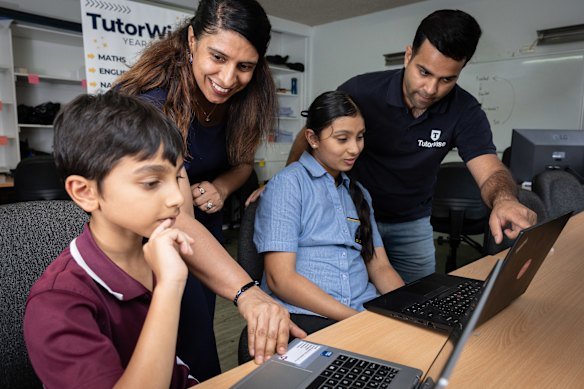
Shanaya Pandir, 11, with Jyoti Sachdeva (left) and Abhishek Narang from TutorWise in Quakers Hill. Sharvil is preparing for his first NAPLAN test.Wolter Peeters
Gniel said he was aware that some non-government schools and select-entry government schools in other states – where competition for places was greatest – were using the test results as part of enrolment applications.
“I think it is horrendous, and it’s a complete misuse of the assessment. It’s not one of the purposes and therefore the test is not designed as an entrance exam and shouldn’t be used as such,” he said.
“I would encourage parents not to provide that to schools that might ask for it as an entry requirement. By all means provide it once the student is enrolled.”
The King’s School in North Parramatta defended reviewing NAPLAN reports as part of its enrolment process.
“NAPLAN results are never used in isolation when considering enrolments. The school places more emphasis on reports of a student’s effort, attitude and character, which are often more predictive of a student’s long-term success than a single test score,” a spokesperson said.
“Any implication that parents should selectively withhold information would be inconsistent with the co-operative relationship schools rely on when assessing the needs of prospective students.”
The emphasis on the national testing has fuelled a competitive culture that is driving some parents to employ tutors in the hope of boosting their child’s results, but Gniel said this “constant drilling on NAPLAN sort of tests is ill-advised and somewhat futile”.
“We want to see parents supporting students to do their best. That doesn’t mean over-preparing or putting unnecessary pressure on them.”
NAPLAN testing assesses nationally agreed areas of literacy and numeracy to provide a diagnostic tool for principals, teachers, parents and policymakers. It is designed as a snapshot, not a definitive assessment of a child’s skills.
Gniel is aware some schools say the test results are just one consideration in enrolment. “But if it’s only one of the things, then don’t use it,” he said. “It’s not a pass-or-fail test. It’s a test that helps us understand those strengths and areas for development.”
Some schools say they don’t use the results to determine eligibility but rather to indicate if a student needs extra support. However, schools that ask for NAPLAN scores as part of scholarship applications, and that promote state or national rankings of results, are among other signs of the competitive culture surrounding the national testing.
After two years of tutoring classes, Sharvil Pandir, a year 3 student at Mary Immaculate Primary School in Quakers Hill, is gearing up for his first NAPLAN exam this week. It’s a process his older sister Shanaya, who is in year 7, is well acquainted with. She has been enrolled in NAPLAN and selective coaching classes for about three years.
Their father, Sandeep Pandir, said he enrolled his children in TutorWise’s NAPLAN classes to ensure their learning experience remained consistent across the curriculum.
“We know how to get to the answer and explain it to them, but the way we explain [a question] could confuse them because it might be different to how they learnt it at school or in NAPLAN classes,” he said.
Pandir said his daughter, who attends Rouse Hill Anglican College, took part in the competitive selective schools entrance exam last year and narrowly missed out on securing a spot. But receiving extra help in NAPLAN courses had boosted her confidence both at school and in extracurricular activities.
“Tutoring does help, but it goes hand in hand with self-studying too. It brings confidence in the children. If they’re doing something right, they have someone to validate them and say ‘OK, is this correct?’,” Pandir said.
In Homebush and Edmondson Park, Jimmy Liu runs tutoring company Educo, which provides NAPLAN classes for primary school students. He believes some private schools would consider NAPLAN results during the enrolment process as there are “not enough tests” that show where students are academically.
“I’m sure these days, private schools, they want to be ahead academically. So I’m sure that NAPLAN will be one of the results they’ll look at, as well as the school reports,” he said.
ACARA deliberately does not rank schools when publishing results, instead comparing a school’s performance with others of similar backgrounds. Gniel said schools could use the publicly available data how they wished but he encouraged families to use the My School website to put these comparisons in context alongside socioeconomic, enrolment and attendance information.
“It’s really important when we are looking at these results we are comparing apples with apples.”
Start the day with a summary of the day’s most important and interesting stories, analysis and insights. Sign up for our Morning Edition newsletter.


From our partners
Read the full article here