







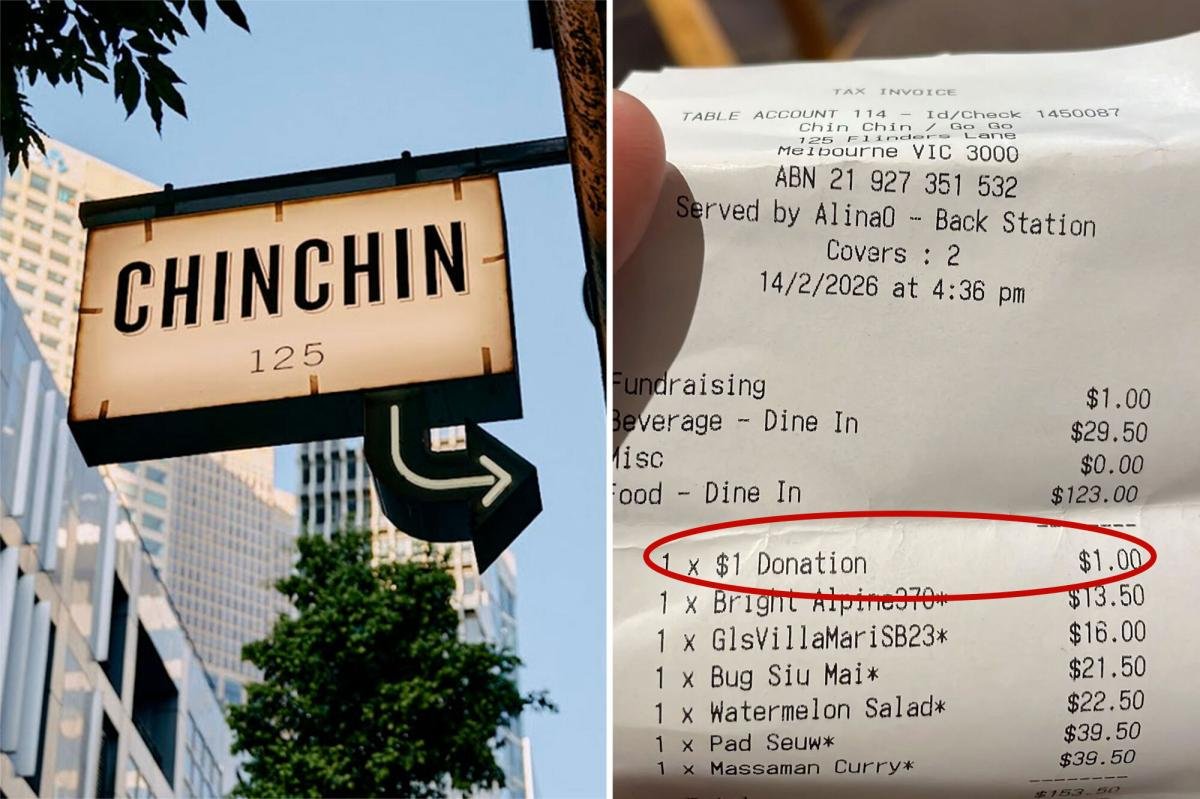
A customer was left confused after spotting a $1 donation automatically added to their bill at popular Melbourne restaurant Chin Chin, without explicit consent.
The frustrated diner vented on social media, sharing a photo of the receipt from the Southeast Asian restaurant’s CBD location, with the line ‘1 x $1 donation’ listed above the rest of the menu items.
“When did this become a thing?” the diner asked. “Is it legal to include a donation in the bill without asking?”
It turns out the donation goes towards the Collective Foundation – a not-for-profit launched by hospitality mogul Chris Lucas through his Lucas Collective group of restaurants, including Chin Chin.
According to its website, the purpose of the foundation – which is a registered charity with the ACNC – is to “support the long-term sustainable future of Australia’s hospitality sector.”
It aims to achieve this by raising awareness of the industry and available career paths, fostering creativity and innovation, providing education and career development for emerging hospitality leaders, and training aspiring hospitality professionals.
Funds are currently being collected via these ‘removable upon request’ donations to support the 2026 launch of the ‘Future Hospitality Academy.’
While the diner raised questions about the legalities of this practice, it is indeed legal – provided it’s clearly disclosed beforehand, such as on menus, which Chin Chin does in small print with a QR code linking to more information on the foundation.
It is also promoted on Chin Chin’s website and social channels, and communicated in booking confirmation emails. It is understood that an information card is also meant to be presented with all bills.
Angie Bradbury, Executive Director of the Collective Foundation, told news.com.au that the auto-donations are just one way the charity raises money.
Funds are also raised through “support from our founder, philanthropists, and corporate partners,” Bradbury says.
It’s not the first time the Lucas Collective has conducted this kind of fundraising – they’ve previously done so through programs such as Dine Smart, where $2 was added to bills to support local homelessness services.
“We are keen to ensure that the collective and acquittal of fundraising is clear and transparent,” Bradbury added. “We will be obligated to report financial activity as part of the ACNC requirement each year, and are in the process of deductible gift recipient registration.”
News.com.au has contacted Chin Chin and Lucas Collective for comment.
Some Aussies erupted with backlash to the concept, saying the “opt-out not in” mechanism didn’t sit well with them, despite the restaurant disclosing it.
“That’s pretty messed up – it’s just a dollar, but still that’s the kind of thing they should be asking if you wanted to do.”
Another echoed: “100 percent – it’s not the amount, it’s the tactic.”
Others said they would have preferred that the foundation take $1 off the total bill instead of adding it as an extra.
However, a couple of people defended the restaurant – pointing out that it is clearly outlined on the menu.
“You had the opportunity to have it removed,” one said.
John Hart, President of Restaurant and Catering Australia, told news.com.au.
“This, in my view, is not good practice, albeit allowed as long as there is a notification somewhere in the menu or on a flyer or sign as to what it is for.
“Having said that, I don’t think it will go down well with customers.”
It comes amid a broader wave of Aussie diners noticing venues slipping in automatic add-ons such as gratuities or service fees on bills – practices that are legal under Australian consumer law when disclosed but increasingly rubbing customers the wrong way.
Auto-tips, often 10 per cent for groups, are similar to auto-donation models, as they are also ‘opt-out’ – often leaving customers feeling awkward and pressured to leave them in.
Read the full article here