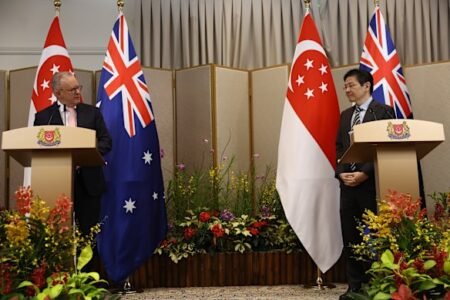




Singapore: The Istana – Singapore’s classical, colonial-era leaders’ residence – is a long way from outer Sydney and Melbourne. Despite the opulent setting, and the distance, Anthony Albanese’s message was aimed directly at Australia’s suburbs and regions.
Rarely is the purpose of a prime minister’s overseas travel so relevant to Australians’ daily lives. Jargon-heavy communiqués were this week replaced by the most retail of political imperatives: securing oil to deliver petrol price relief and to spare a recession.
Fuel signs with prices starting with a three have made clear to Australians that the nation has been plunged into another inflation outbreak after years of elevated prices.
Much of the crisis is out of Albanese’s control, although government ministers were slow off the mark and tin-earned when the Iran war broke out in late February and petrol shortages started last month. Australians largely blame US President Donald Trump’s rash decision to strike Iran and Tehran’s move to close a crucial trade supply route that has crippled the world’s economy.
So the prime minister’s decision to head to Asia this week and next, at a time when his cabinet is meeting relentlessly to finalise the federal budget due in May, is a sign that he knows how fickle voters can be. Albanese’s approval ratings tumbled after his muddled response to the Bondi massacre. It meant he had less skin to lose if his government made a mistake similar to Scott Morrison’s vaccine supply bungle.
The deal signed with Singaporean Prime Minister Lawrence Wong was not a legally binding guarantee to keep shipping fuel to Australia, which relies on Singapore for 55 per cent of its petrol. Such a deal was never likely given Singaporean companies’ commitments to other customers, commercial sensitivities, and the fundamental uncertainty about affairs in the Middle East.
Wong went as close as possible to making a rock-solid guarantee, saying export bans “will not happen”. A shortage of crude from the Middle East could change that.
Albanese beamed in response to Wong’s declaration, saying: “The prime minister [Wong] is just as confident in private as he is in public.”
Face-time and mutual trust are critical in Asian diplomacy. Albanese and Wong have met several times before and they call each other friends.
Albanese will point to the Singapore deal as a sign that Australia is at the front of the queue should supply worsen in coming months. Wong is in demand among world leaders, and Albanese is one of the first leaders to meet him in Singapore since the Strait of Hormuz closed.
The act of jetting to Asia was, in a PR sense, as important as the text of a deal. Just like his questionable decision to hold a televised address last week only to announce nothing much, the act of being seen to lead and take action was the key.
“Our friendships in the region help our farmers back home,” Albanese said, trying to convert a moment of high diplomacy into a domestic win.
The test for Albanese has been set by Angus Taylor, who on Friday said it was on the prime minister’s head to make sure falling oil prices lead to falling petrol prices.
The trip has also put a spotlight on contradictions within Labor’s economic model.
The prospect of a new tax on Australia’s gas exporters has hung like a cloud over this visit. Labor’s need to find new revenue sources and left-wing demands to tax fossil fuel firms have put pressure on Australia to prove it will remain a reliable exporter of LNG.
Standing on a balcony overlooking Singapore’s Jurong Island, the prime minister marvelled at the sight of hundreds of oil tankers that dwarf the number at Australia’s last two refineries. Albanese has hinted about boosting Australia’s refining capacity, which has dwindled under successive governments and contributed to the nation’s paltry fuel stocks.
Yet Labor effectively taxes its last two refineries, via a policy known as the safeguard mechanism, to meet Australia’s hard-to-reach green energy targets.
Albanese is betting that his glad-handing will keep Australia’s economy running at a time of global upheaval. But it will only be papering over deep cracks in Australia’s self-sufficiency.
Cut through the noise of federal politics with news, views and expert analysis. Subscribers can sign up to our weekly Inside Politics newsletter.


From our partners
Read the full article here