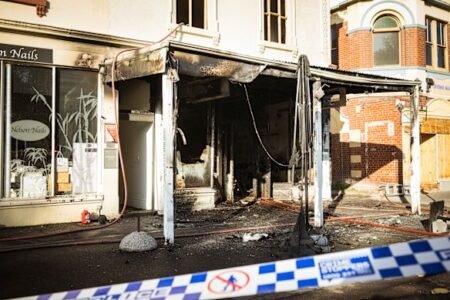





More than two months after the Longwood blaze ravaged north Victorian communities, the scars and defensive lines still mark the landscape where emergency services sought to suppress the fires.
The Longwood fire, which started in early January, claimed one life and destroyed hundreds of houses and sheds as it burnt for almost two weeks. Despite the best efforts of firefighters, the agricultural community was hit particularly hard. The fire killed thousands of sheep and cattle while destroying thousands of kilometres of fences.
It has been longstanding practice for farmers to allow the Country Fire Authority and its contractors to create control lines on their property with bulldozers and graders on the understanding they will return later to repair the land. Emergency services use control or containment lines by clearing vegetation from a stretch of land to remove unburnt fuel and prevent a fire spreading. That will often include cutting fences for property access.
But some farmers are now struggling to rehabilitate their land where control lines were created, and they fear their properties will be seriously damaged by erosion if left unrepaired.
Cattle farmer Michael Stubbe said his entire 770-hectare property at Gooram was burnt in the fires.
“We saved two houses, but that was it. Machine sheds, hay sheds, water tanks and everything else – gone,” he said.
Stubbe estimated contractors established about 2.5 kilometres of firebreaks on his property, but he is still waiting for the land to be returned to its former state. He evacuated hundreds of head of cattle before the fires, and he now wants to return them to the land so he can begin to recover from the disaster.
Fences were burnt but also cut on Stubbe’s property to provide access for emergency services, and they have not yet been repaired.
Stubbe, who is the volunteer captain of the Gooram CFA brigade, said that in years gone by containment lines would be repaired promptly – usually within a week or two. But he said frustration was growing locally about the length of time it was taking for the authority to roll out its containment line rehabilitation program.
“We agree they’re a vital part of firefighting and trying to control it. They give us the safety that we need. But they’ve also got to be remedied again promptly, and they haven’t been.”
He said unrepaired containment lines could create erosion on farmland particularly in heavy rain and farmers were becoming concerned about the looming problem.
Some farmers have questioned whether delayed rehabilitation of their land is due to a lack of government funding for the CFA.
However, the authority’s acting chief officer, Alen Slijepcevic, insisted there were sufficient funds for emergency stabilisation works. He said CFA volunteers, staff and external contractors were repairing and replacing private infrastructure impacted by fire suppression activities in response to the Longwood blaze.
“The team is currently assessing, mapping and gaining approval from landholders to complete the scope of works,” Slijepcevic said. “Landholders are made aware of when the team will be attending to their home.”
He said all fencing and water replacement work was done in response to requests from landholders. So far, 250 landholders have submitted requests for support.
The CFA has mapped 90 per cent of the Longwood fire, including 1600 kilometres of control lines. The fire’s perimeter stretched to 540 kilometres. Although summer has passed, Slijepcevic said the risk was not over.
“Following a dry and hotter than usual summer, most of Victoria will face an increased risk of fire over the coming months.”
Farmer Brian Kelly said it was crucial that farmland was “reclaimed” quickly after containment lines were created, so farmers could rebuild after fires had passed. He said fences needed to be repaired too.
“Fences and pastures are all part of our infrastructure,” he said.
Sheep farmer Neil Devanny has reinstated about 1.2 kilometres of fencing after the Longwood fire, mostly with the help of farming charity BlazeAid.
His property was previously burnt out completely in 1990, and he said that experience helped him better understand the process of getting support from the CFA to repair containment lines.
“The important ingredient is patience,” he said.
Devanny, who is also a CFA volunteer, said the authority’s representatives had visited his property last week as part of the containment line repair program. He was not frustrated with the length of time it took to have containment lines reinstated.
“There are heaps of people who have got to be the recipients of this.”
He said it was sometimes impractical to repair fences and containment lines soon after a blaze due to the risk of fires returning in unburnt land.


From our partners
Read the full article here