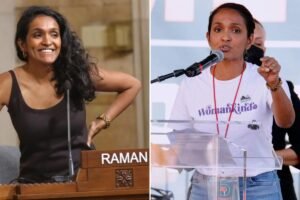








When news broke of the horrific attack in Bondi, my first thought was for the innocent victims, and for all my Jewish and Bondi friends traumatised by that sickening atrocity. Then fear.
Not just about terrorism, but that, just as with the rise of Pauline Hanson, and after 9/11, the Bali bombing, and the Lindt Cafe atrocity, I – and people who look like me – would be targeted: not only by racists, but authorities, just for looking like the attackers.
I was born in Australia. My first language is English. But to many people, I just look “Indian.” Despite being Hindu, I look Muslim. And for some, that means I look like a terrorist – just as Sikh people did after 9/11, suffering terrible violence.
For years afterwards, that meant increased scrutiny at airports and suspicious looks – if not outright hostility – in public. In the aftermath of Bondi, I and many South Asian, Arab, Sikh and Muslim people are anxious about the repercussions.
When a white man shot 35 people dead at Port Arthur in 1996, all white people weren’t viewed as terrorists. Nor when one murdered six people in Bondi Junction in 2024. Let alone after an Australian white supremacist slaughtered 51 worshippers at two Christchurch mosques in 2019, Christian nationalists shot police and a neighbour dead in Wieambilla in 2022, or a sovereign citizen shot police in Porepunkah last year.
But for brown people like me, it’s a different story.
Recently, we’ve seen increasingly virulent attacks on South Asian people, fanned by some media outlets and politicians: from immigration dog whistles to attacks on Indian students and places of worship, and now anti-immigration, anti-Indigenous, antisemitic “Marches for Australia.”
But while the NSW and federal governments have rightly deported neo-Nazis and closed an extremist Islamist prayer centre, what have they done to protect the safety of South Asian, Arab and Muslim people being attacked in public, other than mouth platitudes that “racism has no place in Australia”?
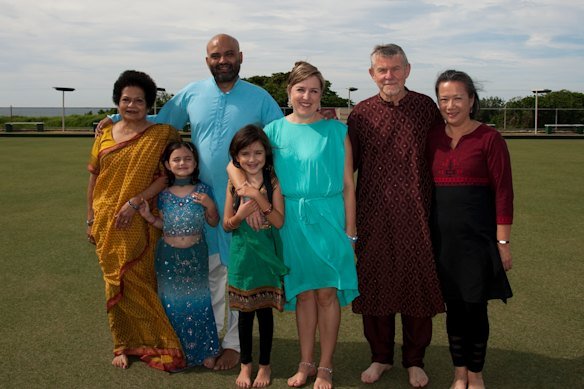
Of course, it doesn’t. Like many of us, my life is enriched by friends from diverse backgrounds and faiths. I have Jewish and Muslim friends, and a family with Anglo, Indian and Chinese heritage.
As playwright and director Wesley Enoch said of his own Nunukul, Ngugi, Kandju, Anglo and Filipino genealogy: “Like this country, my family is not a neatly divided and shelved experience … and like this country, it’s impossible to separate out any part, for to deny any one aspect is to invite a deep self-loathing and external hatred of the thing one fears within oneself … that, if pursued, can only create instability and self-harm.”
How will the federal and NSW governments protect people of colour from being attacked by racists in public, the media and parliament, let alone getting racially profiled in airports or other public places by police and Border Force agents?
Despite politicians at every election lining up to curry favour with South Asian communities in the suburban seats that win government, we’re otherwise expected to prove what good immigrants we are by suppressing or denying our cultures to “just fit in”.
But just as Nazis, Christian Nationalists and Hanson don’t speak for all white people, extremists don’t constitute any community’s majority, least of all speak or act for them.
So why is it demanded, as Scott Morrison and Andrew Bragg did this week, that “community leaders” speak out on behalf of “their” communities to condemn extremists, while, say, Christian leaders are never called on to denounce Christian nationalists?
After all, Christianity isn’t a homogeneous entity, but a multitude of denominations and cultures. Just like Islam or Judaism or Hinduism or Buddhism. Or Australia.
No one should tar entire communities with the same bloody brush as hateful individuals or conflate diverse faiths and cultures with their most repulsive extremes. Isn’t that the very racism that’s led to such discrimination and violence?
The Bondi terrorists not only attacked the Jewish community – they imperilled their own, and others, like mine.
Nobody should have to hide their identity out of fear for their safety, as some Jewish people now sadly feel they must. But that’s not an option for people like me, who can’t hide the colour of their skin.
As Malcolm Turnbull once observed: “None of us can look in the mirror and say, ‘all Australians look like me’. Australians look like every race, every culture, every ethnic group in the world.”
We need to urgently address the scourge of antisemitism and the causes of radicalisation, and we all deserve to feel safe, whoever we are, whatever we believe, or whatever we might look like. But we can only do this together.
In seeking to ensure that Bondi never happens again, and protect the entire community from racism and violence, authorities must be careful they don’t end up singling out any community – and recognise the consequences if they do: not only for many of us, but for all of us.
Sunil Badami is a Sydney writer.
From our partners
Read the full article here