






Tony Wright
The furnishings are dark, weighed by grim history.
The drapes, sombre brown to match the carpet, are heavy, drawn tightly to prevent light escaping or entering and concealing thickened glass designed to thwart eavesdroppers.
A wall is panelled, enabling a secret recess to be revealed or shuttered in minutes. Behind it sat maps charting the course of a war that crossed Australia’s borders.
Arrows, you might imagine, were scrawled across those maps, tracing the intended route of battleships, the path of troops or the flight of warplanes.
The powerful men apprehensively studying their wall of maps knew too well that those arrows led to the likely deaths of young Australians, their enemies, or both. Those men had to guarantee Australia’s store of capital and the entire machinery of government stood behind their fighting forces.
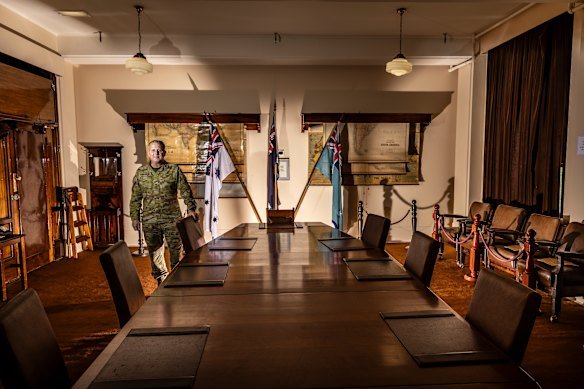
Here in this soundproofed room, through the years of World War II and behind two back-to-back sturdy padded doors, met the members of Australia’s war cabinet.
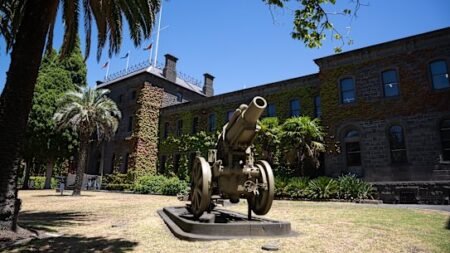
It sits there still within the bluestone walls of Melbourne’s Victoria Barracks, the once grand St Kilda Road running by.
As the federal government contemplates selling vast amounts of Australia’s military real estate to raise an estimated $3 billion, including at least part of Melbourne’s Victoria Barracks, this masthead was granted a tour of the historical site.
The barracks, with their distinctive ivy-covered bluestone walls out the front, were home to Australia’s Department of Defence from 1910 to 1953, before it moved to Canberra. It remains a Defence administrative centre.
Central to its national significance is the War Cabinet Room, found up a set of narrow stairs in what is known as A Block New Wing, built in 1917. It will be protected by heritage legislation, whatever the shape of the proposed sale.
Within, a brass ashtray sits next to a bakelite telephone, speaking of an age past.
Once, cigars and cigarettes were provided freely, with more large ashtrays placed for the personal use of every man – they were always men – around the large wooden table that dominated the room.
A special air-extraction system was installed to cope with the smoke as burdensome judgments were weighed.
Each of the war cabinet members had a button set at his knee with which he could summon staff and documents.
Cups of tea and biscuits were brought for refreshment. The standard order was seven cups of tea and six biscuits, according to a social history of Victoria Barracks written by Agnes Hannan and first published in 1995. Precisely who missed out on a biscuit was unrevealed.
Three prime ministers ran the war cabinet over the six cruel years of World War II.
Each was aided by a small group of his key ministers.
A Defence Advisory Council of senior figures from government and opposition parties met close by, ensuring bipartisan support for the war effort.
The one man who sat through all crucial meetings during the war years was the powerful secretary of the Department of Defence, Sir Frederick Shedden, architect of Australia’s war administration and keeper of meticulous records.
Shedden arrived at Victoria Barracks in 1910, and apart from service in London and France during World War I, and later periods on official business in London and Geneva, he remained at the barracks until 1971. His office sits close to the war room, another esteemed part of Australia’s defence heritage.
Robert Menzies presided over the war cabinet for the first two years, 1939 to 1941. The Country Party’s Arthur Fadden followed for a few fill-in weeks after Menzies, having lost the confidence of his United Australia Party, resigned as prime minister.
Labor prime minister John Curtin shouldered the responsibility for the final years of the war as Australian soldiers, sailors and airmen battled Japan.
The war, the stress and worry of life-and-death decisions, interspersed with gruelling trips to London and Washington and back and forth between Melbourne and Canberra, robbed Curtin of his health.
As Australia’s 7th Division began its last operation against Japanese forces in the Battle of Balikpapan, on Borneo, Curtin died of a heart attack at The Lodge, Canberra. It was July 5, 1945, just two months before the Allied victory in the Pacific.
The War Cabinet Room at Melbourne’s venerable Victoria Barracks, unsurprisingly, has been maintained through the generations as an Australian treasure.
It is not a museum piece in aspic, however.
The room has been used for meetings of both John Howard’s and Paul Keating’s cabinets, and it remains available to host decision-making moments of national and military importance.
A collection of wartime maps still lies furled on one wall. In a cabinet in a room next door sits the War Book: a document instructing all government departments on their required actions as they moved to a war footing.
The war room is a continuing reminder, says Major-General Jason Blain, of the consequence of major judgments affecting Australia and its people.
“The decisions we make now are key decisions for our nation and for our Defence Force, and to do it in what was the home of the war cabinet room just gives you that sense of gravity about making sure that those decisions are going to stand the test of time,” says Blain, the Australian Army’s head of land systems and the most senior Australian Defence Force officer in Melbourne.
The Victoria Barracks date to 1856, when the soldiers of the 40th Regiment of Foot – a British regiment previously involved in putting down the miners’ rebellion at the Eureka Stockade – were required to build their own accommodation.
That first building, G Block, remains standing. It is Australia’s only example of a barracks built by soldiers, according to Bronwyn White, a public servant who regularly leads tours of Victoria Barracks.
Of the long years of history, however, there remains no corner of the barracks so significant as a small dark room where Australia’s leaders directed their nation at war.
Cut through the noise of federal politics with news, views and expert analysis. Subscribers can sign up to our weekly Inside Politics newsletter.
From our partners
Read the full article here