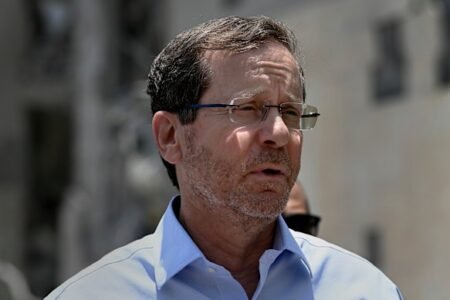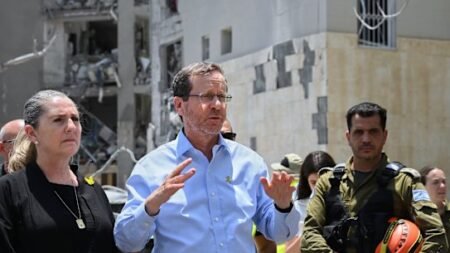








Hamas’ savage attack on October 7 has so traumatised the Israeli people that the idea of creating a Palestinian state is not plausible for the near future, according to Israeli President Isaac Herzog.
This means that the Australian government’s preferred position of a “two-state solution” is not workable at the moment, in Herzog’s view, and fresh ideas are needed to achieve peace between Israelis and Palestinians.
The former Israeli Labor Party leader long supported a two-state solution, with Israel and a Palestinian state living side by side in peace, but told this masthead that the concept doesn’t work on the “emotional side of a dialogue with Israelis” at the moment.
Herzog, who will arrive in Australia for a four-day trip on Monday, is an apolitical head of state who does not make government policy.
He said that Israel was prepared to disarm the terrorist movement Hamas by force if it refused to demilitarise as required under US President Donald Trump’s 20-point peace plan.
“We are not the ones who want to go and carry out this job [but] we may be compelled to do so.”
Herzog said he hoped Australia would play an active role in the reconstruction of Gaza, but that it was up to Prime Minister Anthony Albanese to decide whether he accepts an invitation to join Trump’s controversial board of peace.
Australia last year recognised Palestinian statehood alongside France, the United Kingdom, Canada and other nations at the United Nations, a move Albanese said he hoped would help create momentum towards a two-state solution. This refers to the creation of an independent Palestinian state comprised of Gaza and much of the West Bank, sitting alongside Israel.
“We’re a tiny strip of land, and the people who were attacked on October 7 were the biggest supporters of peace,” Herzog told this masthead.
“They were the first ones to be butchered, slaughtered, raped, burnt and abducted. You cannot ignore it. It’s a national trauma.”
Among those who suffered the worst attacks on October 7, 2023, were progressive Israelis living in kibbutzes near the Israel-Gaza border.
Herzog said: “Following the return of the last hostage two weeks ago, Ran Gvili, we are now exiting from the war. We have to go through a healing process. To come and tell Israelis, ‘Hey guys, divide your land again for a two-state solution’ doesn’t operate on the, I would say, emotional side of a dialogue with Israelis.”
Herzog said the October 7 attack on Israel was a “wake-up call” that shook his faith in the idea of a two-state solution. A Gallup poll released last September found just 27 per cent of Israelis support a two-state solution, down from 61 per cent in 2012.
“I believe that we must reach an amicable solution with the Palestinians and with our Arab neighbours, and it’s feasible as you look at the historical trajectory,” he said in the interview.
“Fifty years ago, there was not even one Arab leader who shook hands with an Israeli leader. Thereafter, we signed agreements and deals with many of our neighbours, including with the Palestinians, but it was violated by terror. So we have to think and think out of the box, and not only be locked into one formula or the other, but to think about a future of peace, and how do we get there.”
Herzog added: “The question of how do we live with our Palestinian neighbours is discussed day in, day out, and it will also be discussed as a key issue in our elections, which will take place later this year because we are a very vibrant democracy.”
Herzog said the question of how to achieve the demilitarisation of Hamas was a “very, very challenging issue”, describing it as “the big discussion that everybody is dealing with”.
“The interlocutors and the mediators claim that it will [disarm]. The proof of the pudding is in the eating, meaning we will have to see it,” he said.
“There will be a deadline. And of course, you know, we are not the ones who want to go and carry out this job, but if we will have to, in order to protect our citizens and also enable a better future to the people in Gaza and our neighbours, the Palestinians, we may be compelled to do so.”
Herzog said that, in Hamas, Israel faced an enemy that embedded itself in civilian infrastructure, making it difficult to avoid innocent casualties.
“You find long-range missiles in people’s bedrooms and living rooms, literally,” he said.
“And you find them in mosques and shops and in schools. You find terror equipment, RPGs, bombs, missiles, rockets, the whole thing … So you have to go in physically to take them. And sometimes it’s painful.”
At least 70,000 Palestinians were killed in the two-year war between Israel and Hamas, with over 500 dying in Israeli strikes since a ceasefire took effect last October.
The International Criminal Court has charged Israeli prime minister Benjamin Netanyahu, former Israeli defence minister Yoav Gallant and the now dead Hamas leader Mohammed Deif with crimes against humanity and war crimes.
Asked whether the Iranian regime’s days could be numbered with Trump threatening the use of force, he said: “I think president Trump’s stance is of great importance to world stability, and I trust his judgment.
“Right now, as we speak, there is a dialogue and negotiations between the American administration and the Iranian leadership, and it is clear to all of us that the situation whereby Iran can dictate by terror … and threaten world stability is unacceptable.”
Iran, he said, had spent “billions of dollars of their own people’s money on destroying their own society and torturing their own people and crushing them while spending billions undermining stability in our region and pursuing terror and rushing to the bomb”.
Cut through the noise of federal politics with news, views and expert analysis. Subscribers can sign up to our weekly Inside Politics newsletter.


From our partners
Read the full article here