







ANNA MURDOCH MANN DEPEYSTER: 1944–2026
For three decades – as long as her husband’s next three marriages combined – Anna Murdoch was the steady, steely, serene, quietly long-suffering, glamorous mainstay and support of her husband, Rupert, as he strove to become a global media titan.
It could not be said that she was always at his side, as she had wished – his restless globetrotting and vaulting ambition made this impossible. This may have contributed to the end of their 31-year marriage in 1999.
Despite Mrs Murdoch’s involuntary exit some months later from the parent board of News Corporation, her role and relationship as mother of their three children – Elisabeth, Lachlan and James – and Rupert’s first child, Prudence, remained undimmed. She ensured that their stake in the empire was undiluted. Given Murdoch had so few intimates and fewer confidants, Anna’s influence, on the corporation and its leadership, and as a wife and mother, is incalculable.
Yet, apart from some Scottish heritage, Anna Maria Torv’s beginnings were starkly different from those of her first husband’s. Rupert’s father, Keith, was a national figure (knighted when Rupert was two), while his mother, Elisabeth Greene, was, despite her raffish father, very much part of establishment Melbourne by the time of Rupert’s birth there in 1931.
Anna’s father, Jakob Torv, had been a farm boy in Parnu, Estonia, who later worked as a village tailor. Between the German and Russian invasions, he boarded a ship, as a junior engineer, to Scotland, where he found work in a tailor’s shop in Glasgow and anglicised his name to Jacob Torv. Soon, he fell in love with and married Sylvia Braida, the shop owner’s daughter. Both became dry cleaners. Anna, the eldest of four children, was born in Glasgow in 1944.
When Anna was nine, the family immigrated to Australia and settled in Blacktown. They ran a restaurant in a picnic park in Sydney’s west. It failed, and Jacob was bankrupted. It proved too much for Sylvia, and she deserted the family. Anna essentially took over as mother of her three siblings, but she benefited from a good Catholic education at the hands of Our Lady of Mercy College in Parramatta.
Anna wanted to be an actor (that would fall to her niece and namesake) but took a job as a telephonist and filing clerk at the Cremation Society of NSW. One day, she took the train into town, seeking a position with a newspaper. With no connections, she had no luck, but after attending a Ban the Bomb rally and writing up a piece, the news editor of The Daily Mirror was so impressed he gave her a cadetship. Her first story with a byline was about a woman who grew a huge sunflower in a jam jar.
Among her mentors at the Mirror was Blanche d’Alpuget, who introduced her to rich yachtsmen, and also to a senior Murdoch colleague and mentor, Douglas Brass, who introduced Anna to Rupert in 1964.
According to the Herald’s Valerie Lawson and Jane Freeman, Anna, by then a girl-around-town living in Blues Point Tower, was sent to interview Rupert for the Mirror’s in-house magazine. He told her he was attracted to her mind; she later said she was struck by his beautiful eyes – “lovely brown, mischievous eyes”.

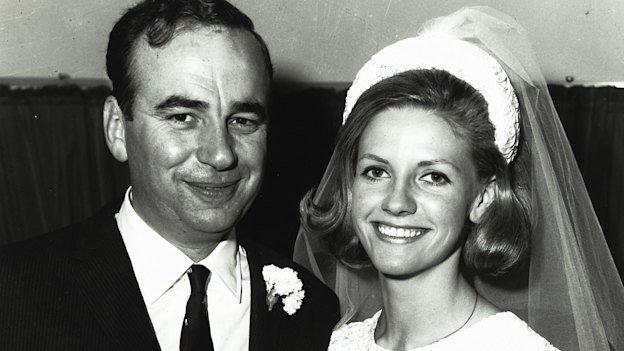
They began a relationship and, at his behest, she moved to Canberra to become a reporter at The Australian. He was still married to his first wife, Adelaidean Patricia Booker, a former flight attendant and sales assistant at Myer. As with Rupert’s next three marriages, the couple had apparently grown apart. They were already living separate lives, although they had a daughter, Prudence, born in 1958.
After his divorce, Rupert and Anna married in April 1967. None of Rupert’s five wives were in his mother’s mould or from her milieu, but Dame Elisabeth loved and admired Anna.
In 1969, Rupert acquired News of the World and for the first of many times, they had to move. As Anna recalled, “I had never had a house and all these pretty things”. With Elisabeth, born in 1968 and named after her grandmother, they settled in Wimbledon.

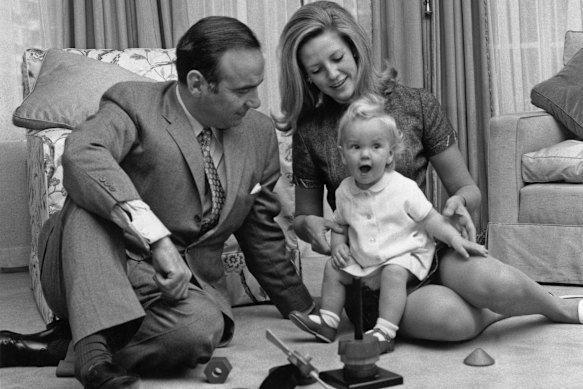
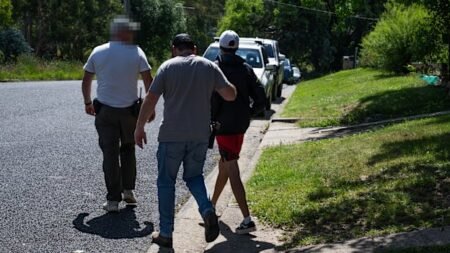
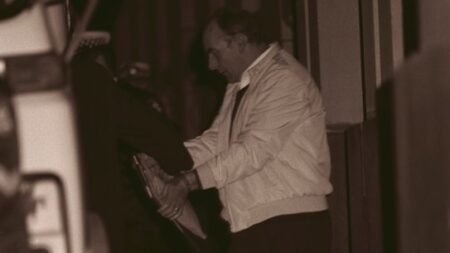
An appalling tragedy not long after their arrival forever soured Anna’s view of London. On the evening of December 29, 1969, a gang calling itself “Mafia, Group 3, from America” kidnapped Muriel McKay, wife of Alick, acting chair of News of the World, mistaking her for Anna, who was on holiday in Australia. A ransom was never paid, and her body was never found. Two Trinidadian brothers, Arthur and Nizamodeen Hosein, were arrested and sentenced to life imprisonment for Muriel’s murder.
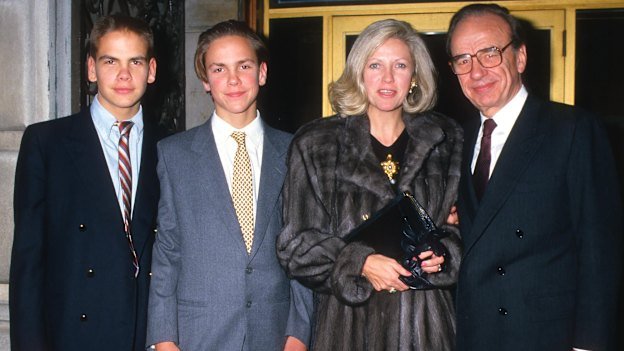
The family’s move – now with two sons, Lachlan and James – to New York after Rupert’s purchase of the city’s supermarket weekly The New York Star came as a relief for Anna. She must have tired, too, of being the wife of “the Dirty Digger”.
In New York, Anna was busy with the children, but Rupert had enough time to meet her after work at the office and for them to dine together. These were joyful years. About this time, Prudence, unhappy with her new stepfather, sought her father’s custody, and Anna took her mother’s place.
Once James began school, Anna too took to study, and over nine years earned a bachelor’s degree at Fordham, and a master’s in English and mythology at New York University. Her next goal was to write a book by the time she was 40.
In 1985, In Her Own Image was published. Set in the early ’60s at Tiddalik, a version of the Murdoch property, Cavan, near Yass, The Canberra Times saw it as a superior Thorn Birds: “No great literary masterpiece, but it is a competent professional story and much better than the average first novel.”
No Succession parallels can be drawn. It was the story of a vindicative, menopausal matriarch and her two daughters in love with the same man. “The overall effect is that of the realistic pastoral romances popular in Australia during the 1920s and 1930s.”
The New York Times wrote of a “tendency toward unrelieved earnestness; humour is in shorter supply here than water during the Australian outback’s driest month, December” but “among the many forms of love she portrays, the most compelling proves to be her own for the Australian outback, whose savage beauty she celebrates”.
Two more novels followed. Family Business (1988) and Coming to Terms (1991). The second was the tale of Yarrow Maclean, a newspaper proprietor who builds a Murdochian empire, and her rival and lover, Elliot Weyden, a businessman who runs for president and dies in the final pages.
Interestingly, Rupert had recently appointed Anna to the main board of News. It was thought she could act as regent if Rupert died early. He took little interest in Anna’s fiction. She wasn’t even sure he had read all of Family Business.
Coming to Terms, set in Poughkeepsie in the Hudson Valley and featuring a dying 77-year-old, The New York Times saw as a tale “that’s short on texture and believability” with “no tricky undercurrents, no threatening breakers or frenzied foam, just gently rolling affirmations and happy endings”.
But what was important to Anna was the fact that she had “stood up for herself”. As she told the Chicago Tribune’s Connie Lauerman in 1986: “I adore him, but there are some things that I like about it in my way. Writing the book and going back to college were my way of subtly doing this.”
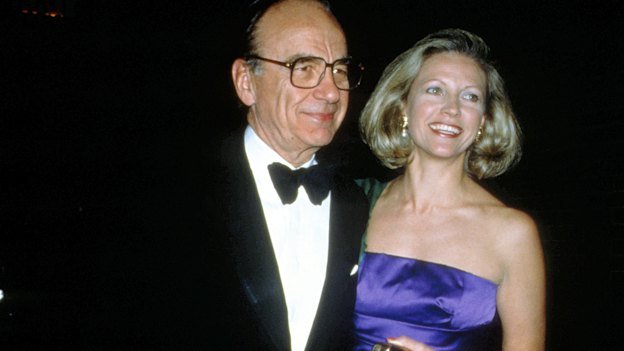
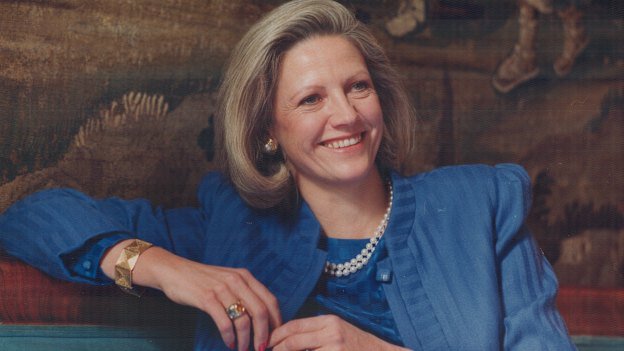
In March 1991, the couple left New York for Los Angeles where, as Mark Lawson put it, Anna had a garden and Rupert had Twentieth Century Fox. Anna was 47, with a cool blonde Hitchcockian beauty that she never lost while “a Scottish precision of delivery survives within an accent moulded by the Australia of her teens, the London of her 20s and the America of her 30s”.
One of Rupert’s editors, Harold Evans, wrote of her “slim crystalline beauty … She was talkative, vivacious and open, whereas he was apparently crippled by shyness. He shuffled, smiled and left sentences in midair … she was warm and animated, and she entertained us with poise”.
As the years rolled on and Rupert became the mogul he always wanted to be, she wished he would slow down and that “we could have more time together”. This was never to be. Another tension was the rivalry fostered and festering between Elisabeth, Lachlan and James over the succession, which horrified their mother.

In 1998, Rupert, along with Roy Disney and Bob Hope, were made knights of the Order of St Gregory the Great, on the recommendation of the Archdiocese of Los Angeles, for their contributions and their unblemished characters. Their three long-suffering wives were made dames of the order.
With their three children in London, New York and Sydney, the nest was empty. Rupert was romancing China and, it soon became apparent, his translator, Wendi Deng.
Their separation was announced in April 1998 and divorce followed in 1999. Anna was forced to resign from the News board in October. Seventeen days after the divorce, Rupert married Deng.
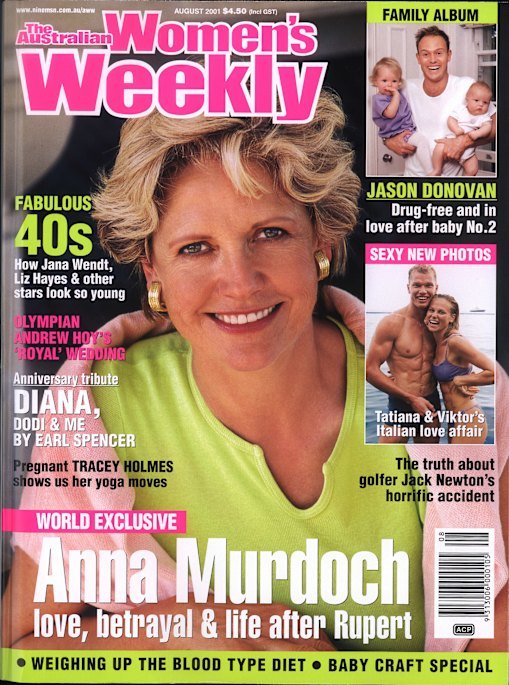
Anna did not speak publicly until February 2000, and then in a measured but still surprisingly frank interview with David Leser for The Australian Women’s Weekly. She said: “I thought we had a wonderful, happy marriage. Obviously, we didn’t. I don’t want to get too personal about this … but [he] was extremely hard, ruthless and determined that he was going to go through with this, no matter what I wanted or what I was trying to do to save the marriage. He had no interest in that whatsoever.”
She denied any bitterness and made it clear that she did not want to distress her children, settling for a fraction of what Californian law might have allowed, to preserve her children’s share and to ensure their control of the family trust.
By then, Anna had wed financier William Mann, a Catholic widower, in St Patrick’s Cathedral, New York in December 1999, which, given it was six months after her divorce, indicated that she had either been swiftly granted an annulment or her long marriage to Rupert had never been regularised by the Church.
Rupert, five years younger, referred to William as “a nice old man”. The couple lived in the Hamptons in a house once owned by the sister of the Aga Khan. Mann died in 2017.
Two years later, Anna married Palm Beach property developer Ashton dePeyster III, a descendant of a 17th century mayor of New York. They settled in Florida.
In September 2023, Rupert anointed Lachlan as his successor and, three months later, launched a legal battle in Nevada to amend the trust that Anna intended would leave all four eldest children in control.
Rupert wanted Lachlan to inherit control of News Ltd, ensuring it retained its conservative philosophy and its profitability so that all four children would benefit; this initiative was codenamed Project Family Harmony.
Prudence, James and Elisabeth (described in their father’s papers as “the objecting children”) challenged the move. Dissention among her children was the very thing their mother wanted to prevent. The decision of the Nevada commissioner, exactly a year later, upheld the four children’s objections.
Ultimately, the family settled so that Anna lived to see Lachlan would inherit the empire, while Prudence, James and Elisabeth forfeited their rights to choose a successor, each receiving $US1.1 billion ($1.5 billion).
During her lifetime she devoted her time, energy and experience to causes benefiting children, playing leading roles at Los Angeles Children’s Hospital and Haiti’s Hospital Albert Schweitzer.
Anna Murdoch Mann dePeyster is survived by her third husband and her three children, 10 grandchildren and one great-grandchild.
Start the day with a summary of the day’s most important and interesting stories, analysis and insights. Sign up for our Morning Edition newsletter.
Read the full article here