







Sydney motorists are bracing for more pain at the bowser as the deepening Middle East conflict sets the stage for a potential surge in already high petrol prices that will threaten household budgets and deliver fresh cost-of-living woes.
Service stations across Sydney were charging more than $2.10 a litre for regular unleaded on Monday, with the steepest recorded $2.15 as prices hit the top of their usual cycle.
But in a blow to already struggling consumers, economists say the US and Israel’s strikes on Iran could push them even higher as the global crude oil supply is severely restricted.
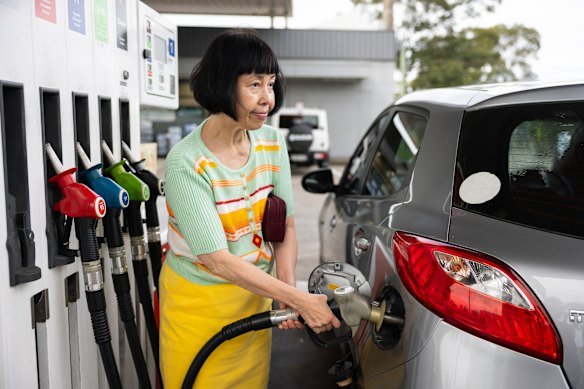
Amy Mok paid $2.39 for premium unleaded petrol at a Strathfield service station on Monday afternoon on her return from work and was already expected a war-led price hike.
“I noticed that the prices are rising at the moment … last week, prices were cheap,” Mok said. “But because of these last two days, these last two days of the war from Iran, that’s why it’ll rise.”
When markets opened on Monday, the cost of a barrel of oil climbed more than 10 per cent before easing back to rises of about 5 per cent by the end of the day.
Contracts to buy and sell a barrel of Brent crude oil, the international benchmark, rose from $US72 to finish Monday at $US76.
As a rule of thumb, if prices continue rising, each $US10-a-barrel rise could add 10¢ a litre at the pump in Australia, economists say.
Analysts said the main worry for energy markets was the Strait of Hormuz, the narrow shipping lane south of Iran, which is a major chokepoint for about one-fifth of the world’s oil and liquefied natural gas supplies. Unless trade flows are re-established swiftly, some experts are tipping oil prices could rise beyond $U100 a barrel.
NRMA spokesperson Peter Khoury forecast a 10 per cent hike in oil prices, and said it could take up to 10 days for disruptions from the Middle East to flow into the Australian market.
“It’s impossible to tell now because of what’s happening overseas … a lot can change very quickly,” said Khoury, noting what occurred in the Middle East over the next 72 hours was critical.
“There’s a whole raft of things we’re watching very closely, but most significant will be what’s happening with Iran, particularly with the Strait of Hormuz. If it is shut and stays shut, it will have an adverse effect on prices, but it’s unclear if the Iranians have the capability to shut it anyway.”
What happens next will depend on a broad range of factors, including whether the conflict eases quickly or widens and affects the production or transport of energy commodities through the region.
“The most recent comparison is during the early days of the Russia-Ukraine conflict, when the fear of loss of Russian supplies drove the oil price to over $US125 a barrel,” said Alan Gelder, head of refining and oil markets at energy data firm Wood Mackenzie.
AMP chief economist Shane Oliver said there was a 60 per cent chance that the war would ease within a week or two and the impact on energy markets would be limited.
However, a longer conflict would have severe global economic impacts, he said.
“This could mean a bigger and much longer disruption to oil supplies, conceivably resulting in a doubling in oil prices to around $US150/barrel, which could drive a sharp fall in shares.”
The conflict in Iran could also affect household energy bills in Australia by driving up the cost of natural gas, which is used for household cooking, heating and hot water, and in the gas-fired power stations that supply the electricity grid.
Anthony Bartulovic, a 22-year-old from western Sydney who relies on his car to operate his business, said renewed pain at the bowser was “frustrating”.
“At the rate it’s rising, it’s not proportionate to the amount of salary that we’re earning,” he said.
Agmal Gulhabin also raised concerns about broader cost-of-living pain brought by the raging war in the Middle East.
“When petrol goes up, everything goes up,” Gulhabin said. “Everything will go up, not just the petrol.”
The cheapest unleaded petrol was $1.49 a litre at two independent stations in Greenacre on Monday, while a handful of retailers across West Ryde, Bankstown and Villawood sold unleaded for less than $1.55 a litre.
Start the day with a summary of the day’s most important and interesting stories, analysis and insights. Sign up for our Morning Edition newsletter.


From our partners
Read the full article here