






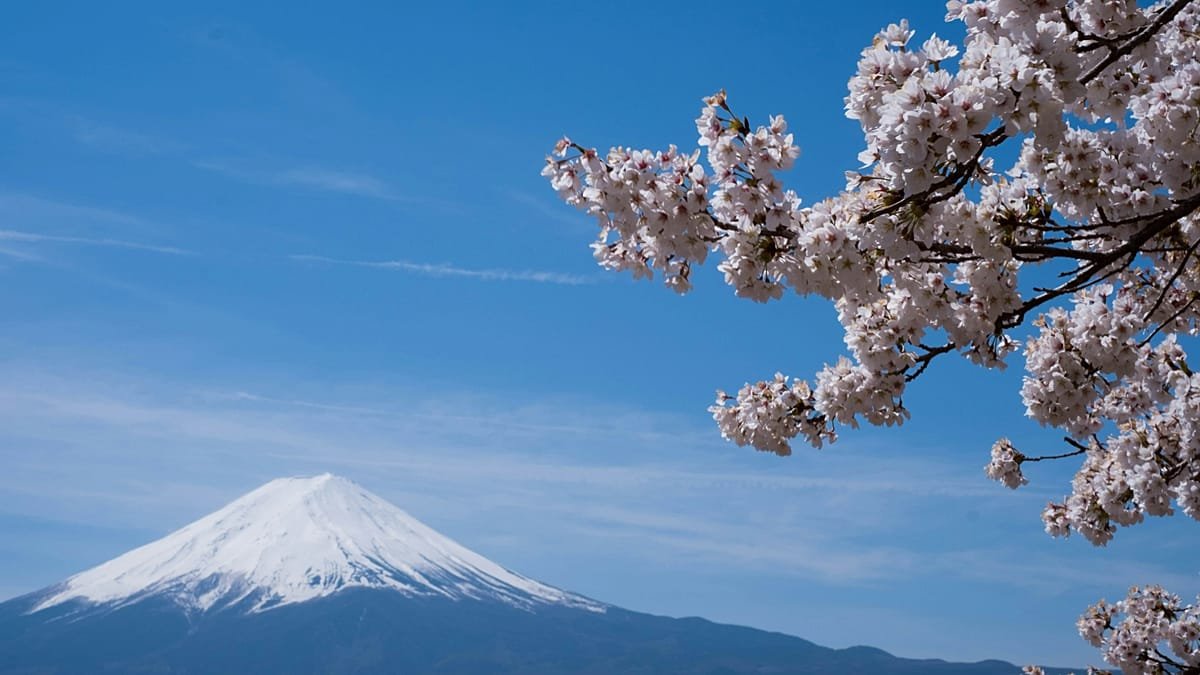
Japan has cancelled a famous cherry blossom festival near Mount Fuji, citing concerns over excessive tourist numbers and bad behaviour.
The annual event, which has been held at Arakurayama Sengen Park for about a decade, draws as many as 200,000 visitors a year to its views, stage events and stalls selling local delicacies.
This year could see peak numbers as a weak yen lures travellers to the historically pricey destination.
The move comes after Mount Fuji authorities imposed various regulations to curb overcrowding.
Mount Fuji cherry blossom festival cancelled over unruly tourist behaviour
On 3 February, authorities in the city of Fujiyoshida announced the cancellation of the sakura festival.
During blooming season, tourists flock to Arakurayama Sengen Park’s observation deck for views of Japan’s iconic mountain framed by cherry blossoms, with the five-tiered Chureito Pagoda in the foreground.
The local council said issues of traffic congestion, disruption for residents and littering have been growing in recent years.
There have been incidents of trespassing, entering nearby homes without permission to use the toilet, and even defecating in private gardens, the Straits Times reports.
In the streets surrounding the park, there have been reports of school children pushed off pavements by the tourist crowds, leading parents to raise safety concerns.
The event has experienced a boom in visitor numbers as the weak yen sees travellers flocking to the country and social media sparks viral photo opportunities.
“For Fujiyoshida City, Mount Fuji is not just a tourist attraction; it is our very way of life,” Mayor Shigeru Horiuchi told local media.
“However, I feel a strong sense of crisis about the reality that, behind the beautiful scenery, the quiet lives and dignity of our residents are being threatened.”
Three-hour waits expected for viral Mount Fuji photo
Despite the cancellation of the festival, the city is still expecting an influx of visitors during cherry blossom season.
Authorities have brought in safety and hygiene measures, including deploying security guards and setting up portable toilets.
Tourists will be encouraged to use public transport and refrain from entering private property and residential areas, as well as taking unauthorised photos.
The Arakurayama Sengen Park observation deck is still expected to be extremely busy, with waiting times of up to three hours.
Mount Fuji’s battle against overtourism
Japan’s highest mountain has been struggling with overtourism. A dramatic increase in visitors is causing pollution and safety concerns.
Last summer, a charge was brought in for hikers climbing up Mount Fuji using any of its four main paths.
The Yamanashi prefectural government, which oversees hiking activities at the UNESCO World Heritage site, introduced an entry fee of ¥4,000 (€24.70) for peak season.
To help clean up the mountain and preserve its environment, authorities previously introduced a fee and a daily visitor cap of 4,000 people on the Yoshida trail, the most popular route.
Another measure brought in last year to curb overtourism in a nearby town has also proved effective.
Fujikawaguchiko got so fed up with tourist crowds that they built a huge fence blocking the view they were coming for – Mount Fuji.
The 20-metre-long and 2.5-metre-high fence covered with a black mesh prevented tourists from taking selfies with the landmark after incidents of littering, crossing dangerously through busy traffic, ignoring traffic lights and trespassing into private properties.
The barrier was taken down in August as a precaution when a typhoon was forecast, but authorities decided not to reinstall it as it had already effectively reduced visitor numbers.
They warned, however, that it could be put back up if tourists return in large numbers.
Read the full article here