







Good morning from Brussels. I’m Mared Gwyn.
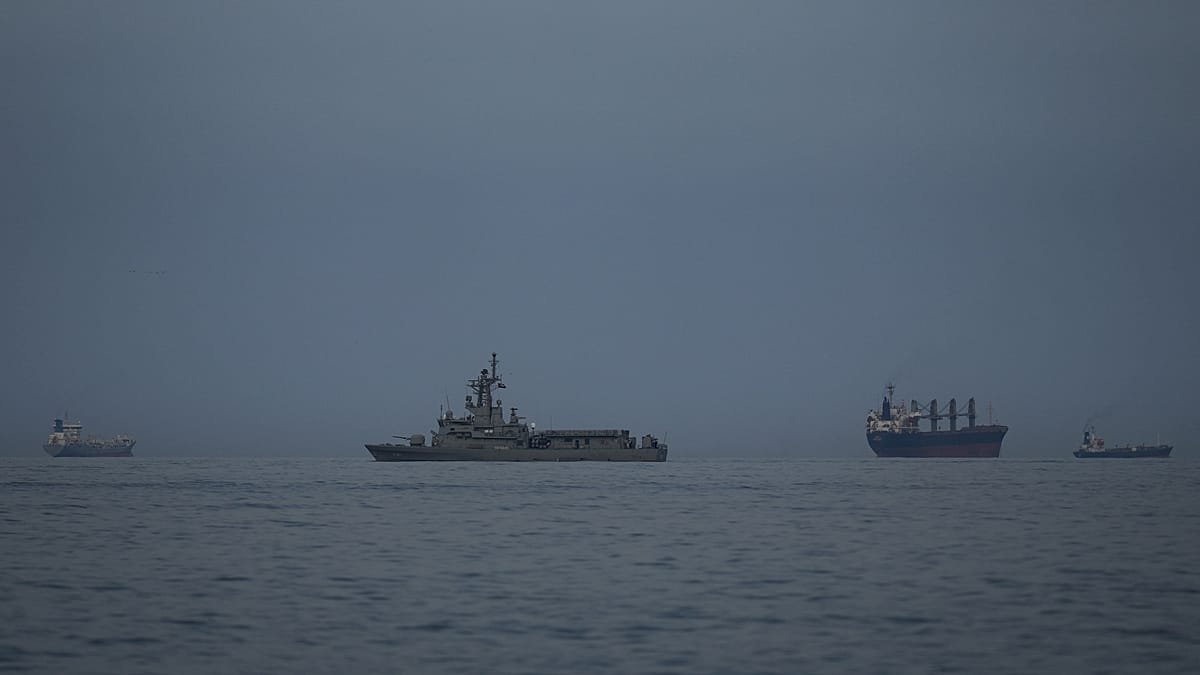
EU foreign ministers are expected to mull bolstering the EU’s Aspides naval mission when they gather in Brussels later today, a diplomatic source told Euronews, as US President Donald Trump ramps up pressure on allies to support the forced re-opening of the Strait of Hormuz.
Trump has called for an international naval coalition that would escort commercial ships through the Strait, a critical maritime artery that has been under a de facto blockade since the start of the Iran war, sparking a global energy supply shock, spiralling prices and economic volatility. Trump told the Financial Times that it would be “very bad for the future of NATO” if European allies failed to respond to his call.
Euronews understands that EU ministers will consider expanding the capacities of its Aspides mission, but are unlikely to deploy it to Hormuz while the war in the Middle East rages on to avoid being drawn into the escalating conflict.
Speaking on Sunday, German Foreign Minister Johann Wadephul voiced scepticism around the plans, saying his country wants to avoid playing an “active part” in the conflict.
Aspides is a defensive mission launched in 2024 to shield commercial vessels in the Red Sea from attacks by Iran-backed Houthi rebels. At the time, the EU resisted pressure to join the US’s offensive equivalent, Operation Prosperity Guardian, as it sought to avoid contributing to a further spillover of Israel’s war on Hamas.
In a veiled warning, Iran’s Foreign Minister Abbas Araghchi, who has said the Strait is open to everyone except the US and its allies, told his French counterpart Jean-Noël Barrot on a call on Sunday that European nations should “refrain from any action that could lead to escalation and expansion of the conflict.”
French President Emmanuel Macron said last week that France and its European allies were prepared to deploy an “ad-hoc” and “fully defensive” naval mission to the Strait, but only once the war had exited its hottest phase.
Macron also pledged an additional two French vessels to the Aspides mission, which originally had three permanent frigates provided by the French, Italian and Greek navies. Greek Prime Minister Kyriakos Mitsotakis has directly called on EU countries with naval capabilities to send more vessels to the mission.
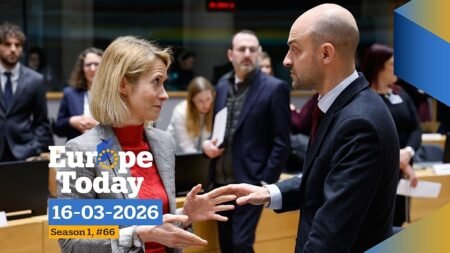
Speaking to reporters earlier this morning, the EU’s foreign policy chief Kaja Kallas said she had spoken to UN Secretary General António Guterres about the possibility of replicating a Black Sea mission used to get grain out of Ukraine during the war to restore the flow of oil and gas through Hormuz.
Kallas also warned about the knock-on effect on the availability of fertilisers and the potential for a global “food deprivation.”
The Iran war’s repercussions for Ukraine will also be under discussion when ministers sit down today, with Kallas warning earlier against letting attention on Ukraine “fizzle out” as the situation in the Middle East escalates.
Several countries have voiced complaints over the US’ recent decision to temporarily waive sanctions on Russian energy, allowing countries such as India to purchase Russian oil stranded at sea in a bid to ease the global supply squeeze. (EU ministers will be joined over lunch later by their Indian counterpart Subrahmanyam Jaishankar.)
The temporary move was announced by the US Treasury Secretary days after G7 leaders agreed in a call to keep sanctions untouched.
German Chancellor Friedrich Merz has described any easing of sanctions on Russia as “wrong”, while Council President António Costa said the US move is “concerning” and carries implications for European security. Kallas earlier today said the decision sets a “dangerous precedent.”
Ukrainian President Volodymyr Zelenskyy doubled down on his own criticism of the US decision over the weekend, and continued to warn European allies over following suit.
Yet there are increasing signs that the war in the Middle East is somewhat shifting the dial on the EU’s position on the war in Ukraine – with Belgian Prime Minister Bart De Wever calling for direct European talks with Moscow over the weekend. More on De Wever’s comments in our top story below.
The scramble to rein in the global energy crisis comes as the dispute over the flow of cheap Russian oil to Hungary and Slovakia through the Druzhba pipeline drags on. In comments over the weekend, Zelenskyy described the pressure placed on him by EU partners to re-open the pipeline as “blackmail”.
The Soviet-era pipeline has been out of operation since late January, pitting Kyiv in a major dispute with Hungary and Slovakia, both landlocked countries exempted from EU restrictions on Russia oil. Hungarian Prime Minister Viktor Orbán is vetoing the EU’s €90 billion loan to Ukraine until the pipeline is turned on again, with the energy shock triggered by the war in Iran further raising the stakes.
Brussels is backing Budapest and Bratislava’s calls for an external inspection and urging Ukraine to repair the pipeline in order to calm tensions and give them leverage to convince Orbán to drop his veto.
But with the EU’s 27 leaders gathering in Brussels for a high-stakes summit on Thursday, officials and diplomats in Brussels are seriously contemplating a scenario in which Viktor Orbán’s veto drags on until after the Hungarian elections on 12 April, my colleague Jorge Liboreiro writes.
Orbán has made the increasing animosity between him and Zelenskyy over the Druzhba pipeline a focal point of his electoral campaign. Many in Brussels acknowledge the Hungarian premier has no incentive to drop his veto until after the ballot – and the EU executive has now concluded Ukraine has the cash needed to sustain itself until early May, due to a G7 line of credit and a new programme by the International Monetary Fund (IMF).
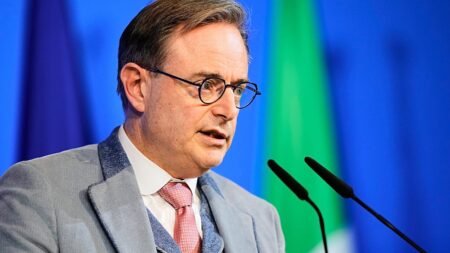
Belgium’s PM De Wever says Europe must strike deal with Russia to end Ukraine war
Belgian Prime Minister Bart De Wever has called on Europe to cut a deal with Russia to end the war in Ukraine, as the war in the Middle East further upends global order and sends energy prices skyrocketing
In an interview published in the Belgian newspaper L’Echo, De Wever argued that a negotiated settlement is also necessary to restore access to cheap energy.
“In private, European leaders agree with me, but no one dares to say it out loud. We must end the conflict in the interest of Europe, without being naïve towards Putin,” the Belgian leader said.
French President Emmanuel Macron and Italian Prime Minister Giorgia Meloni led recent calls for direct talks with Putin in a bid to increase their sway over a future settlement as US envoys brokered direct talks between Kyiv and Moscow. Other EU members such as Poland and the Baltic countries have struck a more cautious tone.
The war in Iran has for now frozen the trilateral talks between the US, Ukraine and Russia, which had been taking place in the United Arab Emirates.
Sándor Zsiros has moreon De Wever’s comments.
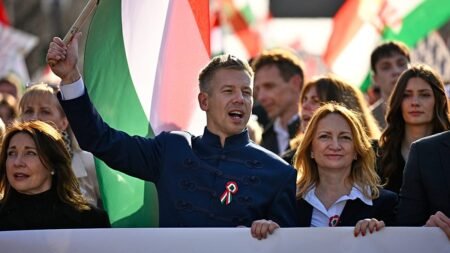
Orbán, Magyar hold competing national day rallies as electoral campaign enters final weeks
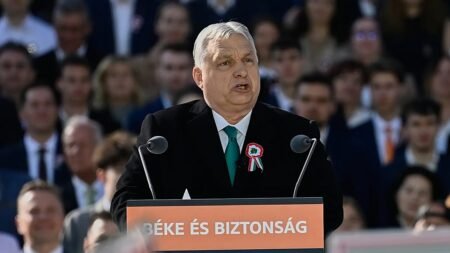
Hungarian Prime Minister Viktor Orbán and his political opponent Péter Magyar delivered competing speeches at major Budapest rallies on Sunday — as the campaign continues to heat up ahead of April elections that will be pivotal for Hungary’s future.
Our Hungarian EU correspondent Sándor Zsiros writes that Orbán once again framed the vote as a choice between election as a choice between peace and war, while lashing out at Ukraine’s Zelenskyy and the EU over the Druzhba pipeline dispute.
“It is time for Kyiv and Brussels to understand that our sons will not die for Ukraine, they will live for Hungary,” Orbán said.
“We must choose who should form a government, me or Zelenskyy? I offer myself, with due modesty,” he added.
Magyar meanwhile accused Orbán of being a traitor to his country and for enlisting the support of Russian agents to rig the vote.
“Orbán invited the most skilled Russian agents to our country to interfere in the elections and once again rob us of our most sacred possession, Hungarian freedom, for which our ancestors gave their lives,” Magyar said.
Magyar continues to lead Orbán in most opinion polls, making him the greatest challenge to the Hungarian Prime Minister’s hold on power after Orbán’s 16 uninterrupted years in office.
More from our newsrooms
EU Parliament firewall breached? EPP reportedly worked closely with AfD. Investigations suggest the EPP group in the European Parliament cooperated more closely with far-right parties, including the AfD, on tougher EU migration laws, with a chat group and a meeting of MEPs playing a key role. Nela Heidner hasthe details.
North Korea conducts test of nuclear-capable rocket launchers. South Korea’s military said Saturday it detected about 10 ballistic missiles fired from North Korea’s capital region toward the eastern sea. The launch coincides with US-South Korean Freedom Shield training, a computer-simulated command post exercise. Jesús Maturana & Emma De Ruiter have more.
We’re also keeping an eye on
- EU foreign affairs and energy ministers gather in Brussels
- The European Commissioner for Defence, Andrius Kubilius, delivers a speech in Brussels
That’s it for today. Maria Tadeo, Sandor Zsiros and Shona Murray contributed to this newsletter. Remember to sign up to receive Europe Today in your inbox every weekday morning at 08.30.
Read the full article here