




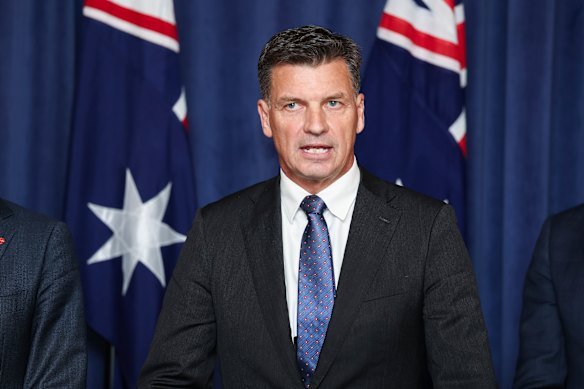
In 2020, Angus Taylor, as energy and emissions minister, signed a deal with the US to store Australian-owned oil reserves in Texas and Louisiana. Why was such an agreement, which clearly jeopardises Australia’s fuel security, made? Texas is 30 to 40 days away by ship, and in times of global upheaval we have no guarantee that maritime transport will even be possible. Being an ally of the United States is no guarantee of access to our stockpiled fuel either. As we have seen, Donald Trump has no qualms about turning against his friends. We have unnecessarily signed ourselves into a dangerous agreement and should set about extricating ourselves immediately. Christina Foo, Wahroonga
What’s the deal with our oil reserves in Texas? Are we drawing down on them? If not, why not, or is Donald holding them hostage? Craig Forbes, Lewisham
Fuelling confusion
When is Prime Minister Anthony Albanese going to show leadership on the fuel situation (“States warn piecemeal fuel rationing would trigger COVID-era confusion”, March 25)? He criticised Scott Morrison for not holding a hose, but he doesn’t think fuel rationing is a decision for him despite having convened the national cabinet and appointed a fuel co-ordinator. Energy Minister Chris Bowen says measures for fuel rationing were not invoked during COVID so aren’t needed, but this is different. People weren’t moving around as they are now. Labor has its head in the sand. Jenny Greenwood, Hunters Hill
In this time of economic crisis, it seems obvious that reducing the excise tax on fuel would help minimise petrol price increases. This reduction in tax revenue could be offset by increasing the gas export tax. Surely this is the type of thinking and action we need from the federal government.
Craig Duckmanton, Birchgrove
Driving clean energy
Rod Sims is right: we should never waste the opportunity that comes with a crisis (“Sure way to keep our nation driving: Make polluters pay”, March 25). It’s clear that Australia’s future prosperity lies in clean transport and industry. Renewable energy and electrification aren’t some distant dream; they offer the most reliable, healthy and cost-efficient forward pathway we have. Sims’ proposed polluter-pays levy – raising $22 billion a year from big gas and other fossil fuel corporations – is not radical. It’s basic fairness. These companies still profit handsomely while the public foots the bill for climate damage. Pressure to make polluters pay is coming from every angle. Will the Albanese government listen? Larni Dibben, Glen Iris (Vic)
In light of the current fuel crisis, I can’t help thinking how different things would be if we still had a carbon tax. We were ahead of the curve internationally until the Abbott-led opposition won the election in 2013 and fulfilled its pledge to “axe the tax”. The Gillard government introduced it just three short years earlier. But there’s nothing to be gained from crying over spilt milk, as they say. At this time of uncertainty, let’s take note of our vulnerability and dependence on fossil fuels. The concept of a polluter-pays levy makes sense as a means to incentivise and accelerate our transition to clean energy. Maree Nutt, Newport
Think about us
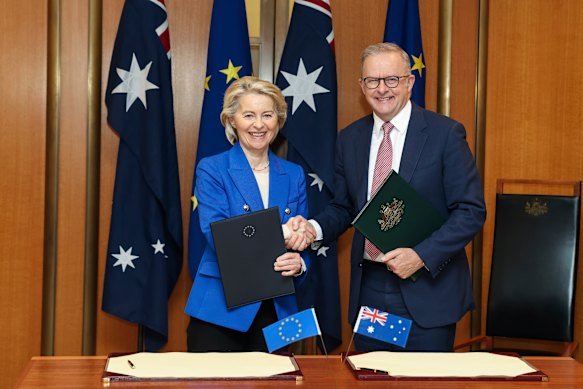
Perhaps the visit by Ursula von der Leyen will emphasise to our government what it continues to deny: Australia is at the end of very long and tenuous supply lines (“EU leader offers bracing message to Australia”, March 25). It’s all very well for Albo to hit the phones, but the long-term solution is to aim for self-sufficiency. Australia, like all nations, benefits from globalisation and trade for mutual improvement, but governments should prioritise the welfare of their own people. What do flight attendants say? “Put on your own mask before assisting others.” It’s not selfish, it’s practical. Andrew Scott, Pymble

Speak up
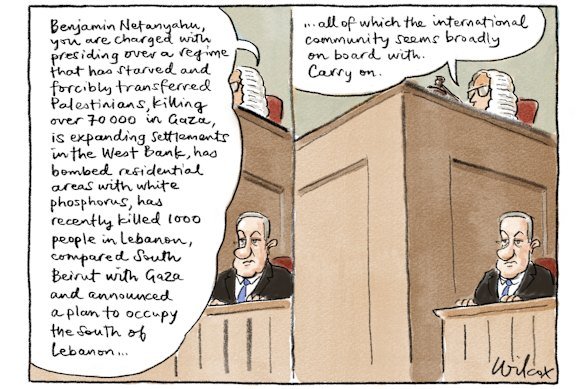
One wonders whether Foreign Affairs Minister Penny Wong asked her Israeli counterpart about the seldom-reported increase in violent attacks by settlers against Palestinians in the West Bank. Just last weekend, on the Eid al-Fitr holiday, rampaging illegal settlers torched homes and vehicles and beat residents. No arrests were made. These attacks have intensified since Israel and the US attacked Iran. And now we hear of Israeli plans to “occupy” southern Lebanon to protect Jewish communities near the border (“‘Security zone’: Israeli military plans to occupy swath of southern Lebanon,” March 25). Minister, do you care? Mark Paskal, Austinmer

Poetry v reality
The quote provided by correspondent Carol Dance (Letters, March 25) from Persian writer Saadi Shirazi – “Governments that pursue prolonged or unpopular conflicts risk undermining their domestic support, weakening their authority and causing their inevitable collapse” – is certainly relevant, but she should have applied it to the Iranian regime rather than Trump. Iran’s leaders have been pursuing conflict against many of its neighbours, primarily Israel, since taking power 1979. It has poured billions of dollars into terrorist proxies while its own people suffered due to its struggling economy, causing great domestic resentment. A popular chant at anti-regime demonstrations has been, “Neither Gaza nor Lebanon, my life for Iran.” The regime lost domestic support long ago, as seen by the horrific violence it was forced to use to maintain power. Hopefully it will soon collapse. Stephen Lazar, Elwood
Propaganda and lies from the Islamist regime in Tehran may be familiar, but it’s hard to outdo a compulsive liar like Donald Trump (“Tehran versus Trump – who do we believe?” March 25). The Iranian leadership has been labelled evil, but then, so has Trump. With such an implacable foe as Iran, there can be no triumphant conclusion to Trump’s illegal war. The regime may well survive, and will neither forgive nor forget Trump’s attack. Payback will most likely continue long after Trump walks away, while the rest of the free world will continue to pay the price for his actions. Graham Lum, North Rocks
As events in the Middle East descend into predictable chaos, one cannot help recalling Henry Kissinger’s remark: “All tactics and no strategy.” Gordon Koch, Ashfield
Irreplaceable ABC
The ABC strike has predictably brought out trolls who want to axe the whole organisation (“ABC staff strike hits TV, radio as news channel diverts to BBC”, March 25). These people never seem to consider what it would cost to replace the ABC in its crucial role as the official National Emergency Broadcaster. Just imagine what a chaotic and expensive mess that could be, with turf wars between the multiple state and federal fire, rescue, medical, marine, aviation, police and emergency services bodies that would have to co-operate with three competing tiers of government, and the military, in setting up and running such a thing. No doubt ASIO and other intelligence bodies would also insist on seats at the table. How many different staff unions would have to be dealt with, instead of the single one at the ABC? The whole enterprise would probably cost at least as much as the ABC, but with a greater risk of failure when actually needed. The costs of regularly testing and servicing the otherwise unused networks and transmitters would be astronomical. Better to let the ABC perform the function, in addition to its main day-to-day business of reliably serving its loyal audiences and maintaining the complex technical infrastructure behind it all. There’s also the added bonus of all that interesting, informative and musical programming to enjoy between emergencies. Simon Healy, Beaumont (SA)
Pining for the fjords?
Some years ago, I discovered the rock bottom of human intelligence when attempting to call in a deceased’s bank account funds (Letters, March 24). I provided certified copies of the original death certificate, a grant of probate and the deceased’s and executor’s photo IDs, but the bank officer nevertheless insisted the deceased had to personally attend the branch. After pointing out the absurdity of this demand, he still wouldn’t budge. When I tried humour, with a parody of Monty Python’s dead parrot skit, things deteriorated further. He’s out of my life now, but AI isn’t. Howard Charles, Glebe
My stepsister and I had a similar experience to your correspondent Steven Lee after my father died (Letters, March 24). To all appearances, it seemed his bank had never had a customer die before. I was told to go to any branch to have my ID confirmed. I did as instructed but the staff at the bank I attended had never heard of this process and sent me away. Eventually, we had to go into my father’s actual branch and wait while staff went through thick procedure manuals to find out what to do.
Andrew Taubman, Queens Park
Damage control
The gun ownership debate continues to be dominated by “half-cocked” ramblings (“Three Liberal MPs cross floor to oppose tighter gun laws”, March 25). The gun lobby still can’t come up with clear and definitive reasons why farmers, all 90,000 of them, need to be allowed up to 10 weapons each. Sure, they trot out the old cliches: feral pests, slaughtering drought-stricken animals, snakes, on and on. But does this apply to every farm, and how often? Is there any farmer who can shoot more than one gun at a time? More importantly, is it possible to monitor the mental wellbeing of all licensed, gun-owning farmers at all times? A few answers from those who know what they are talking about would be welcome. Duncan McRobert, Hawks Nest
Simple solution
If AI is as smart as we are led to believe, I have a question. As we all know, AI is a massive consumer of two of the earth’s most vital commodities, water and electricity. Correct? So why haven’t any of the AI tech nerds in the world come up with the solution to curb such excessive consumption of these resources? Feed that into your AI computers. I’ll wait. Graham McWhirter, Shell Cove
A win is a win
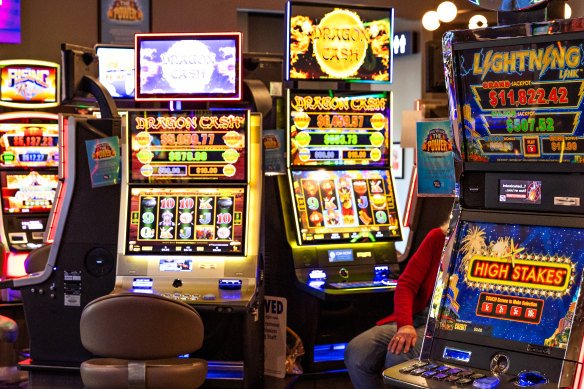
How nice to get some good news for a change (“Rare bright spot in an area dogged by lobbying and political backflips”, March 25). Bevan Shields writes that NSW Labor is at last doing something to reduce the harm caused by pokies. Most venues will be stopped from operating the machines in the early morning hours when the most harm occurs. Nevertheless, NSW will still be the pokies capital of the world. Premier Chris Minns has still not committed to cashless gaming despite the NSW crime commission saying it is essential to prevent criminal money laundering. Federal Labor still hasn’t tackled sports betting, which ensures new young recruits to gambling addiction for the gambling industry. But with Donald Trump continuing to destroy the world and providing a playbook for hard right politicians here, even small wins are welcome. Gary Barnes, Mosman
Better things are coming
I appreciated the tone of your editorial (“Things will get better eventually – so cheer up”, March 25). We all need to be reminded, despite repeated evidence to the contrary, that things will get better eventually. I worked through the 1970s oil crisis and although things were tough, I kept my head down and adopted a business-as-usual approach. Of course, in those days we didn’t have the 24/7 news cycle and social media to keep us worrying, however, things did indeed get better eventually. Phillip Kerrigan, Speers Point
The spirit of your editorial was welcome, albeit a grating reminder of former British PM Tony Blair’s co-opting pop group D-Ream’s Things Can Only Get Better as his 1997 campaign anthem. However, as a former Victorian I must take issue to your name-checking “Things are crook in Tallarook”. Conditions may well be dire there in central Victoria – I hope not, for their sake – but I grew up with another version of the expression: “Things are crook in Tootgarook.” On behalf of that Mornington Peninsula suburb, where it must be said life is generally rather pleasant, I seek a more inclusive approach to such an important issue. Gervase Greene, Clovelly
One Nation gaining momentum
Your correspondent Thomas Shanahan (Letters, March 25) fails to see that “success” for One Nation is much more about attaining political legitimacy and much less about winning government. With something like 22 per cent of the primary vote in South Australia, One Nation no longer stands at the margin of the Australian political landscape. With its South Australian result, One Nation has flexed enough muscle to be taken seriously. A 22 per cent swing in some seats in regional Australia will potentially deliver it more than a couple of handfuls of seats in a federal election. The other measure of success is, of course, that the result has instilled exactly the same kind of fear that free-thinking people had about Donald Trump, which as we can see now continues to come home to roost. Rob Reitano, Lane Cove West
Senseless destruction
As a 91-year-old refugee from World War II and regular observer of world events, I continue to shake my head not only at the needless death of so many people, but the pain and anguish of their grieving families. Not to mention the destruction of infrastructure; buildings, boats, bridges and so much more. It takes years to build a ship or high-rise building, but only minutes to destroy them. Most of this destruction has occurred because humans mistakenly put their trust in “strong” leaders – Trump, Putin, Xi and Netanyahu at the moment. All it achieves is destruction, when what we need is co-operation. Why are we Homo sapiens (“wise men”) so stupid? Ferdo Mathews, Robina (Qld)
- To submit a letter to the Sydney Morning Herald, email letters@smh.com.au. Click here for tips on how to submit letters.
- The Opinion newsletter is a weekly wrap of views that will challenge, champion and inform. Sign up here.
Read the full article here