




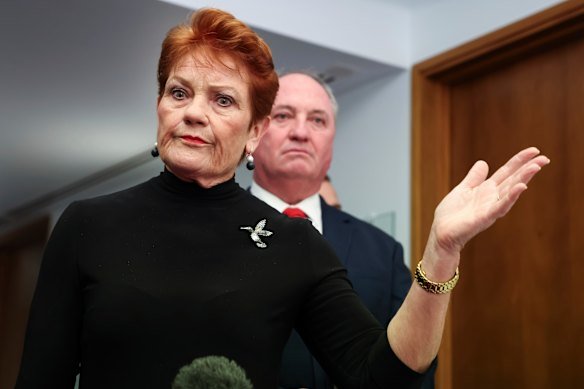
Pauline Hanson has all but guaranteed a preference deal with the Coalition for the Farrer byelection, ramping up her war on preferential voting as left-wing activist group GetUp! re-emerges with a big-money campaign that could help elect a Climate 200-backed independent.
Former prime minister Tony Abbott hit the streets of Albury on Thursday to convince Liberal supporters to stick with the struggling party, warning in remarks to this masthead about the enormous difficulty of clawing support back from One Nation.
The Liberal and National campaign machines are in full tilt as they struggle to fend off a South Australia-style walloping at the hands of One Nation in the regional NSW seat formerly held by Sussan Ley.
The Liberal Party directed its voters to preference One Nation above Labor in South Australia, where the populist party may win as many seats as the Liberals, and Hanson said she would work with the federal Coalition.
“I’d be very happy to do a preference swap with the Nationals and Liberals,” she told this masthead, after Nationals leader Matt Canavan chastised Hanson for failing to direct preferences to the Liberals in South Australia.
Liberal leader Angus Taylor opened the door to a deal with Hanson earlier this month.
Sources familiar with polling conducted by the Coalition parties and One Nation say the Nationals’ primary vote is in the single digits in Farrer. The Liberal Party is in the high teens or low-20s. The favourites, One Nation’s David Farley and independent Michelle Milthorpe, are well ahead of the pack.
Milthorpe received a boost on Thursday when GetUp! announced it was aiming to raise and spend $500,000, more than its declared spending at the last federal election, for an anti-Hanson advertising blitz.
“One Nation’s support is real, but it’s shallow. It’s driven by frustration: people are angry about rising costs, stagnant wages, and feeling ignored. Hanson is exploiting that frustration. But her support isn’t locked in, and it isn’t inevitable,” the group said in a mailout.
GetUp! was a prominent activist group during campaigns in the 2010s, but has since faded as other left-wing groups, such as Climate 200, the teal movement funding machine, have risen. The organisation’s support of Milthorpe, who has distanced herself from the teals, might prove awkward for her as she aims to portray herself as a middle-of-the-road independent.
Labelling the election “one of the most important fights GetUp! has ever taken on”, the organisation told supporters that a One Nation win in Farrer could help Hanson consolidate “actual power”.
“We’ve watched the rise of authoritarian, far-right movements across the world, and we’ve watched country after country fail to stop them in time. We have a chance to stop our own version of this now,” GetUp! said.
Abbott said that the South Australian result was “very significant because it shows that One Nation’s strong polls are not just a protest”.
This masthead revealed on Sunday that Taylor met his most senior MPs last week to map out a plan to take on One Nation. They acknowledged the opposition must develop a big-picture policy agenda for economics, migration and energy to bring votes back from the right-wing party.
Abbott said: “A large chunk of traditional Liberal voters feel let down and ripped off, and we now have a huge task ahead of us to win them back. Better, stronger policy, especially on energy and immigration, is the start. But people need to feel that new policies are the product of conviction, not just circumstance.”
Hanson has in recent months drummed up scepticism towards Australia’s system of compulsory preferential voting.
The Queensland senator is pushing for governments to adopt the NSW model, which allows voters to vote for just one party in the lower house or allocate preferences. Queensland’s LNP government is exploring optional preferential voting in the belief it could benefit conservatives. NSW Labor is pushing for compulsory preferences so Premier Chris Minns can hoover up more Greens preferences.
“The people are fed up with sending preferences where they don’t want them to go. A lot of people don’t want their preferences to go to the Greens or to the Labor Party,” Hanson said.
“They’ve done it for a purpose: to keep people dumbed down so that they don’t understand it, so that they have to follow the how-to-vote cards and that those votes flow back to the majors.”
Populists in the US and Europe have similarly claimed voting systems were designed to suppress the will of the people.
Long-time election analyst Antony Green said it was wrong to say that minor parties and independents were hurt by the system, pointing out that most independents in federal parliament were elected on preferences.


From our partners
Read the full article here