





Opinion
When the prime minister rose in the house to move a motion of condolence for the families and loved ones of the Bondi massacre victims, Anthony Albanese called on Australia to come together “in a spirit of national unity”.
As one member after another spoke in sombre support, that word – unity – was spoken another 55 times. The motion was carried in the same spirit. Unanimously. Governor-General Sam Mostyn elsewhere spoke of Australia as “a place where absolutely everybody belongs”.
Just two months since that mass murder, events force us to ask a hard question of ourselves. Did the shock unify us in appreciation of our precious gift as a place where absolutely everybody belongs? Or did it merely license more hatred?
On Australia Day, the anti-immigration March for Australia crowds hosted Pauline Hanson in Brisbane. The group’s Sydney organiser said she wanted neo-Nazis to help supervise the rally because “they’re good people who are fighting for our country”. The same rally cheered a speaker who declared “heil white Australia” and vilified Jews as the “greatest enemy”. He’s been jailed for hate speech.
On the same day, a man allegedly threw a home-made bomb into an Invasion Day rally in Perth. Police say he’d hoped to kill Indigenous Australians. The bomb failed to detonate. He’s now on trial for alleged terrorism, a first in Western Australia.
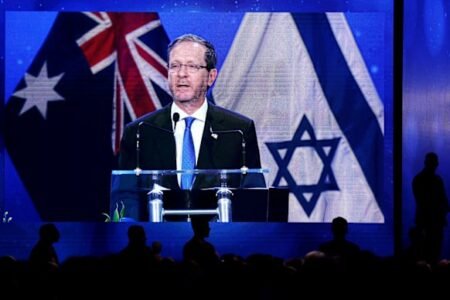
This month, pro-Palestine crowds in Sydney and Melbourne turned out to protest against the visit by Israel’s head of state Isaac Herzog, anger at Israel more important to them than a moment of respect for their fellow citizens in Australia’s Jewish community still mourning their dead.
In the Sydney protests, overzealous police broke up a small group of Muslim men at prayer, an incident now under police investigation. At the same event, Grace Tame took the microphone to scream “from Gadigal to Gaza, globalise the intifada”. Did it not occur to her that that was precisely what the Bondi gunmen had just done, on Gadigal land?
This week, Hanson said in a TV interview: “You say, ‘Well, there’s good Muslims out there’. How can you tell me there are good Muslims?” As Nationals senator Matt Canavan quickly pointed out, the feted hero of the Bondi massacre was Ahmed al Ahmed, a Muslim who gave credit for his pluck to the hand of God.
Hanson, like Tame, learnt nothing from the massacre at Bondi. They will claim to have nothing in common, but both are agitators in pursuit of attention.
Today, there are more guards on duty at Jewish schools in Sydney than there were three months ago. This week, as Ramadan began, Australia’s largest mosque, in Lakemba, was threatened with violent destruction for the third time in two months. Lebanese Muslim Association secretary Gamel Kheir told the ABC: “We’ve had so many inquiries about [whether] it’s safe to go to prayer. That’s not a question any Australian should ask.” Australia’s Jews are asking the same question. As former Jewish Board of Deputies chief executive Vic Alhadeff wrote in The Australian on Friday: “Jewish Australians no longer feel safe in this country. That is our truth. Our new normal.”
Has Australia’s worst terrorist attack chastened us into coming together? Or has it excited us into ripping each other apart? We know how Hanson’s One Nation party sees it. “Part of the house has burned down, and Australians want the fire brigade, not philosophers,” says Hanson’s star recruit and her party’s only lower house MP in federal parliament, Barnaby Joyce.
“Bondi was not a calming moment. It was a seismic change in the world view of the Australian people,” he tells me. Hanson’s campaign to vilify Australia’s Muslims, in other words, has only just begun.
People voting for Trump, Farage and Hanson aren’t asking to see spreadsheets; they want to see sledgehammers.
Hanson, predictably, extracted more attention this week when she was asked to apologise for her claim that there were no good Muslims. She’s been at this in a professional capacity for 30 years, the offence, then the non-apology, followed by the next offence. First hate-baiting Asian Australians, then Indigenous Australians and Muslim Australians next.
She gave a non-apology, predictably. “If I’ve offended anyone out there that doesn’t believe in sharia law or multiple marriages or wants to bring ISIS brides in or people from Gaza who believes in the caliphate … then I apologise to you for my comment. But in general, that’s what they want: a world caliphate and I’m not going to apologise.”
Her insult to Muslims wasn’t a mistake, it was a moment. The way she sees it, this is her moment.
One Nation support in the opinion polls stands at about a quarter of the electorate, equal to, or higher than, that of the Liberals. Hanson’s party has around double the support enjoyed by the Greens and is second only to Labor.
This surge for One Nation did not begin with the Bondi massacre on December 14. It began months earlier, around September-October. And it was not precipitated by an attraction to Hanson primarily. It was a revulsion towards the Coalition and its internal disarray.
Like Donald Trump’s MAGA and Nigel Farage’s Reform, Hanson’s One Nation is not a party proposing constructive solutions. It offers itself as an agent of destruction.
All these far-right populist parties prey on frustration and fear. In return, they offer anger and destruction. Trump said it in 2023: “I am your warrior. I am your justice. And for those who have been wronged and betrayed: I am your retribution.” What is the definition of populism? There are many. The one I favour: it’s a political style that proposes unworkably simplistic solutions to complex problems.
People voting for Trump, Farage and Hanson aren’t asking to see spreadsheets; they want to see sledgehammers. Of course, Muslims might be the main target of Hanson’s vilification, but the whole country will be the victim. Hateful discrimination, once unleashed, becomes undiscriminating.
The Bondi atrocity didn’t start the trend to One Nation, but it certainly did nothing to arrest it. One Nation’s vote has continued to rise, chiefly at the Coalition’s expense, since. Joyce offers his interpretation of the vote shift to his adopted party and its implicit message to the Coalition: “People don’t want to be told Bondi was just a bad day in Australia. ‘You are not taking it seriously and I’m losing confidence in you. We are a bit scared and we are going to scare you’,” he says. “If the major parties don’t have an epiphany, there will be serious consequences at the ballot box.”
But the next federal election is as long as two years away. Can Hanson maintain the rage? Albanese has pointed out that every time support for her has flared up it has soon flamed out. Even when it managed to get its candidates into state or federal parliaments, they’ve soon flaked out. That’s the consistent pattern over three decades. One Nation turns out to be one woman. This time she’s won Joyce over. Another time it was a former Labor leader, Mark Latham. It ended in acrimony, as usual.
And this is the common assumption. Former governor-general Peter Cosgrove this week launched a project called the “civility exchange”. Alarmed at the “downward spiral” of intolerance and incivility, the former chief of the Australian Defence Force is working with the Menzies Leadership Foundation to restore reasoned disagreement over abuse.
Unchecked, “it becomes a deep schism. It may start with antisemitism, but then it’s anti-Islam, anti-migrants, it’s crypto-fascists”, he tells me. “We need to be able to have disagreement with respect.”
Yet he’s untroubled by Hanson’s effort to sow hatred. “The polls have shown a surge but on voting day, some of those chickens will come home to roost. Look at the Greens – they were riding high but at the last election they absolutely tanked.” Anti-immigrant movements have come and gone, a hardy perennial, he says.
The Scanlon Foundation Research Institute is noted for its annual report on social cohesion. Chief executive Anthea Hancocks shares Cosgrove’s concern at the state of public debate. “International political leaders have created a permission structure for people to be far more open about their views,” she says, without naming Trump. “You add Pauline Hanson to the mix and there’s no coming back from that.”
Hancocks is concerned, too, that widespread frustration at inflation and falling living standards is harming cohesion because “people say, ‘I have to find someone to blame’, and right now, lots of people are saying ‘it has to be immigrants. It can’t be me’.”
Yet she, too, is phlegmatic about the future. “We’ve been over all sorts of bumps and crises over 20 years, but there’s a resilience among the Australian population and it’s quite robust.” The next Scanlon empirical measure of cohesion is due in July. Hancocks expects only a modest erosion.
In private, some of the most senior and serious people in both the Labor and Liberal parties are less philosophical about Hanson’s upsurge.
Trump and Farage were both political blowflies for years, laying maggots in the public mind before conditions were right for them to emerge as angry swarms. Australia’s major party strategists are wary of Joyce. Much rides on whether he can professionalise One Nation from a personality cult into a modern political movement.
It may be that Hanson and Joyce are two scorpions trapped in a bottle, poised for mutually assured destruction. If not, Australia’s greatest test still lies ahead.
Peter Hartcher is political editor.
Get a weekly wrap of views that will challenge, champion and inform your own. Sign up for our Opinion newsletter.


From our partners
Read the full article here