




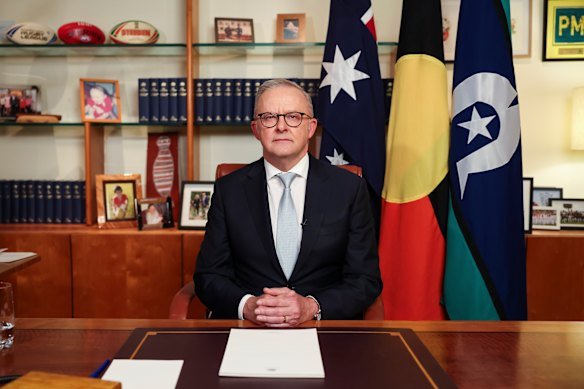
Prime Minister Anthony Albanese has urged Australians to go about the Easter weekend as normal, but warned about grim times ahead and tougher measures to conserve fuel in a rare address to the nation designed to prepare the public for a prolonged economic shock caused by the war in Iran.
Albanese’s message to the nation on Wednesday night will be followed by a National Press Club speech on Thursday in which he will pledge $1 billion for interest-free loans for struggling businesses amid fears of a recession.
Under pressure to project leadership and calm after weeks of panic buying, Albanese will use the global oil shock to propel his vision to overhaul Australia’s economic model by subsidising critical industries and traditional manufacturers.
Albanese will pledge he is preparing his most ambitious budget, tying his manufacturing agenda to social cohesion and “progressive patriotism”, and opening the door for potential state investments in oil refineries and boosting the nation’s low fuel stock holdings.
While the prime minister’s Press Club speech was planned weeks ago, he decided this week to use the address to the nation to speak directly to voters about the war, opting for a sombre delivery that marked a significant change to more upbeat messaging earlier this week.
“The months ahead may not be easy. I want to be upfront about that,” Albanese declared in a three-and-a-half minute speech broadcast at 7pm on Wednesday, the first national address since Scott Morrison’s pandemic message on March 12, 2020, days before the nationwide lockdowns began.
Emphasising that Australia was not actively involved in the war after weeks of escalating frustration directed at the Trump administration, Albanese said Australians should “go about your business and your life as normal” over Easter.
In contrast, he laid the groundwork for harsher measures that might be taken along with state premiers in coming weeks should the supply of oil tankers slow as a result of the war.
“If you’re hitting the road, don’t take more fuel than you need, just fill up like you normally would,” he said. “And over coming weeks, if you can switch to catching the train or bus or tram to work, do so.”
“That builds our reserves and it saves fuel for people who have no choice but to drive.”
Albanese, US President Donald Trump and UK Prime Minister Keir Starmer all announced they would speak directly to their populations on Wednesday, underlining the growing level of public anxiety about the US and Israel’s strikes on Iran, and the global oil crisis triggered by Tehran’s decision to blockade the Strait of Hormuz.
Opposition Leader Angus Taylor said Albanese’s address to the nation was just “a rerun of Monday’s press conference”, and didn’t have the detail Australians needed.
“We need clarity, we need detail and we need a plan,” he said.
The Trump administration, via Secretary of State Marco Rubio, sent signals that the war may be wrapped up in the coming weeks, while reports suggested the United Arab Emirates was willing to use force to help the United States open the strait, through which 20 per cent of the global oil supply travels.
Australian state and territory leaders agreed to a phased plan on fuel conservation that would only require rationing if supply drops off. Fuel supplies have increased in the past week as the government helped secure additional tankers.
In a speech on Thursday, Albanese will match Treasurer Jim Chalmers’ language on the upcoming budget in May, declaring it would be the government’s “most important budget to date, and it will be our most ambitious”.
As economists urge Labor not to stoke inflation by adding further stimulus after it introduced a temporary the fuel excise, Albanese will talk up his effort to find savings. He will acknowledge that more cost-of-living relief might be necessary, potentially undermining the fight against inflation as it aims to protect households from a war-induced downturn.
“Even as we plan and build for this stronger, more resilient future, our number one priority remains helping people with the cost of living,” Albanese will say, as Labor weighs whether to launch a campaign on tax reform as voters enter an anxious period.
“That is the balance we will strike.”
Albanese opened the door to boosting the nation’s low fuel reserves and boosting subsidies in critical sectors such as metals and fertilisers, as the US and Israel’s strikes in Iran exposed Australia’s ability to fend for itself in times of conflict.
Labor has been pumping billions into ailing smelters through its $23 billion Future Made in Australia program, drawing criticism from some economists and free-market advocates while attracting praise from unions determined to revitalise industry.
Albanese will argue these reforms are key to making Australia more secure as the world is roiled by conflicts.
“We will not generate the same prosperity or create the same opportunities if we continue to rely on an economic model designed in a different time and built for a more predictable world,” the prime minister will say, citing his “progressive patriotism” mantra as he ties the economic program to national security and social cohesion.
“There would always be someone else, somewhere else, who would sell us what we needed cheaper than we could make it ourselves.”
The $1 billion loan program for businesses builds on an announcement from Chalmers earlier on Wednesday.
The treasurer pushed back on economists’ fears of stagflation and said the government was keen to avoid COVID-style measures. He unveiled a package of relief for small businesses, including the cancellation of interest and penalties agreed by the tax office. The government said the program would help trucking businesses, fertiliser companies and others.
“There’s more than the usual amount of global economic uncertainty,” Chalmers said. “We understand there’s extreme pressures on growth, substantial pressures on inflation.”
Opposition Leader Angus Taylor questioned Albanese’s decision to deliver a televised address broadcast by TV networks in primetime, suggesting the government must have received bad news about the oil supply issue.
“Why are they saying that there’s more fuel in the supply chain than there was before the crisis? There’s mixed messages. There’s a complete lack of transparency here,” he said.
Cut through the noise of federal politics with news, views and expert analysis. Subscribers can sign up to our weekly Inside Politics newsletter.


From our partners
Read the full article here