






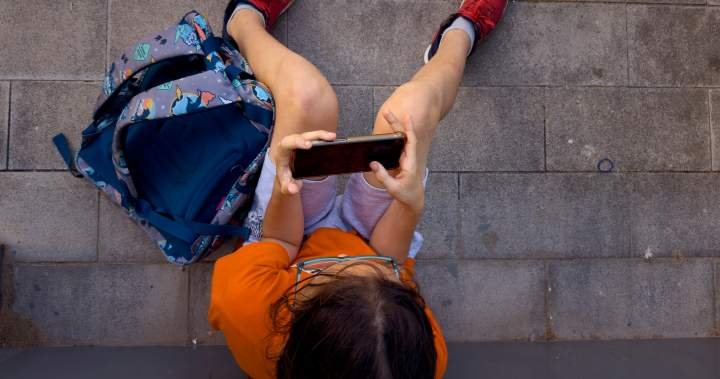
Since Australia became the first country to ban social media for kids under 16 years old in November 2024, it appears that Canadians say they would support a similar law here.
An Angus Reid Institute poll released Monday has found that “banning those under 16 from platforms would be well received by the vast majority of Canadians,” with three-quarters (75 per cent) say they support a “full ban on social media use for anyone under the age of 16.”
Among parents with kids in the household support is also strong at 70 per cent.
The number of those who would support a ban on social media for under-16s was highest in B.C. at 81 per cent and 77 per cent in Alberta. Support sat at 70 per cent in Saskatchewan, 72 per cent in Manitoba, 74 per cent in Ontario, 73 per cent in Quebec, and 76 per cent in Atlantic provinces.
A September 2025 Ipsos poll found an average of 71 per cent across 30 countries believe children under 14 “should not be able to access social media,” with 74 per cent of school-age parents feeling the same.
Twenty-five per cent of those surveyed also stated that social media is a “top challenge” for young people.
The Angus Reid Institute has also signalled a growing concern for children potentially being exposed to misinformation (92 per cent concerned), cyberbullying (90 per cent), explicit content (85 per cent), negative mental health impacts (94 per cent) and addiction (94 per cent).
In addition, surveyed Canadians believe that TikTok (88 per cent), X/Twitter (86 per cent), and Snapchat (84 per cent) should be the platforms that should be banned for those under 16 years old. Forty-eight per cent would ban kids under 16 from YouTube as well.


Get daily National news
Get daily Canada news delivered to your inbox so you’ll never miss the day’s top stories.
Despite these findings, there was no consensus among Canadians as to what age would be the right one for kids to have access to social media.
The age of 16 was chosen at “the highest rate,” by one-third (32 per cent); with near equal numbers say 10-12 (13 per cent), 14 (16 per cent), and 15 (13 per cent).
Nearly five million social media accounts belonging to Australian teenagers just a month were deactivated just a month after the country’s ban.
Since this decision, several Canadian provinces have expressed an interest in adapting similar legislature.
Premier Scott Moe has said his government is planning to ask people in Saskatchewan for their views on banning social media for children under 16.
Moe posted on X that “Canada should be considering options to limit social media use by minors.”
In addition, four Ontario school boards launched a $4-billion lawsuit against Meta, Snap Inc., which owns ; and ByteDance Ltd., which owns in March 2024.
In May 2024, five additional Ontario school boards and two private schools joined the lawsuit.
A release from the school boards and litigation firm Neinstein LLP allege that the social media products have been “negligently designed for compulsive use” and that the prolific and compulsive use of these products is responsible for “an attention, learning and mental health crisis” among students.
The school boards say they are facing “massive strains” on resources as a result, including greater needs for in-school mental health programming and increased IT costs, at a combined total of over $4 billion.
The Liberal party’s national convention set for April 9 to 11 is set to debate this topic.
On March 24, 2026, a New Mexico jury found that Meta, the parent of Instagram and Facebook “is harmful to children’s mental health and in violation of state consumer protection law” in a lawsuit brought by the state attorney general.
The jury determined Meta violated parts of the state’s Unfair Practices Act, based on accusations the company hid what it knew about the dangers of child sexual exploitation on its platforms and impacts on child mental health.
As a result, Meta was ordered to pay $375 million in civil penalties.
In addition, Meta and Google-owned YouTube were found by a jury in a first-of-its-kind lawsuit that their platforms were designed “to hook young users without concern for their wellbeing” on March 25, 2026.
The plaintiff testified at trial that she became addicted to social media as a child and that this addiction exacerbated her mental health struggles.
The jury determined that Meta and YouTube were “negligent in the design or operation of their respective platforms, “and that the negligence was a “substantial factor in causing harm to the plaintiff.”
The jury also determined each company knew their platforms could be dangerous when used by a minor and agreed that they “failed to adequately warn of that danger, further contributing to the plaintiff’s harm.”
TikTok and Snapchat were also named in the lawsuit, but both settled before the trial began.
With files from The Associated Press and The Canadi.
Read the full article here