





Those who have lived closely with police killer Dezi Freeman are not surprised he may have worn out his welcome with those helping to harbour him.
However, the violent end to Victoria’s largest manhunt has added a layer of sadness rather than a sense of closure to an already tragic situation for families, towns and a region in upheaval since the double murder last August.
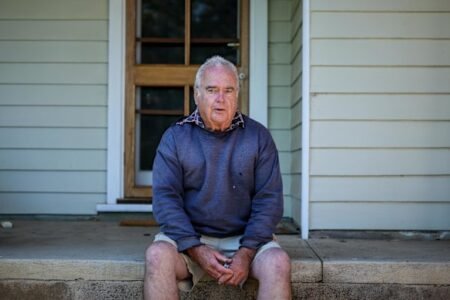
One of Freeman’s former landlords and friends, who asked not to be identified for his own security, said he was relieved the manhunt was finally over after months of fearing he might show up seeking shelter in areas he knew, or angry about past grievances.
“We lived those first couple of months never knowing where he was, but knowing he knew this area very well and that he could have been anywhere,” the former landlord said.
“Everyone is a lot more relieved around here.”
The former landlord was also not surprised that a couple who had been helping Freeman hide had become concerned at his recent behaviour, leading to his discovery on a remote Thologolong property. It fitted a pattern of behaviour that had seen the sovereign citizen repeatedly asked to move on from home after home across the region.
“They are trying to tell me that he just walked into some guy’s container – I find that hard to believe,” he said.
Jamie King lived next door to Freeman in Nug Nug for more than three years and believes he would have made life progressively more difficult for anyone harbouring him, though he wished his one-time friend had been captured alive to face court.
“He lived on my farm for over three years, and he never asked how I was – it was always about Dezi,” he said.
“He just got worse and worse. I think Dezi was his own worst enemy.”
Freeman family friend Leanne Boyd said few people in Porepunkah and Bright wanted to discuss Monday’s events, his death leaving a third family grieving and still no satisfactory answers on how things turned so tragic.
“Whether you say it’s justified or not, we live in a very peaceful country, and we’re not used to witnessing or being part of anything like this,” Boyd said.
Having seen Freeman’s behaviour deteriorate over recent years, Boyd said she believed he had underlying mental health issues that were mishandled or underestimated by police when they went to serve him with a warrant in August last year.
It’s not an excuse for what he did, but part of the complicated motives of Freeman and his family.
“It’s a very sad situation,” Boyd said. “They lost their dad, and someone lost their husband, and all respect to the police officers’ families because they lost their son, and a woman lost her partner.
“They [police] should have taken the mental health team with them to assist on August 26 – maybe that would have led to a better outcome for everybody, and maybe nobody would have died.
“We wouldn’t have three families grieving.”
Those still living at the Porepunkah home where Freeman set up his bus encampment and murdered Detective Leading Senior Constable Neal Thompson and Senior Constable Vadim de Waart-Hottart appear to be passing comment on the wild conspiracy theories that have since flourished, as well as ongoing tension with police.
Neither Andrew or Rebecca Swift, the owners, have commented since returning to the red-roofed farmhouse of Four Gully Farm, but a handmade sign on the newly repaired and reinforced security fence at the front includes a fictitious forwarding address for Freeman in South Africa – a reference to one of the more speculative theories floated about the fugitive, that he was hiding in plain sight in a Cape Town tourist strip.
The crude handwritten sign also references the Australian children’s classic Bottersnikes and Gumbles, illustrated by Desmond Digby.
The book is set deep in the Australian bush, and centres on environmental issues and conflict between the helpful and hardworking Gumbles and the angry, destructive Bottersnikes.
The sign lists Freeman’s address as being in “Wakefield” South Africa, a reference to Bottersnikes and Gumbles author Sydney Wakefield, or perhaps Cape Town-born anti-apartheid activist Sybil Wakefield, who lived in Adelaide.
The Swifts continue to list the rural property on a farmstay website, offering food and off-grid accommodation to farming volunteers.
In exchange for a stay in one of four “huts”, guests are asked to provide assistance with projects including building a chicken coop and sauna, as well as harvesting the farm’s produce.
In the “about me” section, Rebecca lists several interests, including music, cooking and “finding creative ways to subvert the current paradigm of planned totalitarian control. wink [sic] wink”.
“We are all on a journey to greater awareness of self, in connection with others and to our relationship with our Creator,” the couple wrote.
They also ask prospective guests to limit the use of perfumes, sprays, deodorants, make-up and sunscreen. “If used, these chemicals find their way into the soil and water, and in turn pollute our food and waterways.”
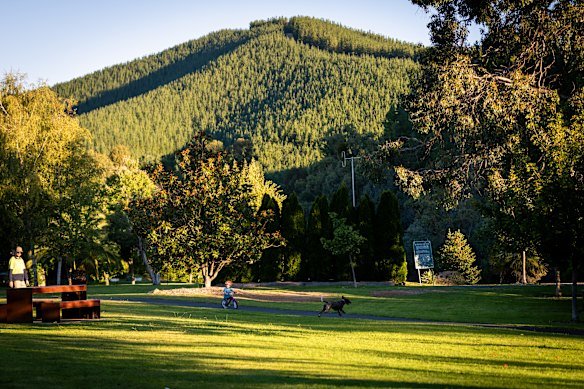
There’s no mention of the tragic events of last August. Perhaps like many in the previously sleepy hamlet in the shadows of Mount Buffalo, they wish they could forget.
Start the day with a summary of the day’s most important and interesting stories, analysis and insights. Sign up for our Morning Edition newsletter.


From our partners
Read the full article here