




In his analysis of the Middle East war’s effect on our economy (“War worse for the economy than floods or debt,” April 9), Shane Wright quotes an IMF report, which documents the economic costs but ignores the massive cost in human lives and the untold damage to infrastructure in Iran and its neighbours. We continue to be amazed at the timid criticism of the aggressors by our leaders. Neither PM Anthony Albanese nor Foreign Affairs Minister Penny Wong are forthright in their condemnation of Donald Trump and Benjamin Netanyahu, despite the immeasurable costs of their aggression. These two irresponsible leaders must be called out in no uncertain terms. Doug Hewitt, Hamilton
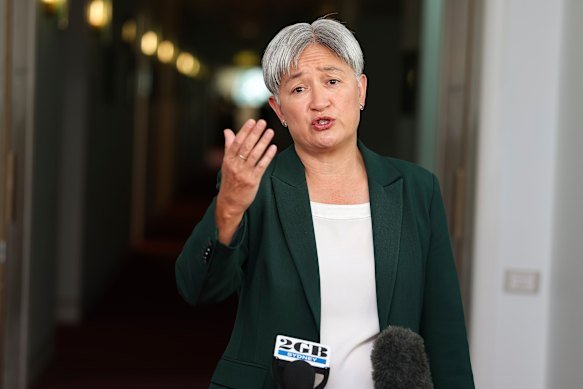
Penny Wong is “deeply concerned” about the bombing of Lebanon. It’s a step up from just plain concerned, which is DFAT’s usual response to a crisis. I have no doubt that the Foreign Affairs Minister is just as horrified, saddened and outraged as most Australians will be to this news. Just occasionally, could DFAT use words like this to convey the true horror of a situation? Children are dying, villages razed, a journalist killed and medical facilities damaged. Our reaction should be stronger than concern, deep or otherwise. Genevieve Kang, Glebe
It seems a three-sided cease fire may have been the better option (“‘Fragile’ ceasefire tested as Israel pounds Lebanon, Iran claims Strait of Hormuz closed”, April 9). Stephen Driscoll, Castle Hill
Two wrongs
No, David Crowe (“US president stands accused, but a chilling message exposes Iran”, April 9), the easy rejoinder to your claim that Iran is committing a war crime by arranging a human shield is not “to point to something worse elsewhere”, but rather to simply point out that a power plant is not a military target. Geoff Walker, Glebe
Trump’s threat to “destroy a civilisation” was matched by the Iranian regime’s threat to use their own people as human shields. Is there any limit to the darkness of which human beings are capable? Mark Porter, New Lambton
It’s quite obvious that regime change needs to happen (“A whole civilisation will die’ if Iran fails to make deal with US”, April 8), however, I’m doubtful President Trump will go willingly. John Bailey, Canterbury
Future-proofing fuel
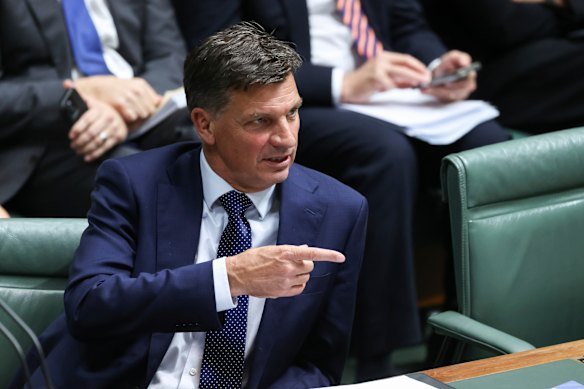
Angus Taylor’s call to scrap environmental regulations and drill for domestic oil is a poor solution to the wrong problem (“Why Australia can’t just drill its way out of a global crisis”, April 8). The basins he has named – Beetaloo, Taroom, Bass Strait – are either frontier prospects or ageing fields that would take a decade or more to yield meaningful production. They would not ease today’s supply shock by a single barrel. Worse, Australia’s refining capacity is so limited that domestically extracted crude would still need to be exported for processing and reimported as fuel, leaving the underlying vulnerability entirely intact. What Taylor is really proposing is permanently weakening protections against land degradation, water contamination and ecosystem damage in exchange for no near-term energy security benefit whatsoever. If genuine fuel security is the goal, the faster and smarter path is accelerating domestic renewable generation and storage – capacity that can be deployed in years, not decades, and that is immune to Middle East supply shocks entirely. Using a geopolitical crisis as cover to gut environmental law is not a strategy, it’s opportunism. Raj Kamath, Castle Hill

Australia cannot afford complacency when it comes to fuel security. We rely on petrol, diesel and jet fuel to sustain both our economy and our way of life, yet the public debate remains curiously narrow (“The fuel crisis is painful, but Australia has an advantage many don’t”, April 8). Attention is given to new oil reserves and refinery capacity on one hand, and to alternative energy on the other. Far less is said about improving the efficiency of ethanol production or expanding the recycling of industrial and food-based oils into viable fuels. No single solution is without drawbacks. That is precisely why a broader, more pragmatic approach is needed. If we are serious about resilience and greater self-sufficiency in an increasingly uncertain world, we should be investing in a diverse mix of fuel sources, not limiting the conversation to a select few. Energy security deserves a more comprehensive and less selective debate. Roger Hallett, Toowoomba (Qld)
Would it be naive to think that oil and gas producers love a good war (“Ceasefire brings hope of fuel relief for motorists”, April 9)? The speed with which domestic fuel prices rose with the outbreak of this Middle East war is most unlikely to be matched by an equally fast drop once hostilities cease. While we wait for ages for prices to fall, there will be mega-dollars of windfall profits going to many parts of the fuel supply chains, including Australian governments via increased LNG royalties and GST at the bowser. Do you reckon any of them are going to share this booty with us? Not likely. We mugs are the source of their bonanzas, not the recipients. Russ Couch, Woonona
Maintain a safe distance
Donald Trump, Pete Hegseth and their lot may have a cutting-edge 21st-century military at their disposal, but their culture and mentality are still in the Stone Age (Letters, April 8). For the modern, civilised, rules-based world, there must be no going back and no capitulating to their violence. These men are a serious threat to our future, particularly to women and anyone else of different race, colour or creed to their dangerous, phoney Christian manifesto. They will cause serious damage to us all before they’re finished. We need to get out of AUKUS immediately and distance ourselves from the US until order is resumed. Howard Charles, Glebe
Are Donald Trump’s threats to bomb Iran “back to the Stone Age” if it didn’t “open the f—in’ strait”, followed by his heinous statement that “a whole civilisation will die tonight”, going to be his supporting statements in his next submission for the Nobel Peace Prize? Alan Marel, North Curl Curl
Hate speech hysteria
If someone is found guilty of damaging property over the Big Banana graffiti incident it would be a fair cop (“Hate speech investigation after Big Banana vandalised”, April 9). But if someone is found guilty of hate speech, it would be wrong. Israel is a nation, not a religious group, and is engaged in a cruel blitzkrieg and the obliteration of civilians. Like many Australians, I am angry at the nation and especially its leadership, who seem to have lost their moral compass. A public expression of that anger via graffiti would not be my choice of expressing my opinion, but it is not hate speech. If convictions on this basis result it demonstrates the massive overreach of the legislation imposed by the Minns government. Peter Hull. Katoomba
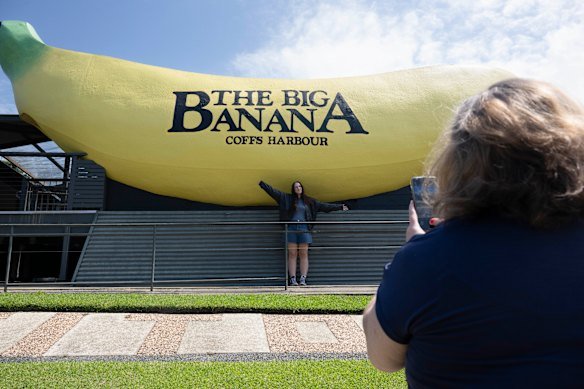
It’s difficult to understand how vandalising the Big Banana with anti-Israel graffiti constitutes “inciting hatred on the grounds of race” (“Hate speech investigated after Big Banana vandalised”, April 8). Israel is not a racial entity, it is a political state comprising a religious and ethnic composition of a Jewish majority and an Arab minority. If the graffiti had instead been “f— the USA” would it also be regarded as hate speech on the grounds of race? Stephen Foster, Glebe
The fact that graffiti on the Big Banana is being investigated as a hate crime is evidence that police have been flick-passed a can of worms. If “f— Greenland” or any other country had been used, would it be attracting the same level of attention? Neil Reckord, Gordon (ACT)
Silence is golden
With respect to Dr Carrie McDougall, it seems entirely appropriate to me that our PM would avoid commenting on the Ben Roberts-Smith case (“Albanese’s dodge over Ben Roberts-Smith tells the world we’re a Trump lackey”, April 8). This is in direct contrast to attempts by Donald Trump to influence and interfere in judicial processes in the US, and even to pardon convicted criminals. I am thankful for that. Another refreshing difference between our leaders was evident, when, at his recent National Press Club address discussing our oil supply, Anthony Albanese was asked to stay on for extra time to allow for every journalist with questions to be heard and answered. He did. Willingly. Respectfully. By contrast, Trump threatens, abuses and bans members of the US press. That said, it’s true that PM should be calling out America’s many abuses of international law, in Iran, Venezuela and Cuba. And then there’s AUKUS. Nell Knight, Avoca Beach
Thursday’s wide range of articles about Roberts-Smith and comments attributed to his various political and corporate supporters made for interesting reading, with some suggesting he should be given latitude because he’s a hero and it was war. I’d suggest that this type of thinking is a slippery slope. Let’s not forget that a wide range of witnesses, including a federal parliamentarian, gave evidence in the civil case, the Brereton inquiry and other administrative inquiries within the ADF. There’s also a plethora of government records that were part of all of those investigative processes. There is no harm caused to the ADF or the government by this case. Arguably it proves what a great place we have in Australia, where accountability matters. Remember that many other countries, like the US, have a system of no accountability, with many given pardons for serious offences/breaches. We don’t need or want that. Bernard Stever, Richmond
Once again, Anthony Albanese is choosing timidity over leadership, this time in relation to the arrest of Ben Roberts-Smith. Why can’t he just say “A war crime is a crime, and Australian defence personnel are not above the law. Mr Roberts-Smith will have the opportunity to defend the charges in court”? Tip-toeing around every issue in fear of causing offence to anyone seems to have become our PM’s standard response. Alynn Pratt, Grenfell
Diagnosis not the cure
As a practising mental health social worker, I enthusiastically embrace any attempt to deconstruct the latest societal trend to (over)diagnose middle-aged women with ADHD (“Think you have ADHD? Look at the people around you”, April 9). Such medicalisation of the challenges created by parenting and caregiving in tandem with full-time work and the lion’s share of domestic labour makes it easier to individualise the problem. Indeed, locating problems within an individual through the person’s own pathology is a time-honoured practice of avoiding cultural analysis and a critique of the social systems that affect us all. A critique of the social structures that may lead to high distress and a sense of distraction in women is just too hard, whereas an atomising approach that blames or diagnoses the individual is the handy path of least resistance. After all, if we understand individual challenges more systemically, then political change and more supportive social policies may be needed. Josie McSkimming, Coogee
Women struggling with work, families, households, ageing parents and more are seeking diagnoses of ADHD because they perceive that they are failing to meet their own and others’ expectations. So in the absence of appropriate support systems, rather than recognising that the struggle is real and their response understandable, they are provided a questionable diagnosis reinforcing the belief that they are the problem – they have a disorder that can be fixed with a tablet. It’s 60 years since the Rolling Stones sang Mother’s Little Helper: “And though she’s not really ill, there’s this little yellow pill … and it helps her on her way, gets her through her busy day”. I fear this will always be a woman’s lot. Carolyn Lucas, Grose Wold
Voters demand more
Perhaps Shaun Carney is correct (“The ‘major parties’ era is at an end”, April 9). My take on this is that more and more voters weren’t brought up in homes where parents and grandparents always voted for a particular party. Now, with universal access to the internet and social media, and ever-increasing immigration numbers, voters are not simply voting along traditional Australian family lines. The world has changed as new generations vote according to social issues. All political parties need to change with the times and not rely on past loyalties. Denis Suttling, Newport Beach
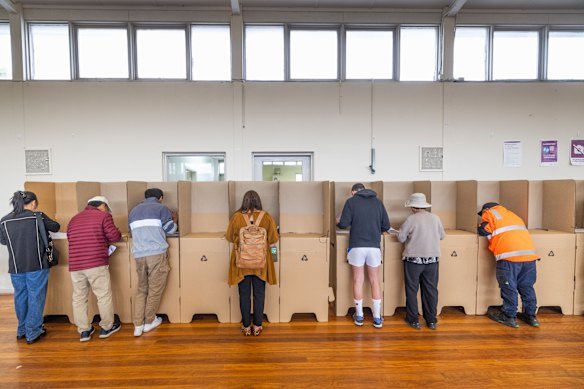
The surge in support for One Nation is not so much the result of disillusionment, more likely delusion. Bland, competent governments of both colours over many decades have cemented our fond belief that nothing can go badly wrong in Australia. But let a flaky outfit led by Pauline and Barnaby anywhere near the steering wheel, and we will get a form of US-style incompetence that will destroy any such complacency. A protest vote for One Nation risks an outcome we really shouldn’t wish for. Margaret Johnston, Paddington
Unmanned with a mission
Not to derogate the bravery and daring of the astronauts who travelled around the moon, but in the modern era, why was it necessary for this mission to carry any people at all? The cost of sending a fully robotic craft would have been massively less, plus there would not have been any toilet problems. Scientifically, it would have achieved the same outcome. Modern robotics can do whatever needs to be done without risking human lives and without “human error” being an issue. Doug Vorbach, Narwee
The communication to and from the astronauts and between other outer space stations is incredible (“Astronauts get chatty on far side of the moon”, April 9). Meanwhile, here on Earth you can find yourself in a black hole in the middle of the city if you’re trying to get the 5G fired up. Lisa Clarke, Watsons Bay
- To submit a letter to the Sydney Morning Herald, email letters@smh.com.au. Click here for tips on how to submit letters.
- The Opinion newsletter is a weekly wrap of views that will challenge, champion and inform. Sign up here.
Read the full article here