








When the report by Geoffrey Watson, SC, into corruption in the CFMEU’s Victorian branch had its title changed from Something Has To Change to Rotting from the Top, it became an ultimatum.
That ultimatum was about leadership. In identifying the eight factors that “wrecked the CFMEU”, Watson named three individuals: John Setka, Joe Myles and Mick Gatto.
Setka, as leader of the Victorian branch, defines an era of degeneration. Myles was given control over the branch’s civil work – transport infrastructure such as roads, bridges and tunnels – and, in Watson’s words, set out to “build a power base” with a view to one day succeeding Setka.
If “the Setka era CFMEU turned to looking after gangsters, standover men, bikies, heroin traffickers, and even killers”, as the report states, Gatto was the standover man-in-chief, who could (in his own words quoted again by Watson) “stop anyone doing anything” on construction sites in Victoria.
“It is important to record what went wrong as part of identifying the path for the process of correction,” the report rightly says.
At the beginning of this week, The Age knew that Mark Irving, KC, the administrator appointed by the Albanese government to overhaul the CFMEU, had removed two sections of Watson’s report before it was submitted to a Queensland commission of inquiry into the union’s activities in that state.
The sections related to what Victoria’s political leaders knew about the massive corruption and criminality on the state’s Big Build and how much it is likely to have cost our state – a number Watson put conservatively at $15 billion.
When our investigative reporter Nick McKenzie wrote to Irving to ask him about removals, the deleted sections were abruptly supplied on Tuesday evening, with the explanation that “the administrator … was not satisfied that they were well-founded or properly tested”.
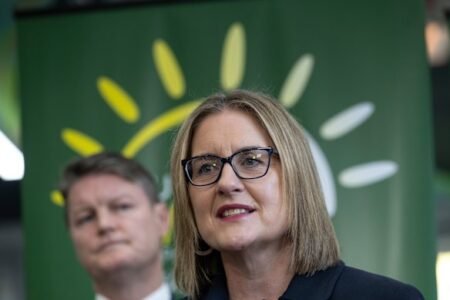
During her disgraceful press conference at the Murdoch Children’s Research Institute on Thursday, Premier Jacinta Allan once again relentlessly stonewalled over the extent of her knowledge of CFMEU corruption and criminality before mid-2024. From that point on, we are told, there was zero tolerance; before that, it is implied but never stated, there was zero awareness.
It’s not a credible position.
In the stripped section of his report, Watson states: “As early as 2010 [The Age] and the ABC were reporting that crime intelligence linked building industry corruption to bikie gangs, the narcotics trade and the CFMEU. If the press knew, then the public knew. If the public knew, then the government must have known.”
Watson’s report states that the links between the union and organised crime were turbocharged by the rise of Setka from 2012 onwards and the launch of Labor’s Big Build in 2015. One experienced person in the construction sector told Watson: “All of a sudden there was too much government money, and too many really big jobs. There was a shortage of labour and the CFMEU had all the negotiation power and, from that, too much power generally.”
In the section stripped from the report by Irving, Watson states that Victoria’s Labor government both “knew and had a duty to know” that corrupt union and underworld forces had infiltrated its signature Big Build infrastructure scheme, but chose to do “nothing about it”.
The Big Build was Victorian Labor’s big-ticket vote-winner. Asked by the Queensland inquiry to explain inaction over the massive corruption of that program, Watson speculated that the Victorian government “just wanted to get the projects finished”, and the only way to do so was to “keep the CFMEU on side”.
As Watson states in the abridged version of his report: “This was a uniquely Victorian problem … the problems in Victoria were exponentially worse and far more dangerous than elsewhere.”
That is precisely why there must be a uniquely Victorian inquiry into what was known and who knew it. Why is it that the police, who are now arresting CFMEU figures and their associates, were “dormant” (Watson’s word) for so long?
Watson repeatedly calls for “an investigation supported with coercive powers”. On Thursday, that call was backed by the general manager of the Fair Work Commission, Murray Furlong. Like Furlong, The Age believes “Victorians have a right to know”.
This would be not just an exercise in writing a history. As The Age reported this week, only last month there were firebombing attacks linked to construction and an alleged attempted extortion by a bikie with strong Big Build heritage. This is an industry far from free of its criminal cancer.
The chief obstacle to transparency is the person who served as minister for transport and infrastructure in the first two terms of the Andrews government, the politician in the hard hat on countless Big Build site visits and media appearances: Jacinta Allan.
In her Thursday press conference, Allan invoked the independent review by Greg Wilson that she commissioned, a review Watson has already characterised as functioning as a cover-up because (through no fault of Wilson) it was not empowered “to go inside the doors of the senior bureaucrats and actually into the ministerial offices in Spring Street”.
Allan also had the temerity to use the removal of the $15 billion figure from Watson’s report – a figure Furlong told a Senate committee in Canberra he regards as credible – to argue “that claim, of any amount, has not been well tested or properly founded”.
At a time when Victorian taxpayers are seeing cuts and delays in health and education and the state’s debt continues to spiral upwards, the suggestion that it somehow falls to administrator Mark Irving to decide whether billions (or “any amount”) of public money ended up in the coffers of crooks is breathtakingly dismissive even by Allan’s standards.
If the premier prefers a well-tested number, as surely Victorians deserve, she needs a properly founded inquiry with coercive powers.
If she doesn’t, she fails this significant test of leadership and will be rightly judged harshly.
Start the day with a summary of the day’s most important and interesting stories, analysis and insights. Sign up for our Morning Edition newsletter.


From our partners
Read the full article here