





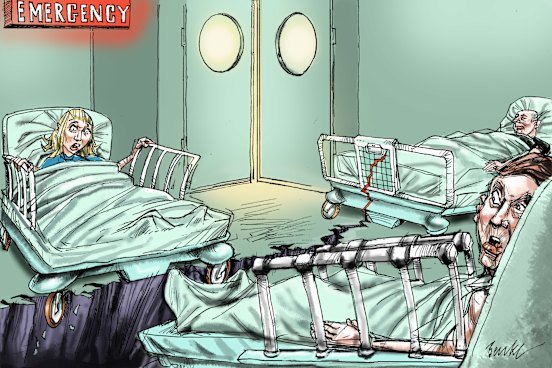
There are few certainties in life, but this is one: what unfolds in Victoria’s hospital system this week will read like an Oscar-winning script from a medical horror film. It always does.
The sharp end, the area that exposes the entire hospital dysfunction, is the emergency department, where people admitted because of threat to “life or limb” are being wheeled into a medical version of a chaotic street market.
Essentially, it’s happening in secret. Those who see the horror and have ideas to fix it are not allowed to talk about it. They’re gagged.
Staff are being abused and bashed, patients are suffering and probably dying when they need not die, and corridors are at times jammed with beds with sick people getting sicker as they wait up to 24 hours to go to a ward.
Victoria’s auditor-general 11 years ago found health workers faced an “unnecessary and preventable” risk of violence in the workplace. Staff say it’s only escalated.
Recently, a young female psychiatrist was badly bashed by a patient, a senior doctor was bitten several times and a nurse was kneed in the face and had clumps of hair pulled out. Imagine if that was happening to building workers.
It’s common. This system has been disintegrating for years as politicians and administrators seem more worried about political window dressing than solutions.
But senior doctors have now urged whoever wins the state election to launch a staff-led review and re-organisation.
The good news is it can be improved, possibly without mortgaging whatever the government has left to mortgage.
The experienced staff who work in this cauldron of human misery have fresh ideas and different strategies which they believe could turn the horror show into a less horrible version.
The bad news is they believe nobody is listening because they are not trusted to speak publicly.
All public hospital contracts carry the gag clause.
So we trust them to massage a human heart, or decide when to stop resuscitation and allow death to come, but we do not trust them enough to allow them to speak with balance and common sense to the people who have a right to know – the Victorian public.
Over recent weeks, I have spoken to emergency doctors across the state. The Age has agreed to their anonymity as whistleblowers so their concerns can be made public.
Hospitals cannot be named. The doctors are all emergency physicians but not part of any organised protest group.
What they say exemplifies deep professional frustration. They aren’t playing politics. They want change.
A long list of horrible incidents has been provided. It shows care compromised, avoidable injuries and health complications rising because the system doesn’t work well enough.
All doctors quoted research that showed the longer a patient is delayed in ED the more likely they are to die or spend longer in hospital.
‘With the increasing daily violence, somebody will die. And all we get are reports, words and more words.’
Anonymous worker in a Victoria’s hospital
Some of those horror examples are below. First, a series of anonymous comments from various medical staff who should not have to be anonymous.
On the chaotic system: “It is like the Boxing Day sales every day – everybody is scrambling for what they want.”
“We raise Lazarus with ECMO treatment [a sophisticated life-support system] by the roadside for sudden cardiac arrest but the same day the system seems to tolerate the 86-year-old frail and frightened grandmother lying on a trolley in an emergency department for 16 hours as she waits for a bed in the ward.”
“You don’t ask people to ride on the roof of a train but that’s the equivalent of what we are doing with the most vulnerable and sickest people.”
On the violence: “With the increasing daily violence, somebody will die. And all we get are reports, words and more words.”
“During one shift we had 10 code greys [violent and dangerous patients or family] and one code black [involving a weapon]. We had seven police and five security in ED.”
On the impact for patients: “Patients in ICU will be determined as ‘ward ready’ but there’s nowhere to go so they stay in ICU. So the critically ill patient in ED stays there waiting for an ICU bed.”
“We put mental health into the general system 30 years ago and never provided the resources. Look at it now and [we] say, ‘What the f— were we thinking?’”
“It’s getting worse – people are getting sicker, expectations of treatment are greater, we are too scared not to treat people. We need a more holistic view. Why put a pacemaker in a 99-year-old with comorbidities?”
“It’s common to have 40 to 50 patients waiting with all beds in the department occupied.”
“It’s common to have people into their 90s waiting almost 24 hours in ED for a ward bed.”
On consultation: “We should and can do better. We need honest conversations and encourage somebody to listen.”
“We are not allowed to talk. But if you see something wrong you should speak up about it.”
“We call it access block rather than bed block. It is a whole hospital problem.”
There’s a different culture among emergency doctors. They embrace challenge. They have a social conscience and will plug systemic gaps others may not.
We could fill pages with the horror stories they tell. Sadly, you’ve heard examples from distraught families before.
Like the psychotic woman, aged early 20s, physically and chemically sedated. Waits 16 hours for a bed in the psychiatric ward.
‘It’s common to have people into their 90s waiting almost 24 hours in ED for a ward bed.’
Anonymous worker in a Victorian hospital
Or the 85-year-old with dementia and pneumonia. No ward bed available. Wanders around, disturbs a mental health patient who has to be sedated and restrained. The pneumonia patient falls over and breaks a hip.
Cancer patients, immune compromised, waiting for hours on trolleys in the corridor as every manner of potential virus wanders past. It happens often.
An elderly man, bedridden, with gastro problems. On a trolley for hours. He can’t reach his water or get out of bed to toilet. Staff are too busy to monitor him properly.
There are ways to improve this mess and these are the people who see answers. But they say serious staff consultation seems a dream. One suggested setting up mobile medical teams to attend urgent cases in nursing homes, so the patient doesn’t occupy a bed in the major hospital.
Another idea is so simple it seems incredible it doesn’t exist: establish a computer system which allows the emergency ambulance to communicate patient details to the hospital while en route.
And another most would assume was already in place: there is no universal emergency medical register for patients, which can be quickly accessed when they arrive at hospital.
All doctors warned that computer connection between hospitals desperately needs streamlining.
Some want a dedicated system and purpose-built area to handle mental health and aggressive drug-affected patients.
One suggested body-worn cameras for doctors so offsite specialists can see the injuries and consult remotely.
The technology is the easy bit. Industry has been using it for years but hospitals seem stuck in another era.
The ideas are there and so is the crisis.
One doctor said ED problems were causing increased medical errors, higher in-patient mortality, longer bed stays once patients were admitted and difficulty getting staff.
Another, almost pleaded: “The system is no longer fit for purpose. It’s unsafe and under-resourced. It needs fixing. This is the chance to do it. First they need to listen.”
Neil Mitchell is a broadcaster and podcaster.
Get a weekly wrap of views that will challenge, champion and inform your own. Sign up for our Opinion newsletter.


From our partners
Read the full article here