






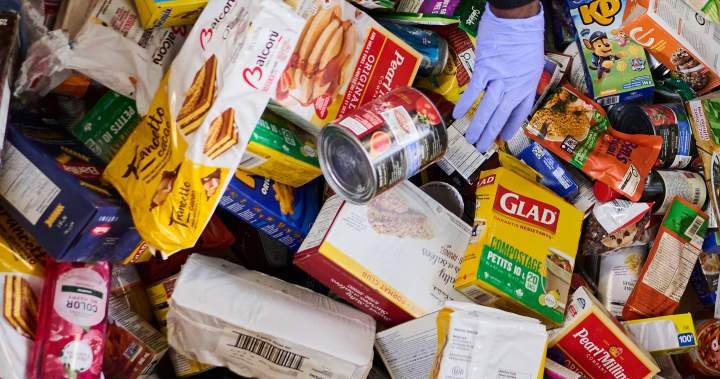
Health officials in southwestern Ontario are raising concerns that household food insecurity is rising across the region due to not enough access to food because of financial struggles.
The joint statement from five health units says one in four households in the region struggled to access food in 2024, the most recent year for which data is available. Families had to decide between paying rent and buying groceries due to increased housing and living costs, the units note.
“More people across our region are being forced to make difficult choices about which basic needs they can afford — and too often, food is one of the first things cut,” Dr. Ninh Tran, medical officer of health for Southwestern Public Health, said in a statement.
The percentage of households that were food insecure ranged across Southwestern Public Health, Grey Bruce Public Health, Middlesex-London Health Unit, Huron Perth Public Health and the Windsor-Essex County Health Unit. But the overall average for the region sat at 25.3 per cent.
Jennifer Proulx, director of family and community health for the Middlesex-London unit, told Global News that number is even higher for her area, with approximately 30 per cent of residents dealing with food insecurity.


Get weekly health news
Receive the latest medical news and health information delivered to you every Sunday.
“For families, it really means making impossible decisions around essential expenses,” she said. “We’re seeing rates of food insecurity increase quite significantly over a fairly short period of time.”
The data from Public Health Ontario also shows that food insecurity rose in all five health unit regions in 2023-24 compared to the year prior, with some increasing by as much as five to 10 per cent.
With increased rates, the health units are urging action by governments, including an increase to social assistance rates such as Ontario Works, improved income supports for low- and modest-income homes and policies that reduce the cost of housing and essential expenses.
“Local trends show that affordability is becoming more of a challenge, leaving many households struggling to keep up,” said Dr. Miriam Klassen, Huron Perth Public Health’s medical officer of health, in a statement. “Long-term solutions will require a focus on income and financial stability.”
An example of the impact food insecurity can have is how much money a family of four on Ontario Works uses a month, Proulx said. Each month, the family would receive about $2,994 a month.
“If we allocate $1,877 a month for rent and $1,196 for groceries, so for the whole month that family is already in a deficit of about $80 and they haven’t paid for internet, phone, transportation, clothes,” she said.
Those numbers, she noted, were based on average local costs in the Middlesex-London region.
The joint statement from the health units also showed a single adult receiving Ontario Works in southwestern Ontario could face a monthly deficit ranging from $301 up to $859 depending on the location.
But Proulx said food insecurity should not be considered a “personal failure” or inability to budget.
“It really is a math problem where people don’t have enough income to pay for all of the essential things that they need to live based on their rent and their food, or they’re having to make impossible decisions,” she said.
“It needs income-based solutions to address it.”
Read the full article here