






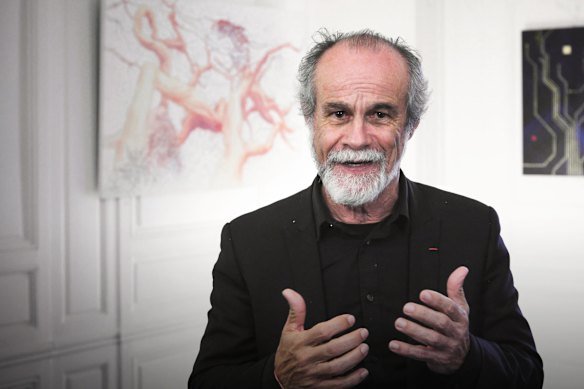
Carlos Moreno is used to defending the idea of a 15-minute city.
His radical idea of bringing work, schools and essential services within a short walk of every resident has been widely adopted around the world, but it has also been weaponised by online agitators as a blueprint for government surveillance and criticised for embedding inequality.
The French academic is undeterred and believes it might just be the essential, urgent prescription needed to fix Melbourne’s housing crisis.
Moreno developed the concept a decade ago as a means to a low-traffic, low-carbon future, but he says it is as relevant as ever as a way to address housing affordability and make Melbourne’s fringes more liveable.
“People pushed into living far away have difficulty accessing the local services, medical services, cultural activities and educational services,” he says over a video call early in the morning from Paris, where he lives. “For this reason the 15-minute city is an amazing opportunity for transforming radically this situation.”
Moreno and former New York City mayor Bill de Blasio are two of the keynote speakers at The Age’s upcoming Melbourne Assembly, which will be held in October.
Melbourne Assembly will bring together some of the world’s brightest minds across city planning, innovation, education, arts and sport to discuss ideas for Melbourne’s future.
What is a 15-minute city?
Moreno, who teaches at the University of Paris 1 Panthéon-Sorbonne, coined the phrase “15-minute city” in 2016, and it was embraced by a group of nearly 100 mayors worldwide as a way to help recover from the COVID pandemic.
A 15-minute city is a principle that everything you need should be within 15 minutes’ walk of your home – schools, shops, libraries, parks, transport, job opportunities and healthcare. The idea is that a network of 15-minute cities provides inhabitants with easy access to everything they need.
If you live in a city, how long does it take you to get to a supermarket? What about a pharmacy or a school? For adherents of the 15-minute-city concept, the answer to all those questions should be “less than 15 minutes” – and it should not involve a car journey.
The actual timeframe is slightly fluid: 15-minute cities are also referred to in urban planning speak as 20-minute neighbourhoods, and Copenhagen trumped everyone with a “Five Minutes to Everything” model.
The concept has provided inspiration to the City of Melbourne and the Victorian government, which implemented “20-minute neighbourhoods” in its statewide planning and development strategy Plan Victoria.
“We have a global movement for implementing this idea, reducing the role of individual cars, preserving biodiversity, developing a more vibrant local economy and developing a new economical geography,” Moreno says.
Moreno says the lack of affordable housing near services, jobs and retail hubs makes the need to shift to 15-minute cities even more urgent.
“The housing crisis is not only in the Victorian state, the question of the housing crisis is a worldwide crisis,” Moreno says.
Melbourne’s urban challenge
Moreno devotes a chapter of his book The 15-Minute City: A Solution To Saving Our Time And Our Planet to Melbourne, referring approvingly to it as a “pioneering” 20-minute city.
However, even Moreno concedes Melbourne’s sprawling suburbs and large “McMansions” are a barrier to creating walkable neighbourhoods.
He says a mindset shift is needed to move from focusing on the importance of individual homes to prioritising sociability instead with higher-density living.
He wants to see more apartments where residents spend more time out and about at libraries, local shops, cinemas and theatres instead of in cars commuting to their jobs from large homes in the outer suburbs.
“We need to develop this new kind of social infrastructure for offering these new kind of services,” Moreno says. “This is today one of the rules for transforming our cities. We need to densify because the presence of the massive individual homes represent a relevant cost for us collectively.”
Moreno points to the high infrastructure cost of building in greenfield outer suburbs where roads, public transport, sewerage and power all need to be installed.
It’s an argument the Victorian government has deployed in designating 60 activity centres across Melbourne – including areas such as Camberwell, Brighton, Ringwood and Frankston – where it is seizing local planning controls.
In these zones, the government controversially allows developers to bypass local councils to build high-density apartments up to 20 storeys.
Moreno says he supports more development around transport links such as train stations because it helps reduce car dependency, which causes traffic jams, contributes to pollution and reduces physical activity.
“We need to transform these places, we need to densify,” he says. “Low densification was the lifestyle of the 20th century, this is no longer possible in the 21st century.”
Conspiracy theories and death threats
Moreno’s work has attracted opposition including from what he calls “conspiracy mongers” who are concerned that 15-minute cities are really designed to restrict people’s movements so they can be better surveilled by the government.
Some claim 15-minute cities represent the first step to open-air jails where residents will not be allowed to leave their prescribed area.
Moreno has received death threats and has been told that he wants to “integrate a permanent lockdown” and to “require people to have a chip for controlling their movements”.
He says the best argument to rebut the conspiracy theories is reality.
“Visit the city of Paris,” he says. “We don’t have that constraint. We have 1200 kilometres of protected bike lanes, we have local shops.”
Moreno says 25 per cent of housing in the city is social housing and fewer than 20 per cent of Parisians own a car.
Other critics of 15-minute cities are concerned it could lead to further social segregation with wealthy residents ensconced in prosperous enclaves.
Harvard economist Edward Glaeser describes the concept as a “dead end” in a 2021 post for the London School of Economics and Political Science, warning that it would exacerbate the “enormous inequalities in cities”, creating ghettos without connection.
Moreno counters that the housing crisis has been driven by increasing gentrification, with rising house prices already creating social segregation.
“The question of the housing crisis is a question of the social housing crisis,” he says. “At the centre we need to deploy an ambitious social housing policy.”
Moreno says social housing is not just the responsibility of government and the private sector needs to be involved as well.
He may be surprised when he visits Melbourne in October to find the government in the process of tearing down public housing in some of Melbourne’s highest-density neighbourhoods.
While Melbourne has enthusiastically embraced the idea of a 15-minute city, it has proved more difficult to adopt in practice.
Melbourne Assembly will be held from October 19 to October 21. More information is available on the Melbourne Assembly website, including special offers for Age subscribers.
Read the full article here