






The federal Liberals say they’re getting a windfall from better-than-expected fiscal revenues and are largely putting that money back into circulation to support households and build up the economy.
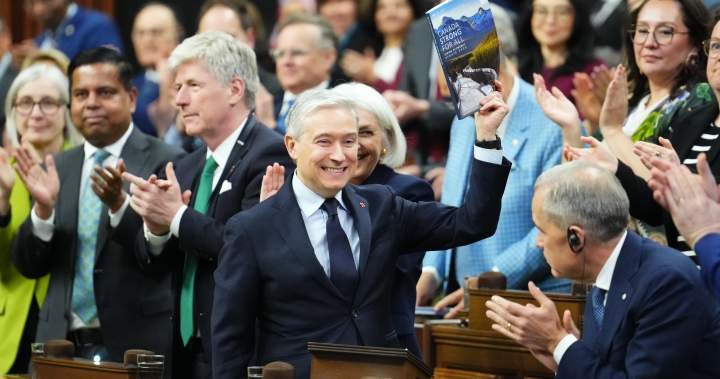
Finance Minister François-Philippe Champagne on Tuesday tabled Canada Strong For All, a mid-year fiscal update that includes $54.5 billion in new costs and spending since Budget 2025.
Improved revenues and reduced expenses elsewhere mean the spring economic update includes $37.5 billion in net new spending.
The Liberals now estimate last year’s federal deficit came in at $66.9 billion, more than $11 billion short of the $78.3 billion forecast in the 2025 budget, thanks largely to improved economic performance and some lapses in planned spending.
Deficits for this and future years will also be marginally smaller than forecast — and would be sharply lower if not for a jump in planned new spending.
Spending since the fall budget is led by the already announced temporary boost to the GST benefit, soon to be renamed the Canada Groceries and Essentials Benefit. Costed at $11.8 billion over five years, increased payments start with a 50 per cent boost to the benefit slated for June 5.


Get daily National news
Get daily Canada news delivered to your inbox so you’ll never miss the day’s top stories.
The federal government’s roughly four-month pause on the fuel excise tax, announced earlier this month, is the other top-line affordability item added to Ottawa’s books.
Heading into the spring economic update, federal Conservative Leader Pierre Poilievre called on the Liberals to slash spending and get the deficit back on a path to balance.
Ottawa’s planning horizon now sees the deficit shrink to $53.2 billion by 2030-31, but there is no plan to present a balanced budget.
In the spring update, the federal government sticks to its fiscal anchors of a declining deficit-to-GDP ratio and a balanced operating budget in the next three years.
The federal debt-to-GDP ratio — previously a fiscal anchor under former prime minister Justin Trudeau’s government — is projected to rise modestly but remain broadly stable over the government’s planning horizon.
$66.9 billion: Projected deficit for 2025-26, $11.5 billion lower than the projection in Budget 2025. The government predicts the annual deficit will decline to $53.2 billion by 2030-31.
$37.5 billion: Net cost of new measures included in the spring economic update over six years. The government says 45 per cent of that spending is for measures to address the cost of living and the housing shortage.
$7.2 billion: Average annual increase in federal revenues over previous budget projections.
$31 billion: Increase per year in level of nominal GDP over 2025-2029, compared to projections in Budget 2025.
$6 billion: The sum to be invested over five years in Team Canada Strong, a strategy to recruit and train 80,000 to 100,000 new workers in the skilled trades to boost housing, infrastructure and resource development and construction.
10.2 per cent: Canada’s net debt-to-GDP ratio, which the government says is considerably lower than the G7 average of 101.8 per cent.
$25 billion: The seed money Ottawa says it plans to invest to kick-start the Canada Strong Fund — even though the spring economic update doesn’t say where the money is coming from.
Zero: The number of opposition votes the Liberals need to pass the spring economic update, thanks to their new parliamentary majority.
Read the full article here