





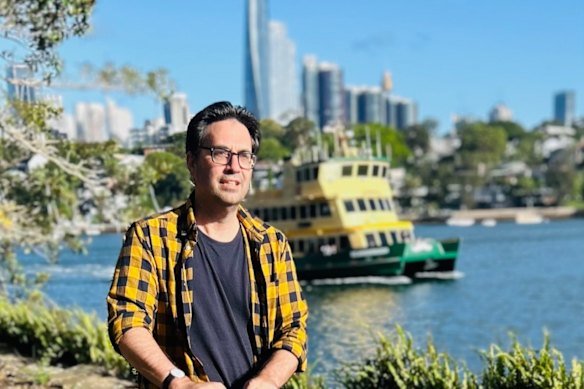
I’m not born and bred. This fact alone means that, in the eyes of many Balmain lifers, I’ll never truly be regarded as a local. But I’ve been here long enough that I now find it impossible, at the tail of a long evening, to sit on the Balmain ferry and not feel a rushing sense of homecoming as the vessel hums past Goat Island and points its bow towards the warm, twinkling houselights of Mort Bay.
This is the second time I’ve written about Balmain for the Herald, which, for someone who never thought of themselves as especially parochial, feels like two times too many. But it turns out that even the most outward-looking people have indelible attachments to their home. Indeed, the older I get, the more I suspect that our worldview – far from being informed by op-eds in The Guardian or podcasts by Karl Stefanovic – is mostly forged on our local streets; such as on the morning after bin night, when the kindest of neighbours mount search-and-rescue parties to locate all the bins that have been inexplicably strewn across five separate blocks.
I guess this is what people mean by community: that hackneyed, syrupy term that’s more or less been rendered meaningless by politicians. But Balmain really does feel like a community, as if every resident belongs to the same secret, slightly smug club. It’s a symptom of living on a peninsula, I think. Nobody enters a cul-de-sac unless they’re comfortable with the possibility that they won’t ever leave.
Of course, Balmain isn’t perfect. But its imperfections are largely what give its residents their sense of purpose: there’s always something to complain about, to oppose, to petition against, and to mourn. This kind of outspokenness – indeed this strong sense of guardianship – only comes from having a place that’s worth fussing over in the first place.
And even non-residents would agree: Balmain is worth fussing over. It’s a rare waterfront suburb that sits on a part of Sydney Harbour where tugboats, barges and ferries still happily outnumber super yachts. These working vessels give enormous succour to the scores of politically progressive millionaires who now call Balmain home, and who comically like to tell themselves that they’re living in a working-class suburb.
The area’s origin story is a huge part of the romance. A historic enclave of sandstone inns, shipyards and boozers, Balmain is the place where grog and ideals once combined to help give birth to the labour movement. It remains a proudly left-leaning electorate, even if political chats these days are more likely to be fuelled by fiano than beer, and even if the topics of choice centre less on workers’ entitlements and more on the deteriorating diction of ABC radio presenters.
This new breed of resident isn’t blind to the paradox that their presence creates, where the old-world charms that drew them to the area now risk being eroded by their own new-world affluence. Gentrification is a delicate dance in these parts: something that’s both openly resisted and secretly welcomed, often by the same people. Perhaps nothing better encapsulates the area’s difficult relationship with change than the fact that Balmain’s swankiest and longest-running pub takes its name from the actual dry dock whose 1850s workers would probably fall off their bar stools if they saw that a caviar station now sits where once there was a dartboard.
In Balmain, everything comes back to the pubs. People are fond of saying that Balmain has more pubs per square metre than any other suburb, but I’m not actually sure that’s true any more. If it has a claim to fame these days, it might be for its record number of Teslas, or its concomitant Tesla contrition: both are at stratospherically high levels. Bakeries are another big feature. Indeed, it can’t be long before the area’s famous pub crawls give way to patisserie crawls, where visitors are challenged to down a pain-au-chocolate at every high-end pastry shop on Darling Street. Sure, you still can’t find a restaurant in Balmain that’s open after 9pm, but you can find at least 12 bakeries open at 5am, ready to sling you a salted caramel cronut.
Bakeries, optometrists and chain-outlet pharmacies: this is the Balmain of 2026, built to meet the needs of the suburb’s newly diverse population that runs the full gamut from English expats who work in finance all the way to English expats who work in insurance. According to population data I unearthed from Balmain Library, the only demographic that now outnumbers English expatriates is cavoodles.
Indeed, dogs, generally, are everywhere. Perhaps they need them to run all the bakeries. My wife and I used to joke that residential entry into Balmain must be conditional on having at least one dog and one baby – and preferably both. Finding ourselves with neither, we became increasingly concerned that the council might try to evict us; so we madly rustled up a baby just so we could stay.
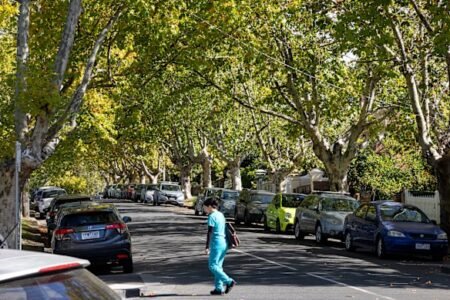
And I’m so glad that we did. In my daughter’s first few weeks, I took her on long walks in the pram through the suburb that I love; down all my favourite streets lined with dollhouse workers cottages, sandstone churches and weatherboard charmers. It’s quite a thing to introduce someone to their new home – to their community. And even if she spent most of those walks in a deep infant sleep, I knew that she was already a better local than I’ll ever be … because she was born and bred.
Chris Taylor is a writer, performer and broadcaster.
From our partners
Read the full article here