




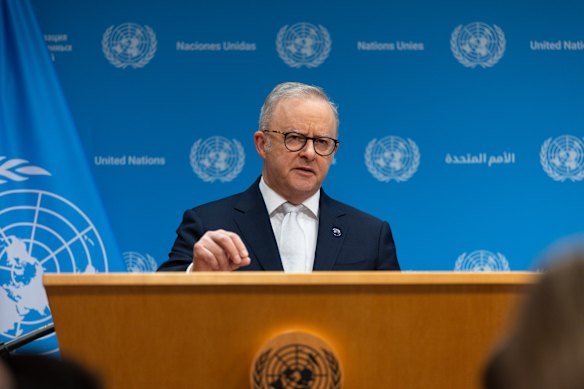
What does Australia hope to achieve by taking a seat on the United Nations Security Council (“PM takes AI fight to UN as Australia launches bid for Security Council”, September 21)? Is there something Australia can do to achieve world peace that can’t be done by another middle power, or is it just window-dressing to enhance our international image? In July, Australia failed to support a resolution of the UN Economic and Social Council regarding the living conditions of Palestinians in Gaza and the occupied territories. Supporting that resolution would have been a good start to justifying our right to be on the Security Council. Ian Adair, Hunters Hill
Anthony Albanese’s call for the UN to place restrictions on the US-China race for dominance in artificial intelligence could not come at a more opportune time. But even more urgent, as AI shows signs of being able to rapidly spiral out of control, placing AI under a rule-based order akin to the Nuclear Non-Proliferation Treaty is a top priority. The treaty can act as a blueprint for the UN to bring AI under some form of control. There are no winners in a nuclear arms race, and nor in an AI race between the US and China. Vincent Zankin, Rivett (ACT)
Hearing Albanese yet again say AI must not be allowed to control humans had me thinking more ironically. Assuming AI can seek out the best knowledge, facts, data, science and information, free from religious and other dogma and ideologies, and free from corrupt media, political and financial influence, then it should start to address all the failings of our politicians and keep at bay all malignant vested interests. We may yet counter the environmental apocalypse we currently face and start making the best decisions for the sake of humanity, all other life species and the planet. But then I remembered it’s those same politicians and billionaires/trillionaires who will do/regulate the programming. Howard Charles, Annandale
Nuanced numbers
Oh, that it was as simple as just setting the total number of immigrants (“Labor must remain above the chaos, or be consumed by it”, September 21).
The Coalition says it will cut the number of immigrants by a certain amount. One Nation targets another number. And, in setting that number, each has an eye to the availability of housing and the needs of business, agriculture and universities. But as Sean Kelly explains, and as Tony Burke indicated in his speech last week, it is much more nuanced than that. There is the mix of visa types. There are the categories of certain immigrants like families, backpackers, international students, et cetera. There are the economic impacts, both globally, in the regions, and the particular businesses where immigrant workers are needed. There are the ages of immigrants to consider. And there are connections to other policy areas. Focusing on a single total number is not taking this issue seriously. David Rush, Lawson
Sean Kelly highlights the policy mendacity of an opposition desperate to stave off One Nation. A rampant, ignorant One Nation peddles the policies of fabulists and conspiracists. A government “seeking to ground the overarching political narrative in a sense of seriousness” struggles against the purveyors of snake oil . Across the globe we see those permitting ignorance are empowering it; can we avoid the same fate? Wayne Duncombe, Lilyfield
Dispel this fog of war


Former prime minister Ehud Olmert’s criticism of Israel’s refusal to prosecute Zomi Frankcom’s killers (“Ex-PM blasts Israel’s failure to act on Frankcom killing”, September 21) creates an opportunity to dispel the fog of war that shrouds this brutal incident. Many share Penny Wong’s outrage at Israel’s decision “not to pursue criminal charges against those responsible”.
If Israel is convinced of its soldiers’ innocence it has nothing to fear from an independent investigation. What it does fear, as evidenced by its long-standing ban on international journalists reporting from Gaza, is scrutiny of its crimes against humanity there. Olmert’s call for accountability could achieve two welcome outcomes. One, some measure of justice for the whole population of Gaza, living and dead. And two, consensus that criticism of Israel is not inherently antisemitic. Tom Knowles, Parkville (Vic)
America’s tax benefit
American counties have one advantage over Australian communities regarding data centres (“Data centre capital counts cost of golden goose”, September 21). They collect local taxes that can be ploughed back into the community. Australia sees only a perceived glow from the international spotlight as we hand over precious resources and devastate communities.
There is no compensation for the huge social, environmental and financial costs that are shouldered when data centres come to town. The government can’t even find adequate resources to accurately monitor their emissions, analyse their wastewater and protect our communities and rivers. Elizabeth Darton, Lane Cove West
Three into one doesn’t go
There are still people in the NSW public service with a sense of humour (“Schofields flagged as key metro hub”, September 21). Extending Sydney and Western Sydney Airport metros to Schofields brings together at one station Sydney’s three incompatible commuter railway systems. Before 2011, we had technology upgrade paths that resulted in compatibility. Business cases, reviews by federal public servants and state-commonwealth city deals led to expensive, poor-value projects. In the 19th century, with parliamentary committees leading the development of transport networks, we got a network development strategy closely tied to economic objectives, and a 74per cent reduction in the cost per mile of railways. We can’t address unaffordable housing, stagnant productivity, migration, the environment and economy without access strategies for all of Australia. Peter Egan, Adelaide (SA)
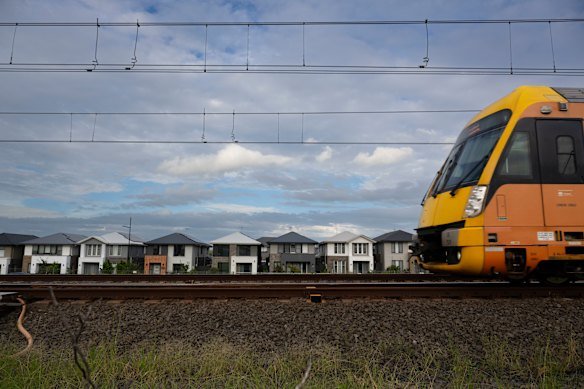
Metro extensions sound worthy as housing development in the outer suburbs spreads. Simultaneously high-rise development is being fast-tracked around existing Metro stations. Meanwhile, there are no plans to increase capacity, even though at the morning peak hour it is standing room only by Castle Hill, which is exacerbated at Epping and Chatswood where commuters transfer from the heavy rail suburban network. Apparently it would take three years for extra trains to arrive if ordered today, so why isn’t this being considered Heather Bell, Kiama
Decisions of successive state governments have left western Sydney with three incompatible rail systems. When it comes to transport networks, I’m not sure that diversity is our strength. Doug Walker, Baulkham Hills
Grand design
The Sydney Opera House has recently restyled the disabled public toilet off the lower concourse area, which houses public dining. It is a great improvement to the old “door open directly onto the diners” design. There is now a short corridor to navigate and a corner to turn, both of which ensure privacy. Many thanks to the Sydney Opera House. Diana Blom, Turramurra
Not so proud of ‘Western values’
A blanket declaration of “pride” in Western culture needs some qualification (Letters, September 21). What are we “white men”, members of the much vaunted “Western civilisation”, so proud of? Destroying the climate with our infernal inventions and “improvements” which promise to make the planet uninhabitable in our children’s lifetime?Nullifyi ng nature’s use of viruses and bacteria which once kept populations at a sustainable level (upsetting though it is when children die and populations succumb to disease)? Poisoning ourselves, other creatures and the environment with microplastics and forever chemicals? Inventing nuclear weapons, which promise to wipe us all out in the most horrible way? Developing new, humanoid creatures, who will threaten our existence, or so we are told? Our Indigenous peoples learned to live happily for more than 60,000 years. We landed in this healthy, thriving country inhabited by healthy, thriving people and destroyed much of it and reduced its people to poverty and ill health in less than 240 years. Pride is hardly what I am feeling. Jeannette Tsoulos, West Pymble

It’s rare these days for me to find anything amusing in political reporting, but I must say I laughed out loud when I read the Coalition’s proposed educational reforms. Apart from making vague motherhood statements about “excellence in school education” and reforming the curriculum to something resembling the Britain of the 1950s, the Coalition proposes that to improve classroom discipline and behaviour, and support “Australian values”, the answer is a fast-track program to retrain soldiers as teachers. What are these soldiers going to do to achieve these goals? Shoot the kids? Take them prisoner? Terrify them into submission? How extraordinary that politicians could ignore experienced educators and educational theory and philosophy, display such ignorance of child development and behaviour management, and dream up such simplistic answers to complex problems. June Simpson, Petersham
So Julian Leeser imagines that “restoring excellence” in our education system will be achieved by instilling a bit of military discipline in our schools.
How far back should we go, Julian? And to what “excellence”? Back to my primary school days, when the cane and the strap were daily features of classroom life, often administered with brutal cruelty? Back to my secondary school days of copying copious notes about the superiority of “Western civilisation” from the blackboard? For entire period after entire period? Without ever mentioning the struggle that workers and women underwent to wrestle the bones of democracy from the clutches of the ruling elites.
Yes, Julian, I understand military instruction might make for an efficient machine, though I don’t know how court-martialling classroom miscreants would work. The devil’s in the yet-to-be-released detail, I suppose.
Plus discerning the difference between an act of national defence and an act of colonial aggression, for example, to determine whether an order is just or humane and should be followed. How would it be if those students were engaged in a liberal education? Instead of marching up and down and standing to attention following a bit of bayonet practice or whatever it is that your “root and branch” overhaul involves. Pretty vague, Julian. Did you pinch it from Pauline or are you just making it up as you go? John Mester, Clunes
Julian Leeser has said he wants to have national pride and Western values taught in schools. I wonder if he could elaborate on the details of these rather nebulous concepts. Paul Duncan, Leura
As a teacher of Australian history for 25 years in schools with very mixed ethnic populations, can I say that I see little wrong with Julian Leeser’s policy? We taught some Asian history, and it wasn’t especially popular; I recall one parent saying her son wasn’t interested in it, despite the fact it was the history of his own country of origin, he was only interested in Maths and Science. I also remember how unpopular the teaching of Indonesian became, despite its obvious implications for Australian trade. Ancient Greece and Rome were far more favourably received, as was the history of the industrial revolution in Britain. The growth of parliamentary democracy seems an obvious need, as is that of federation. Aboriginal history has been taught since 1990, and Leeser certainly supports that; what seems to upset some people is the development of national pride, which I found well-developed in the study of our role in modern wars, something which was very well received by boys, and which explains our Anzac tradition. I can see nothing of use in denying our Western cultural traditions, or our role in upholding them. Vivienne Parsons, Thornleigh
I served in the Army Reserve for 20 years. As a school teacher, I doubt I’d be allowed to send a recalcitrant student out to double around the school yard with their backpack. Donald McVay, Concord West
Pain relief, please
As a septuagenarian, I’m with your correspondent (Letters, September 21): bring on the injectable drugs for arthritis. I’d like to be restored to “normal health” too – along with my elderly, deaf, arthritic cattle dog, Heidi, who is currently on the same underperforming medication as me. We’d both like the analgesics, please. Heidi is a smart dog and promises she won’t drink and drive while taking them. We’re not seeking a performance boost – just enough pain relief to keep playing on with an eye on the ball. Vivien Clark-Ferraino, Duckmaloi
Carbon-based being
Not that I’m in the market, but I expect that as I age, the only dating relevant to me will be carbon dating (“Ditch the dating podcasts, guys, you’ll learn about women by reading”, September 21). John Bailey, Canterbury
- To submit a letter to the Sydney Morning Herald, email letters@smh.com.au. Click here for tips on how to submit letters.
- The Opinion newsletter is a weekly wrap of views that will challenge, champion and inform. Sign up here.
Read the full article here