





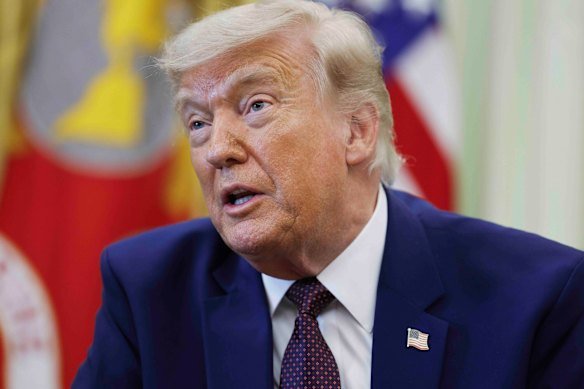
The federal government’s anti-slavery commissioner has accused the Trump administration of weaponising important human rights issues by seeking to impose tariffs against Australia and dozens of other countries for failing to do enough to prevent forced labour.
The government will push for the US to scrap the proposed 12.5 per cent tariff, or at least reduce it to the less onerous 10 per cent rate suggested for some other countries, in its negotiations with the US.
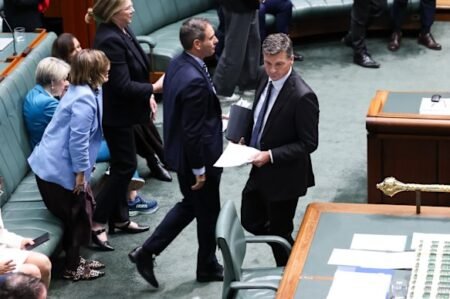
Commissioner Chris Evans, a former Labor cabinet minister, conceded Australia was not doing enough to prevent forced labour in supply chains but said the Trump administration was not motivated by a genuine concern about worker rights.
Evans said the United States Trade Representative’s office had only conducted a “very cursory examination of the issues” involving one interview with Australian officials.
“It was a show trial effectively,” he told this masthead of the investigation released on Thursday.
“This is not about modern slavery, which is an important human rights issue. This is a distraction and a weaponisation of trade measures, not about modern slavery concerns … This is an attack on Australian businesses and jobs.”
But he pushed back on Prime Minister Anthony Albanese’s claim that Australia has “robust” and “world-leading legislation” in place to address forced labour and modern slavery.
Evans said Australia’s Modern Slavery Act was ahead of its time when passed in 2018, but was now too light touch.
“The legislation is not fit-for-purpose or at a gold standard level,” he said.
“We have real problem with our supply chains, especially in South-East Asia. We need to be doing more to ensure the products Australians are buying are not tainted by forced labour.”
Evans said Australia needed to introduce a due diligence obligation requiring Australian companies to move beyond disclosure and take reasonable, proportionate action to prevent forced labour in their supply chains.
But he said Australia was “by no means the worst offender” and that the Trump administration’s push was “motivated by the wrong reasons”.
“It’s clear there is an agenda to impose higher tariff rates by the Trump administration,” he said.
Trade Minister Don Farrell used a face-to-face meeting with US Trade Representative Jamieson Greer on the sidelines of an Organisation for Economic Co-operation and Development gathering in Paris to argue the proposed tariffs should not be applied to Australia.
Albanese told ABC radio on Thursday: “Any tariff on Australian exports to the United States are unjustified, they’re inconsistent with our free trade agreement, and also with regard to the specifics that have been put forward by their trade representative.
“Australia has robust, comprehensive, and world-leading legislation addressing forced labour and modern slavery.”
He added: “We continue to use every opportunity that we have to advocate that US tariffs imposed in Australia are unwarranted, and of course, our view is that tariffs are actually a penalty on consumers in the United States.”
Major Australian exports to the US, including beef, pharmaceuticals, rare earths and gold, are excluded from the proposed tariffs, suggesting the overall economic impact would not be dramatic.
Foreign Minister Penny Wong said: “Australia continues to assert our view that we are not supportive of tariffs, and we continue to value open trade that has benefited both Australia and the United States.
“It is the government’s position that we do not believe there is a basis for these additional trade measures, and that is what we will continue to robustly put.”
A small group of six economies – Canada, the European Union, Ecuador, Indonesia, Mexico and Pakistan – were hit with a lower proposed 10 per cent tariff because the investigation found they were the only countries who had “not failed to impose a forced labour import prohibition”.
An existing 10 per cent tariff on all countries, including Australia, that was imposed by the Trump administration in February is due to expire in July.


From our partners
Read the full article here