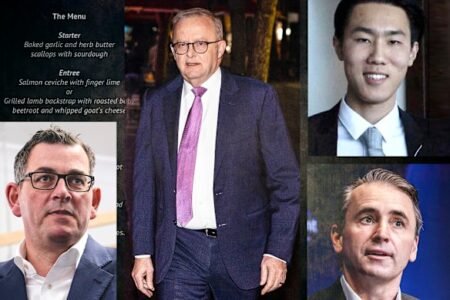



Prime Minister Anthony Albanese attended an exclusive dinner hosted by an uber-rich 25-year-old whose billionaire father was accused by the Tax Office of repeatedly deceiving authorities to funnel huge sums of money from China into Australian bank accounts and mansions.
The accusations are detailed in a damning 189-page Australian Taxation Office affidavit about the Lee family patriarch, which this masthead fought for months to obtain and describes red flags about the sources of the Lee family’s wealth.
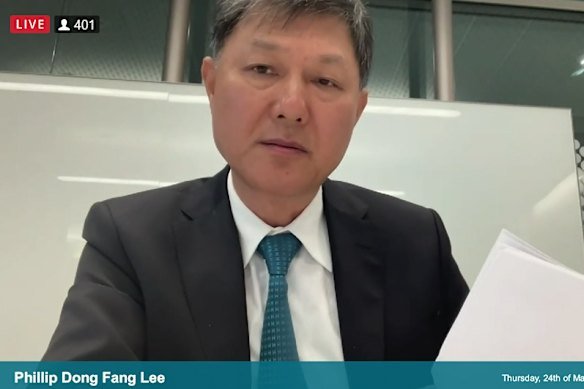
The 2021 document also contains suspicions that 60-year-old Phillip Dong Fang Lee secretly controlled business and financial interests in China despite earlier vowing to the Australian government that he had sold his Chinese business assets.
Questions about the Australian family’s wealth have been thrust into the spotlight after The Australian Financial Review reported this week that Phillip’s son Felix pledged Albanese a $1 million donation at the exclusive dinner at the family’s Point Piper mansion, Mandalay.
Also at the dinner was Commonwealth Bank chief executive Matt Comyn, while the Financial Review reported the bank’s former boss David Murray, ex-ASIC chairman James Shipton and former Victorian premier Dan Andrews also attended.
Albanese has refused to confirm how much was donated, saying any contribution to the Labor Party would be appropriately disclosed as required.
A senior government source, unable to speak publicly, said the amount would be “drastically less” than $1 million.
The source said they also did not believe the prime minister’s office was aware of the Tax Office’s allegations against Phillip Lee.
That apparent failure of due diligence comes despite the wider issue of political donations from wealthy donors looming large since 2019, when a corruption inquiry into the state’s donation laws revealed Chinese billionaire Huang Xiangmo had delivered $100,000 cash in an Aldi plastic bag to the NSW Labor Party.
Climate 200 group founder Simon Holmes à Court has also drawn criticism for the financial backing of teal independents, as has One Nation leader Pauline Hanson more recently when she was gifted a private jet by mining billionaire Gina Rinehart.
The allegations against Phillip come on the back of an exhaustive ATO investigation, drawing on data from anti-money laundering agency AUSTRAC, bank records, information from Chinese authorities and ATO interviews with Phillip and his associates.
Chief among the Tax Office’s claims are details about “sham arrangements” where purported loans from Phillip’s 92-year-old mother, friends and business associates are allegedly designed to conceal the true source and character of the foreign income. It was not suggested Phillip’s mother was involved in wrongdoing.
It comprehensively details deep suspicions held by the Tax Office that Phillip used dishonest means to move vast sums of money from China to Australia over several years to fund his Australian business, property and gambling activities.
There is no suggestion by this masthead the allegations are true, only that they were made.
But the allegations also shatter the mystique that has developed around Phillip, and sheds light on the ATO’s theory of how the reclusive businessman accumulated a substantial property portfolio worth hundreds of millions of dollars, and landed on the 2024 The Australian Financial Review Rich List with an estimated $1.66 billion fortune.
The ATO’s allegations have led to no criminal charges and have never been tested in any court after the Tax Office and Phillip reached a settlement that included paying back part of the tax liability.
The ATO makes no adverse comments about Felix. Instead, the damning affidavit shows the Tax Office suspects the family’s Australian wealth was founded via a scheme that effectively moved money into this country through the purported loans from his elderly grandmother and associates.
The ATO’s affidavit also raises the prospect that Felix has been an unwitting beneficiary of his father’s allegedly suspect dealings.
It details a 2015 transaction where $7.86 million was withdrawn from a bank account in the then 15-year-old Felix’s name to fund the purchase of an investment property in Bellevue Hill.
That investment was sold for $12 million in 2019, with the proceeds of this sale mostly going to Phillip’s bank account.
Mandalay, the house where the prime minister was hosted, was also purchased, according the Tax Office affidavit, after money was transferred from the account of Phillip’s mother, through the account of another of his sons, Edward, who at the time was 10 years old, before being used to raise a cheque.
More recently, a 2442-hectare pine plantation at Tea Gardens on the Mid North Coast that was bought by Phillip’s company, Australian Pine Products Pty Ltd, for $22 million in 2017 used funds that the ATO traced back to Edward’s bank account.
Title records show that the property was transferred to Felix’s Lee Family Office last month.
Phillip did not respond to requests for comment.
Asked about the Albanese dinner, a spokesperson for Felix said he would not comment on private engagements or his father’s tax troubles.
“Phillip Lee’s tax affairs are his own and are not related to Felix Lee.”
Felix now runs an investment family office touted as wholly independent of Phillip’s wealth and chaired by former federal treasurer and ex-ambassador to the United States Joe Hockey.
“Felix is pursuing his own path and is entitled to be judged on his own conduct, decisions and standards,” Hockey told this masthead early this year.
“The Lee Family Office is 100 per cent Felix Lee – with its own governance, purpose and operating boundaries.”
A source familiar with the business, but not permitted to discuss its dealings publicly, said funding for the investments came from Felix’s paternal grandmother – the same woman Phillip claims also previously funded his Australian business and financial activities.
It’s a claim shared by friends and neighbours, although none know her name.
Phillip, who the Tax Office stated is also known in China as Fei Xie, also credits his parents with much of the family wealth.
He told the ATO his late father started a real estate and freeway construction business in China in about 1985, investing in various freeway projects.
Phillip’s mother was involved in the family business, as was Phillip from the early 1990s when his father helped him set up companies related to small freeway construction projects.
Phillip’s father died suddenly in 2010, leaving his mother as the beneficiary, although by that time, Phillip claims, his financial interests in China had been wound up.
Phillip told the Taxation Office that he cashed in his business interests for about $200 million in 1998, bringing about $80 million of that to Australia, and depositing the $120 million balance into banks in other jurisdictions. A year later he migrated to Australia.
The paper trail for Phillip’s family in China is thin. Phillip’s father, Shiwen Xie, and mother Zhangzhu Li, 92, had at the time of the Tax Office investigation in 2021 never filed a tax return in China.
What’s more, the ATO was told by Chinese authorities that “no companies have been identified with Phillip’s father as a shareholder or a legal representative”.
The affidavits also detail a series of contradictory statements by Phillip about his business history.
Phillip’s claim in 2017 that he had sold his Chinese business interests in 1998 is inconsistent with what he told the National Australia Bank in 2006 when applying for a business loan to buy his controversial bushland retreat at Fame Cove on the NSW Mid-North Coast.
An internal memo, quoted in the court documents, about a business loan sought by one of Phillip’s companies stated that the NAB understood Phillip’s main business interests were constructing freeways and highways across China.
It was a point Phillip reiterated in 2021 as he sought another business loan for his Landmark Development and Finance Group as a trustee for his Terrey Hills Golf and Country Club interests.
In a document supporting that NAB loan application, detailed in the affidavit, the bank describes Phillip as running an infrastructure construction company specialising in freeways, bridges and tunnel construction, and which had over 20 subsidiaries in major cities across China, a total asset portfolio of $2 billion and more than 60,000 staff across the country.
According to Phillip’s immigration application he established the freeway construction company Guangdong Hu Shen in 1993, which was awarded the contract to build the Shenzhen-Shantou expressway from 1994-96 and the Tu-Wu-Da Expressway in the Xinjiang Province.
His other majority-owned company, Mi Quan, was contracted by Guangdong Hu Shen to supply safeguard products for freeways.
According to Chinese authorities, Phillip sold his shares in Guangdong Hu Shen in 1996.
Phillip’s shareholding of Mi Quan remained when in 2005 the company’s business licence was revoked by the authorities for failing to pass annual inspections the previous year.
Loans from friends and family
In 1999, soon after Phillip had moved to Sydney, he married Xiaobei Shi, then 22.
The couple maintained a relatively low profile until 2015, when Shi purchased their Point Piper trophy home, Mandalay, setting a $40 million non-waterfront house price record for Sydney.
The decade since has been marked by a series of headlines over a long-running dispute over alleged environmental breaches at his private bushland retreat on the state’s Mid North Coast and revelations about his prodigious gambling in the 2022 inquiry into The Star casino.
In 2017, Phillip was informed there would be an audit of his taxable income from 2012 to 2016, from which the ATO determined that Phillip’s income was understated by $262 million.
Among the audit’s most notable findings, outlined in the affidavit, was the $120 million received into Phillip’s various Chinese bank accounts in 2015 and 2016 that he claimed was from loans from friends and associates, and $115 million transferred into his wife’s bank accounts in 2012 and 2015 that he said was also a loan from his mother.
In detailing the loans, the Tax Office listed $25 million sent from Phillip’s mother that was executed in Shanghai and witnessed by Phillip’s sister. The Tax Office claimed his sister was in Australia at that time.
Another loan, this time for $100 million in 2015, was witnessed by Phillip’s then 23-year-old nephew on February 30, a date that doesn’t exist. Phillip’s lawyer later amended the date to February 28.
There were also loans from some of Phillip’s and his late father’s friends.
Among them, five family friends loaned Phillip roughly $60 million from 2010 to 2018, all without any loan agreement and, in some cases, with no interest payable. None of those loans had been repaid, as of the Tax Office’s evidence of 2021.
The Tax Office also alleged that Phillip’s mother’s bank accounts were operated by “Lee and his wife as if they were their own”, and the money used at their own discretion.
“The purported loans are sham arrangements, being devices to conceal the true source and character of the funds as foreign undisclosed income”, states the affidavit.
Phillip’s UnionPay Debit Cards account at Star City casino was also analysed by the Tax Office, revealing that $110 million was processed by Star City Hotel. Of that, $97 million was transferred to Phillip’s account and $9.5 million to his business associate Weihua Li.
“The commissioner believes that the funds used by Mr Lee in his dealings with the Star City Hotel represent unexplained foreign income,” states the affidavit.
Start the day with a summary of the day’s most important and interesting stories, analysis and insights. Sign up for our Morning Edition newsletter.


From our partners
Read the full article here