





Did you know that Australia has one of the oldest federations in the world? And did you know that this year we are – or should be – celebrating its 125th birthday? Apparently, this is known as its quasquicentenary.
In a recent speech to high school economics students, Dr Steven Kennedy, the former Treasury secretary and now boss of the prime minister’s department, offered a potted history of the economy’s many ups and downs over that time.
I drew two conclusions from his graphs of unemployment, inflation, government debt and home ownership. First, most of the big knocks to our economy come from overseas and so are beyond our control. The question is how well we responded to the hit.
Second, our econocrats have been far better at managing the economy over the past three decades or so than they were over the previous three.
This ought to be obvious, but Kennedy spells it out. In setting up our federation, we drew on the design of the US federation. Upper house called the Senate; lower house called the House of Representatives.
Of course, much of the way we do things comes from the Brits, hence the coinage that our federation is based on the “Washminster” model.
Kennedy observes that even countries that aren’t democratic and capitalist like ours benefit from the global economic order created by the democratic capitalist countries.
“China’s economic transformation could not have occurred without trade, investment and demand from democratic capitalist economies across the world,” he says.
“China’s entry into the World Trade Organisation in 2001 transformed it into the ‘factory of the world’, driving an explosion in its global trade.”
Some economists like to say that free markets are guided by an “invisible hand” but Kennedy says markets depend on laws, trust and public institutions to function effectively.
Surprisingly for a hard-nosed economist, he says the key is trust. As a famous economist once said, “virtually every commercial transaction has within itself an element of trust”.
Kennedy puts much emphasis on the rate of unemployment. It leapt to about 30 per cent during the Great Depression of the 1930s but fell sharply during World War II and stayed very low during the post-war “Golden Age”.
But after the OPEC oil shock of 1973 ended the Golden Age, unemployment jumped to 6 per cent. It jumped even higher in the three recessions of the 1970s, ’80s and early ’90s. In each recession, it peaked at a higher level, reaching 11 per cent at the end of 1992 and each took longer to fall back.
Kennedy says,“the unemployment rate provides a unique insight into whether an economy is working for all people, especially the disadvantaged”. “Employment matters profoundly for individuals, families and communities” and especially for young people.
Some Treasury types may get lost in their statistics, but not Kennedy. He says, “every percentage point in this chart represents real people”. “And when unemployment rises, the consequences are felt in confidence, mental health, family wellbeing and social cohesion.”
Kennedy, who started his working life as a nurse, adds that a person who spends an extended period unemployed can lose skills, confidence and valuable work experience. “By comparison, a strong labour market helps people find suitable jobs faster, earn higher starting salaries and build skills,” he says.
Since the recession of the early 1990s, the Asian financial crisis of the late 1990s, the global financial crisis of the 2000s and the COVID-19 pandemic, the rise in unemployment has been much smaller.
Why was there this difference? A big part of the story is that Australian policymakers learnt from the earlier episodes and created new policy approaches – including the floating dollar, decentralised wage-setting and more judicious use of interest rates by the Reserve Bank and the federal budget – that allowed us to better handle those later shocks to the economy.
So, in all your complaining about the cost of living, never forget that, at about 4 per cent, we’re doing well on employment.
Kennedy says one of the big economic achievements of the past 30 years has been keeping inflation relatively low and stable compared with earlier decades.
Much of the credit for this goes to the Reserve Bank, which was formally given independence to manipulate interest rates as it saw fit by the Howard government in 1996.
No top econocrat’s speech would be complete without a commercial message. Here’s Kennedy’s.
“History reminds us that major shocks can emerge unexpectedly and place significant pressure on public finances. In ‘good times’ we need to have policy settings that restore [government] debt such that it will be possible to respond in a relatedly unrestricted way when major negative shocks hit.
“Looking across 125 years of history, the lesson is that governments should always expect the unexpected.”
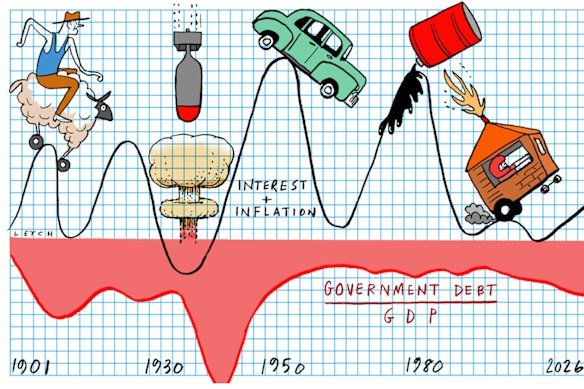
Actually, what stands out in his graph is the government’s gross debt shooting up to a peak of more than 130 per cent of gross domestic product during World War II, then taking three decades to get back to a more normal level.
But from its almost negligible level in the 2000s, our debt has increased markedly to about 38 per cent of GDP, with much help from the spending by the government in its efforts to keep the economy alive during the pandemic, but also a succession of budget deficits.
Hence Kennedy’s commercial message. Even so, he’s far from panic stations: “Australia’s debt remains low by both historical and international standards.”
If that judgment surprises you, have a look at the Yanks. Expressed as a proportion of GDP, the United States’ gross government debt after World War II was the same as ours. Now, however, while we’re back up to 38 per cent, the Americans’ debt is back up to where it was at the end of the war: more than 130 per cent.
Finally, the much-debated home ownership. He says there’s a “growing disconnect” between how much you have to pay each month on a mortgage and how much people are earning from their work. For decades, the former has been growing much faster than the latter.
And the solution is? Still working on it.
Ross Gittins is economics editor.
Ross Gittins unpacks the economy in an exclusive subscriber-only newsletter. Sign up to receive it every Tuesday evening.
From our partners
Read the full article here