






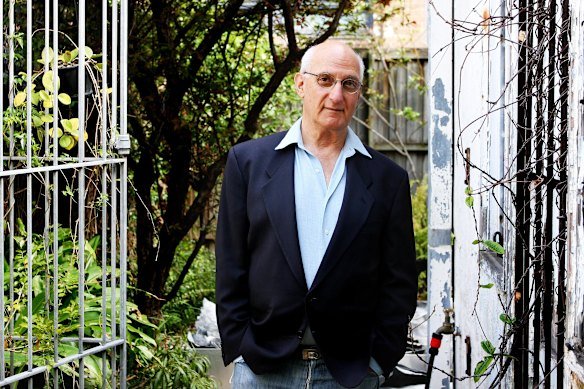
Patricia Maunder and Amy Ripley
DAVID GEORGE JOSEPH MALOUF: 1934 – 2026
Widely respected both as a man and a writer, David Malouf was best known for novels such as Johnno and The Conversations at Curlow Creek, but was first and foremost a poet. In addition to numerous poetry collections, he wrote prose less concerned with plot than a poetic expression of “things that don’t belong to consciousness, but which are on the edge of it. I am looking for that other kind of knowledge we have, which sees the real pattern of the world,” he said.
A polite, erudite and cosmopolitan man who was both very sociable and deeply private, Malouf was described by critic Peter Craven as “a master, a superb writer and also (which is not the same thing) a completely sophisticated literary gent.” He died on Wednesday night aged 92.
Malouf was born in Brisbane on March 20, 1934. His father, George, was a Catholic of Lebanese descent, his mother, Welcome (nee Mendoza), a London Jew with Iberian ancestry. Together with his sister, Jill, with whom he remained close, David grew up in comfortable circumstances as his father’s grocery delivery business prospered.
Their mother relented to her children being raised Catholic, but otherwise enforced her Edwardian English ways. Though he harboured aspirations of being a typical Aussie kid, young David nevertheless studied piano and violin, and before his teens had devoured his mother’s books, particularly Shakespeare, Dickens and Dumas. The latter was in translation but he went on to learn French, as well as Latin, at Brisbane Grammar, and later also became fluent in German and Italian during extensive European travels.
In 1951, Malouf began studying law at the University of Queensland as a scholarship student. “In those days, if you were bright, you were expected to do law or medicine,” he later recalled. “I quickly discovered that wasn’t for me and I transferred to English.”
After graduating with first-class honours, he became a self-described “hopeless” clerk for BHP and taught at both his alma maters, including for a single semester at Brisbane Grammar, whose headmaster apparently dismissed him due to lack of ability.
By 1959, Malouf “could see nothing I could do that suited me among the various limited possibilities” in his hometown and sailed for England. He taught English literature there, including at the bohemian Holland Park School in west London, known as the “socialist Eton” and where a pre-Roxy Music Bryan Ferry later taught pottery. Malouf frequently travelled in Europe, developing his passion for art, architecture, theatre, opera and music.
Despite his profound delight in Old World culture, he soon realised that, as an Australian, his roots were not there. Writing to a Brisbane friend shortly after relocating, he concluded that “we really are different people, neither English nor European, and that the 2000 years of European culture which we might like to feel behind us, is not really ours.”
Malouf, who would live in England for a decade, had grasped what would become important threads in his writing: Australian identity and a sense of place. They are particularly apparent in his 1985 memoir 12 Edmonstone Street (named for his childhood home), the 1998 Boyer lectures, and the collection of essays published on his 80th birthday, A First Place.
It was as a poet that Malouf began wielding a pen in earnest,. In 1962, his verse appeared in a collection of contemporary Australian poetry, Four Poets, then in 1970 came the first of nine bearing his name alone: Bicycle and Other Poems.
His first novel, Johnno, was published five years later. “I wrote poetry for a long time before I wrote prose that I thought publishable,” Malouf observed decades later. “I think that you learn habits of working as a poet which I’ve used in making the fictions, so I think they are in their structures very poetic.”
The most autobiographical of Malouf’s novels, Johnno was inspired by his friendship with John Milliner, a mercurial figure who died in 1962. Its vivid depiction of the Brisbane of his childhood tapped into his strong sense of place, but what Craven later described as a “God-given book” also established the key themes of male identity and soul-searching that run through much of Malouf’s fiction.
Johnno’s subtle homoeroticism became more apparent to readers when, in a 1996 issue of OutRage magazine, the author publicly exited what has been described as his “glass closet”. Malouf had long been openly but discreetly gay.
After a decade at Sydney University, first as a senior tutor then a lecturer, Malouf resigned in 1977 to pursue writing full-time (he returned 20 years later to receive an honorary doctorate). For many years, he retreated for extensive periods to the house he bought near Florence in Italy.
“I wanted to go somewhere where I could sit down quietly and discover what else I had to write, if anything,” he said. “I did not want to be part of a literary scene, which I’d already become too much part of, and I did not want people looking over my shoulder and telling me what I could do and was incapable of doing.”
At his Tuscan retreat, and later a Gold Coast high-rise apartment by the beaches he frequented as a child, Malouf escaped Sydney’s distractions. He went on to write – always with pen and typewriter – novels such as Fly Away Peter and The Great World, opera libretti including an adaptation of Patrick White’s Voss, short stories, essays, reviews, poetry and a play.
He received numerous honours including the Miles Franklin Award, NSW Premier’s Literary Award, The Age Book of the Year and Commonwealth Writers’ Prize. His 1993 novel Remembering Babylon garnered the inaugural IMPAC Dublin Literary Award (then the world’s richest) and was shortlisted for the Man Booker Prize.
In 2000, Malouf was awarded the Neustadt International Prize, an American accolade bestowed on the likes of Gabriel García Márquez that recognises an author’s body of work, and received the 2016 Australia Council Award for lifetime achievement in literature. He was made an Officer of the Order of Australia in 1987, declared a National Living Treasure 10 years later and named the Australian Book Review’s first laureate in 2014.
In 2010, alongside Peter Carey, Thomas Keneally, Tim Winton, Bryce Courtenay and Coleen McCullough, he was featured in a series of Australia Post stamps to honour national writers.
Such honours were partly in recognition of his active support of Australia’s literary community, and the wider cultural scene. He was a member of the Australia Council’s Literature Board and the Opera Australia board and was prominent in a campaign opposed to removing researchers and books from the State Library of NSW’s Mitchell Reading Room. He made regular visits to literature classes for disadvantaged and homeless students organised by Mission Australia and Australian Catholic University’s Clemente Program.
“He’s one of the most generous people of personality and mind, very warm and very encouraging,” said the poet Vivian Smith, Malouf’s friend since their days teaching at Sydney University. Smith was one of many in Malouf’s extensive social circle, which also included Jeffrey Smart and Bill Henson. The work of these and other artist friends graced his Chippendale home, which was frequently filled with guests and housemates (who might stay for a month or a decade), good food and music.
Malouf was widely liked, even in the sometimes venomous literary scene; the only public attack was made by Germaine Greer, who declared Remembering Babylon a “supremacist fantasy”.
However, while Malouf was often described as both generous and gregarious, he was also considered mysterious. He shielded “the privacy of his intimate life extraordinarily carefully and well”, said David Marr of the friend who once admitted to having been in love “three or four times”.
His sister, Jill, an antiques dealer, predeceased him in 2020.
The Booklist is a weekly newsletter for book lovers from Jason Steger. Get it delivered every Friday.
From our partners
Read the full article here