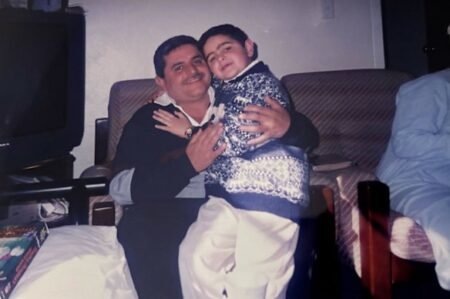





When my family arrived in Melbourne in 1988, from Soviet Odessa, we landed in Doncaster. This affluent suburb of hilly cul-de-sacs starkly contrasted the poverty and repression we had just fled.
My parents enrolled in English classes at Box Hill TAFE, my brother and I at the local primary school, where we didn’t have to chant dogma about Great Leaders. The shops brimmed with food, for which we did not have to queue. And yet, my mother, eight months pregnant with her third child, looked along our vast, silent street and wept. “Where are our neighbours?” she asked my father. “Where is the sea?”
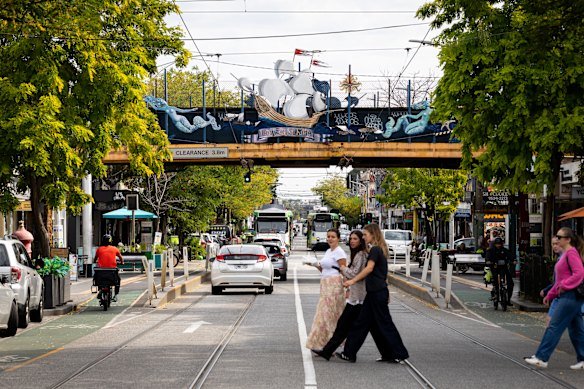
We soon realised that we needed to move south, towards our Russian-Jewish community. And so we did, approaching the heartland incrementally, via Glen Huntly, then Carnegie and eventually Caulfield. And the heart of the heart, was of course, Balaclava. Here, my mother shopped for pelmeni (dumplings) and tvarog (soft cheese); here, she could ask the grocer for a specific selyodka (salted herring) and know that he knew. She sat in its cafes and imbibed its residents – artists and musicians drifting up from St Kilda, the Italian fruiterer, the ultra-Orthodox Jewish boys scuttling between the Yeshivah and the kosher bakery, the dog-walker striding to Alma Park.
And of course, there was the sea. From the hill on Balaclava Road we could see its glistening ribbon, and the view always felt like a homecoming. We, like so many people of this neighbourhood, are people of the port. And not just the briny smell of seawater and the greedy squawk of gulls. We know ourselves by migration: cargo and cargo ships, suitcases and sailors, buskers, hustlers, escapees. We – the migrants who populate so much of Melbourne’s shtetl-south – understand the energy of coming and going.
In 1857, Balaclava was named after a battle in the Crimean War. Nearby, Sebastopol and Odessa streets share this provenance. This seems like a remarkable coincidence, given the make-up of the area. Did these names – so familiar to our Slavic ears, straight out of an Isaac Babel story – somehow draw us to this shtetl-by-the-sea?
For some, shtetl (meaning village or small town in Yiddish), is pejorative, synonymous with insularity, parochialism. But this has never been my experience of Balaclava. I like its mosaic of synagogues; some grand, some so tiny they are in a private home. I love how the air crackles with anticipation at sunset before a High Holy Day, people buying last-minute flowers or candles or holy bread. But what I treasure most is the integration of this with the wider village between Hotham and Chapel streets, Ripponlea and St Kilda proper.
Balaclava is home to about 5300 residents, who at the last census comprised 58 ancestries. St Kilda library hosts story-time in Amharic, Hindi, Russian and Spanish.
I am writing these words and drinking coffee in the breezy courtyard of Levanter, which is run by a Syrian mother and son. The building next door once housed my family’s cafe, which they named, perfectly enough, Common Ground. (Though the interior was crisply modern, the menu was pure Russian nostalgia, steaming vats of borscht rubbing shoulders with pierogi.) Today, the iconic Wall Two 80 cafe occupies the old premises of a kosher butcher, its facade an ever-changing canvas to local street art.
In Balaclava, you can learn Torah on the same street as you can learn yoga (at last count, tiny William Street, just 200 metres in length, had six fitness centres). You can play drag bingo at The Local Taphouse, or stand in Westbury Street and hear, through an open window, a child learning piano with her Moscow-born teacher. I have been that child and I have been that street-listener.
Of course, Balaclava is not utopia. Many of its locals are unhoused or living with disadvantage. It’s not uncommon to see street violence or the rough arm of substance abuse. Recently, for many of the Jewish residents, “home” has become complicated by the upsurge in antisemitic violence.
But alongside the adversity, there are countless people quietly living side by side; waiting for trams, lugging their groceries, borrowing books, minding their children, donating clothes. Carlisle Seafood (established by a Greek immigrant in 1922) is the oldest fish-and-chippery in Melbourne, while Nelson Street kinder has been there for 110 years. These are not just fun facts, these are symbols of continuity, the fascia of one large, beating heart.
No, Balaclava is not utopia. But it is, for the most part, a lesson in coexistence. And in today’s world, this might be the most precious commodity between human beings: the ability to keep trusting each other’s goodness, to honour each other’s basic needs.
The birth of my first child was heralded by the 2006 New Year’s fireworks over Port Phillip Bay. Back then, I lived at The Avenue, along the Sandringham train line that flies above the Williams Street playground. That child learned to walk at the park on Orange Grove; their first “real food” was a scrap of bagel, scored at midnight from the post-Shabbat bake at Glick’s. I survived newborn-induced insomnia on the beans of The Coffee Company in Carlisle Street, its roastery perfuming the block since 1969. But the gifts of Balaclava extend beyond these expected suburban signifiers. The gifts are quiet and often invisible: they are the agreements of a village, a shtetl, a playground, a bustling port and all its arrivals.
Katia Ariel is a book editor, author and educator based in Melbourne.
Get a weekly wrap of views that will challenge, champion and inform your own. Sign up for our Opinion newsletter.


From our partners
Read the full article here