





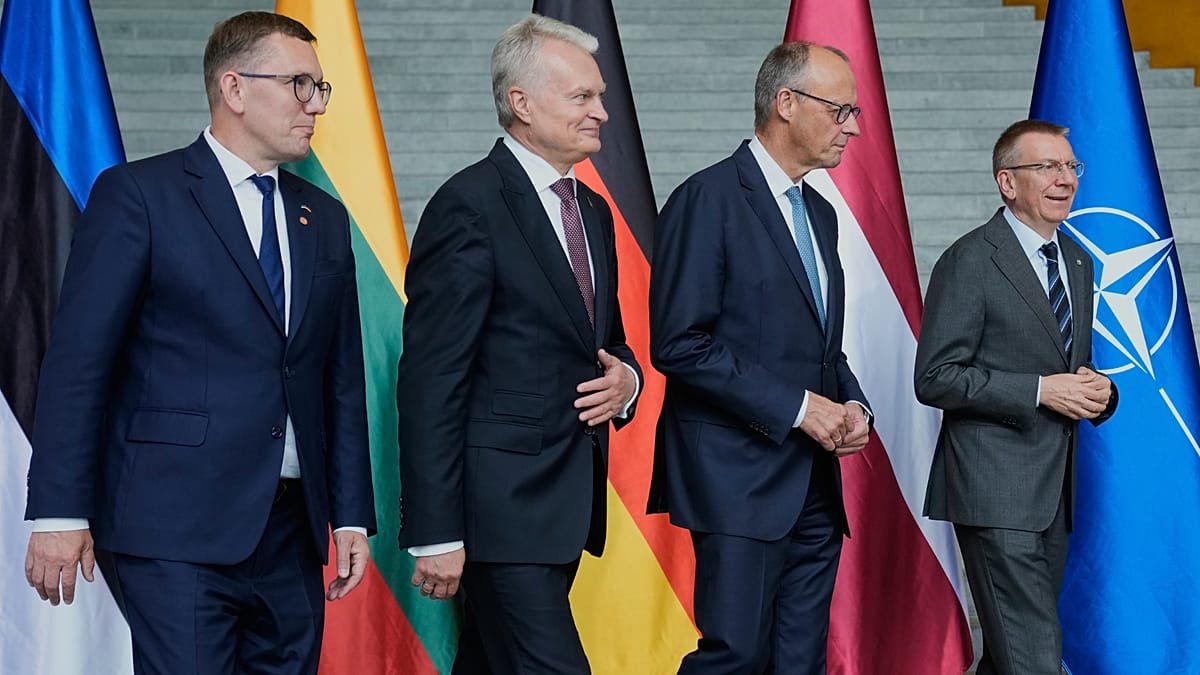
Lithuania, Latvia and Estonia have each summoned Russian diplomatic representatives, accusing Moscow of spreading false claims about the Baltic states as it steps up missile and drone attacks on Ukraine.
Claims that the Baltic countries were preparing mass deportations of Russian speakers and had allowed Ukraine to use their airspace to attack Russia are part of the Kremlin’s playbook, the countries said.
The governments of Estonia and Lithuania told Euronews that the deportation accusations made by Russian Foreign Ministry official Grigori Lukyantsev are used by Moscow to portray Russia as the victim while diverting attention from its own conduct in Ukraine.
“Russia is desperately seeking to divert attention from its aggression against Ukraine, as well as to portray itself as a victim and thereby absolve itself of responsibility for crimes committed,” Lithuania’s Foreign Ministry told Euronews.
In the meantime, Estonia accused Moscow of trying to distract from “Russia’s own serious violations of international law, including the forcible transfer and deportation of Ukrainian children,” Estonia’s foreign ministry spokesperson Susan Lilleväli told Euronews.
Lithuania said claims it was planning to deport Russian-speaking residents were “entirely false,” while Latvia said everyone in the country was protected by the rule of law regardless of ethnicity.
Rejecting Russia’s claims, Estonian Foreign Minister Margus Tsahkna said his country was “a democratic state governed by the rule of law” and that suggestions otherwise amounted to “nothing more than unfounded Russian propaganda.”
Lukyantsev’s allegations came following the presentation of a joint human rights report of the Belarusian and Russian Foreign Ministries, which alleges Baltic countries are at fault for “Nazism” and “Russophobia”.
The report also criticises Latvia’s amended Immigration Law, which requires Russian citizens to apply for EU long-term resident status, demonstrate A2-level Latvian language skills, and pass security and background checks to remain legally in the country.
The measures affected approximately 30,000 people, the majority of whom ultimately complied with the new requirements.
The allegations echo longstanding Kremlin narratives about the Baltic states.
The Lithuanian intelligence services in their 2026 Threat Assessment say Russia “consistently” accuses Lithuania, Latvia and Estonia of persecuting Russian speakers, glorifying Nazi collaborators and rewriting the history of World War II.
The report says Russia’s Foreign Ministry plays a central role in amplifying those claims through diplomatic channels and international organisations to justify Moscow’s foreign policy and increase pressure on the Baltic states.
The diplomatic démarches by the countries were also triggered by Russian Deputy Foreign Minister Mikhail Galuzin’s claims that the Baltic states had provided air corridors for Ukrainian drones attacking Russian civilian infrastructure.
Galuzin’s statements following Ukraine’s successful strikes on oil infrastructure in Russia are “blatantly false,” Latvia’s foreign ministry said in a statement, demanding that Russia “immediately retract this false information.”
Lithuania and Estonia likewise said they had never allowed their territory or airspace to be used for drone strikes inside Russia.
The diplomatic row unfolded as Russia launched another wave of missile and drone attacks on Ukraine.
In their notes to Moscow, the three countries condemned a wave of Russian missile and drone attacks on Ukraine.
The governments cited recent strikes on Kyiv and elsewhere that killed dozens of civilians and injured hundreds more, arguing that Russia was escalating its campaign of attacks against civilian targets.
Lithuania said the deliberate targeting of civilians and civilian infrastructure constituted a grave breach of international humanitarian law and amounted to war crimes. It said it would continue efforts to hold those responsible for crimes committed during Russia’s invasion of Ukraine to account.
Russian President Vladimir Putin and other Kremlin officials have repeatedly accused Ukraine of Nazism and systemic Russophobia without providing evidence.
Putin has used both as a pretence for the full-scale invasion of Ukraine in early 2022.
Read the full article here