






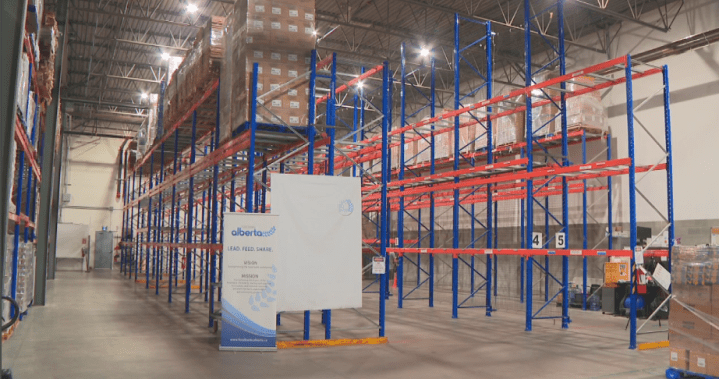
Where pallets of food and supplies should be stacked high instead sit row after row of empty warehouse shelves.
Food banks across Alberta are sounding the alarm as some of their inventories reach dangerously low levels, making the organizations increasingly anxious as the holiday season approaches.
“This is the first time that we’ve encountered this level of scarcity within our warehouse,” said Darryl Burry, executive director of Food Banks Alberta.
The shelves at Food Banks Alberta are typically stocked with pallets upon pallets of donated products, piling all the way up to the roof of the warehouse. But right now, those same aisles are largely bare because of increased demand.
“Our goal here is to receive the donations of products that come from many corporate sponsors and supporters, and then we distribute that out to our network of food banks,” Burry said.
“Unfortunately, this month we have not received the same volume of donations and support as we normally would.”
The organization’s warehouse supplies 112 member food banks across the province. When a local food bank needs extra support, they place an order with Food Banks Alberta, who subsequently ships out the needed items.
In 2025, the association distributed 3.36 million pounds of food province-wide.


Get weekly money news
Get expert insights, Q&A on markets, housing, inflation, and personal finance information delivered to you every Saturday.
Demand increased so much this year, it distributed nearly 90 per cent of its total 2025 volume in the first six months of this year alone — with the busiest months still to come.
In August, the volume sent out ran 32.8 per cent higher than in August 2025.
Food Banks Alberta says statistics provided by Food Bank Canada’s 2025 HungerCount show Alberta recorded more than 210,000 average monthly food bank visits — a nearly 22 per cent jump from 2024.
“Most of the people walking through our members’ doors are working people and families trying to make ends meet,” Burry said. “They are our neighbours, our co-workers and the children sitting beside our children at school.
“Nobody in this province should have to choose between rent and groceries.”
While the 2026 HungerCount numbers won’t be released until October, projections indicate there’s been yet another significant jump in those accessing food banks in Alberta.
When it comes to this summer, Burry says they have shipped more food out faster than donations came in.
“We’ve got about 350 pallets worth of product that we are short for the coming month of September,” Burry said.
Food Banks Alberta isn’t the only group noticing unprecedented demand; so is Edmonton’s Food Bank.
The organization supports more than 43,000 people monthly through its hamper program and the need is growing.
“We’re seeing higher levels of demand, and that can be in part for a large variety of reasons. However, we’re always trying to match that community demand as well,” said Haley Grinder, communications and media coordinator with Edmonton’s Food Bank.
“It does seem like this is a very, very difficult year for Albertans.”
The food bank says when demand outpaces supply, like it’s on track to do again this year, they have to spend some of their own funding to keep up and inflation makes it even harder.
“Last year, Edmonton’s Food Bank spent $3.9 million on food purchases. We anticipate being higher than that — approximately $2 million more on food purchases — just to offset the lack of donations and our buying power,” Grinder said.
“2026 obviously has been a year of immense challenges, there’s no doubt about that. Inflation, everything that’s going on in the world right now that has that trickle-down effect, and we’re definitely feeling that — so every little bit counts.”
As we head into the busiest season of the year for food banks in the province, they’re hoping for some additional help from Albertans.
“This is the first time that we’ve encountered this level of scarcity within our warehouse,” Burry said.
“It’s going to become a huge challenge as food banks want to make their orders, and we simply don’t have the product to be able to provide them.”
Read the full article here