





Updated ,first published
RBA governor Michele Bullock has warned the bank is willing to keep raising interest rates to curb inflation while flagging property prices could fall by 20 per cent without seriously risking the country’s financial stability.
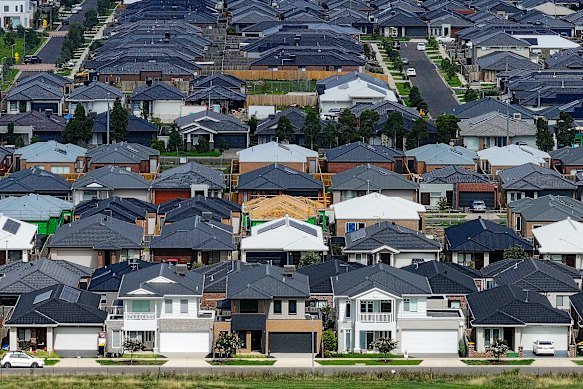
The decision followed a warning from ANZ economists that property prices could slump by almost 15 per cent over this year and next, citing interest rates, low levels of affordability and the federal government’s property tax changes.
In a press conference on Tuesday, Bullock said the downturn in the property market was “not a massive risk” to financial stability, not a major factor keeping interest rates on hold, and “not [currently] the main game” for the bank.
“We’ve done a little bit of work on [the property market] from a financial stability perspective,” she said. “If property prices fell by 20 per cent, still only about 5 per cent of households would be in negative equity.
“Awful circumstances [for the homeowners affected], which are compounded by the fact that you’d have to sell your house, but it doesn’t pose a risk to the financial institutions because they are very well capitalised.”
On Tuesday, the bank kept the official cash rate on hold at 4.35 per cent – the same rate it set for all of 2024 – while releasing updated forecasts that showed inflation staying above the 2 to 3 per cent target band until the end of 2027.
Financial markets believe there is a 50-50 chance of a further rate rise late in the year, with rate relief not expected before the second half of 2027.
Bullock said the decision to keep interest rates on hold was unanimous, that a rate cut was not discussed, and that the board remained focused on ensuring high inflation did not become entrenched.
“We’ve already raised [rates] three times, and we will go again if we need to,” Bullock said. “I think personally that it’s quite possible we might need to go, but we’ll wait and see what the data tells us.
The board said in its report: “Following three increases in the cash-rate target since the beginning of the year, financial conditions are now tighter than they were, and the economy appears to be slowing as expected … But inflation is still too high.”
Inflation is likely to remain high for some time, the bank warned, because of the disruption to global oil supply caused by the Iran war that meant higher fuel prices were flowing through to other goods and services.
Bullock also said there was a risk that the AI-driven data centre boom in Australia could put pressure on areas such as construction, which is already facing high demand, possibly keeping inflation elevated before the nation sees any productivity improvements from the technology.
The bank said while household consumption had eased gradually, business investment had been much stronger than expected, largely driven by data centre construction.
The board “will still need to see some further progress before [it] can be confident that we are going to get inflation back to target with current monetary policy settings,” Bullock said.
The bank’s latest forecasts show it expects economic growth to be slightly stronger, though still lacklustre, for the rest of the year compared to its forecasts in May, coming in at 1.4 per cent by Christmas and 1.6 per cent by December next year.
Price growth across the economy remains above the RBA’s target range of 2 to 3 per cent, at 3.8 per cent in June, but the inflation figures were substantially lower than the 4.8 per cent figure the RBA forecast in May.
Unemployment, at 4.4 per cent in June, is still outside the rate the bank considers “full employment”.
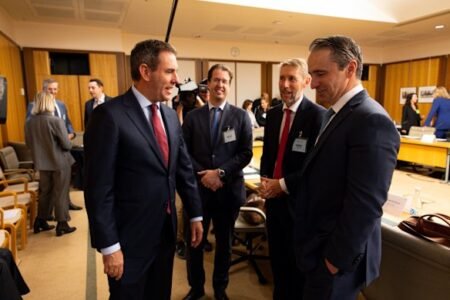
Treasurer Jim Chalmers told parliament the Reserve Bank’s decision to keep interest rates steady would “come as a relief to Australians with a mortgage”.
“This decision reflects the fact that inflation has been coming in well under the Reserve Bank and Treasury forecasts,” Chalmers said.
Earlier on Tuesday, ANZ said it believed capital city prices would fall by 4.3 per cent this year and by 3.4 per cent in 2027 before staging a recovery the following year.
Combined, the falls would mean a drop of 10.6 per cent from the peak in prices to their trough.
The biggest hit is expected in Sydney, where the median value is now $1.5 million, with house prices tipped to fall by 14.5 per cent from their peak at the start of the year. Melbourne prices are tipped to fall by 12.8 per cent from their peak. Prices in both cities are expected to recover by almost 5 per cent in 2028.
ANZ senior economists Madeline Dunk and Adam Boyton said the market was slowing sooner than they had expected due to a combination of restrictive interest rates, tax policy changes and global uncertainty.
“Auction clearance rates are very soft, coming in below 50 per cent for the past 10 weeks across the capitals,” they said.
Cut through the noise of federal politics with news, views and expert analysis. Subscribers can sign up to our weekly Inside Politics ewsletter.


From our partners
Read the full article here