







The 25th Amendment is a particularly tricky corner of the US Constitution. Not so much its first three sections: they’re relatively straightforward. It’s the last bit, section 4, that has people tied up in knots. Entire books have been written about its 270 words and still even lawyers aren’t always completely clear about how it’s supposed to work. Which, ordinarily, might not matter, except that section 4 is the mechanism some are hoping can be used to kick Donald Trump out of office.
The basis for triggering section 4 would be Trump’s increasingly erratic behaviour in recent weeks. Always colourful, Trump has turned up the dial to 11 with all-caps social media outbursts about ending Iranian civilisation “in one night”. He has insulted the Pope (inexplicably calling him “weak on crime” and “terrible for foreign policy”), posted an AI picture of himself dressed like Jesus (only to claim later it had depicted him as a doctor), lectured a crowd of bewildered schoolchildren gathered at the White House for an Easter egg event about the price of actual eggs and … the list goes on.
Loyalists suggest it’s all a bit of an act: playing up unpredictability, they say, gives him leverage against his adversaries, keeping them guessing about his next move. But an increasingly vocal number of influential people claim that something more sinister is going on, and not just Democrat members of Congress (one recently called him “batshit crazy”). Former Republican congresswoman Marjorie Taylor Greene, once a staunch supporter, said Trump had “gone insane”; right-wing podcaster Alex Jones said Trump sounded like “an unhinged super villain” while, in response to Trump’s posts on Iran – “a whole civilisation will die tonight” – conservative commentator Tucker Carlson said people close to the president needed to say, “I’ll do whatever I can do legally to stop this, because this is insane”. In response, Trump called Jones and Carlson “NUT JOBS”.
On April 10, Jamie Raskin, the senior Democrat on the House of Representatives’ Judiciary Committee, wrote to Trump’s personal physician, Captain Sean P. Barbabella, asking that he conduct for the committee a neuropsychological assessment of the president and publicly release the results.
“The country has watched President Trump’s public statements and outbursts turn increasingly incoherent, volatile, profane, deranged, and threatening,” Raskin wrote. “His apparently deteriorating condition has caused tremendous alarm across the nation (and political spectrum) about the president’s cognitive function and continuing mental fitness.” Barbabella, who last October issued a statement declaring the president to be in excellent overall health, has until April 24 to respond.
In the event the president is actually found to not be of sound mind – what then? This is where the 25th Amendment could come into play.
It was muttered about when Joe Biden was visibly deteriorating. It was raised overtly during the last days of Trump’s first term after the events of January 6, 2021, when his supporters stormed the Capitol, apparently with his encouragement. It probably should have been triggered when Ronald Reagan was shot in 1981 but wasn’t, due to timing (more on that later). This is largely uncharted territory, says Laura E. Little, an expert in constitutional law at the Temple Law School in Pennsylvania. “The 25th amendment has never been used to remove a president from office permanently.”
So how does section 4 work? Why is it so complex in practice? Could Trump fight back?

How did the 25th Amendment come into being?
Not that long ago if the president was incapacitated, crippled, deranged, inconsolably grieving or otherwise unable to adequately carry out the duties of their office, it was unclear whether there was a constitutional mechanism to allow them – or to force them – to cede power to somebody else. (That is, apart from elections or impeachment, which is supposed to have an entirely different purpose, removing the president in the event of “high crimes or misdemeanours”, not because of health or fitness.)
When the president was not dead but incapacitated, what tended to happen in practice was that instead of triggering a constitutional crisis, others simply carried on the work as if nothing were wrong.
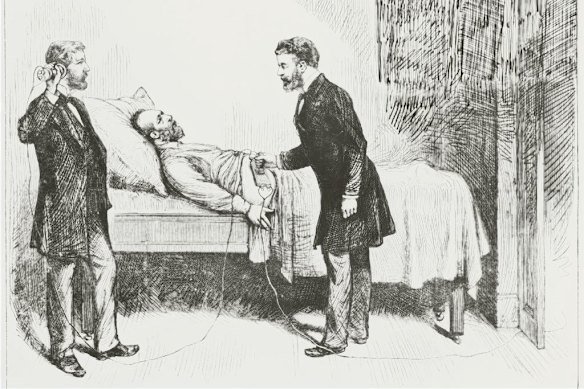
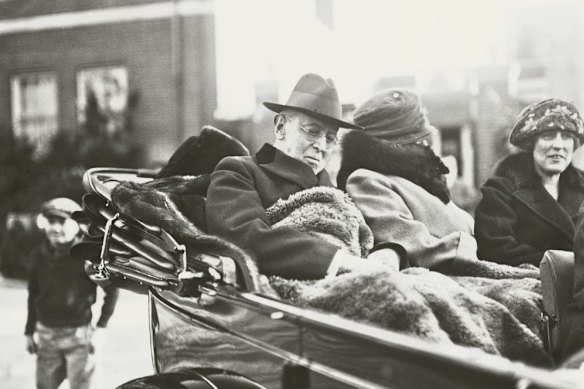
When James Garfield was shot by an assassin in 1881 (an aggrieved attorney who had been passed over for a consular posting) and lay in agony for weeks before he finally died 81 days later, nobody really knew who had been running the country in the interim (and they still don’t). Woodrow Wilson had a life-threatening stroke while on a speaking tour in 1919; his wife, Edith, ran what became known as a “bedside government”, essentially acting as a proxy president, America’s first woman in charge, although she later said she never made a single decision about public affairs. “The only decision that was mine was what was important and what was not,” she wrote in her memoir, “and the very important decision of when to present matters to my husband.” It was certainly easier to pull the wool pre-social media.
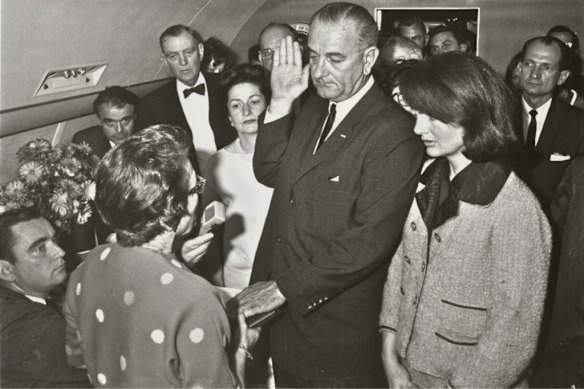
Ultimately, it was the assassination of John F. Kennedy in November 1963 – and speculation about what would have happened should he have survived but been incapacitated – that pushed Congress “to create a detailed, specific, and unambiguous outline of executive succession”, according to the Reagan Library.
‘The 25th Amendment is pretty much about continuity, and guaranteeing the continuity of government.’
Markus Wagner, University of Wollongong
After much nitpicking, on January 6, 1965, senator Birch Bayh of Indiana and representative Emanuel Celler of New York introduced joint resolutions in the Senate and House of Representatives that came to be known as the Bayh-Celler proposals and that would form the backbone of the 25th Amendment. They were adopted by Congress, after being approved, as required, by more than three-quarters of the states, on February 23, 1967.
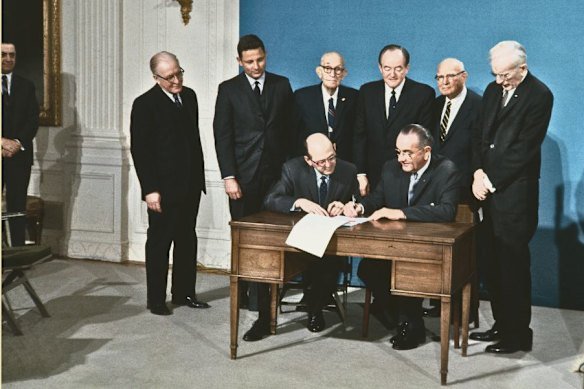
“The 25th Amendment is about continuity, and guaranteeing the continuity of government,” says Markus Wagner, an expert on US constitutional law at the University of Wollongong.
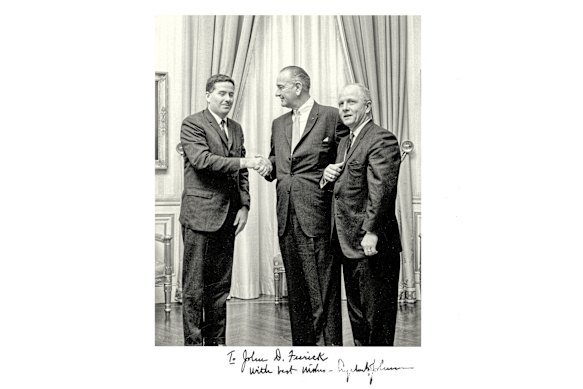
It was a short document, 396 words in total, elegantly drafted chiefly by John D. Feerick, a young lawyer who had been brought onto the team after arguing, presciently, in a 1963 law review article that the Constitution’s original succession provision contained gaps and ambiguities. Kennedy was killed months later.
In 1964, Feerick wrote to The New York Times, “The recent illnesses of [French] President Charles de Gaulle, [Indian] Prime Minister Jawaharlal Nehru and [British] Prime Minister Harold Macmillan are clear reminders that no nation, least of all the United States of America, can afford not to have definite procedures to handle the situation where the chief of state becomes disabled. The shocking fact is the United States has no such procedures.”

The first section clarified that, were the president to be removed from office, die or resign, the vice president would become president. The second section stated that were the vice president to vacate the position, the president would nominate a replacement who would have to be approved by a simple majority in both houses of Congress: presumably a rubber stamp.
Kamala Harris briefly took over for Joe Biden for 85 minutes in 2021 when he underwent a general anesthetic.
The third section formalised how the president would transfer power to the vice president in the event he or she would be potentially unable to act for themselves, as when Kamala Harris briefly took over for Joe Biden for 85 minutes in 2021 when he underwent a general anesthetic for a routine colonoscopy. (This section has been invoked just four times in total.) So far, so good.
“Section 1, section 2, section 3, they’re sort of important but less interesting,” says Jeffrey Gordon, an expert in US constitutional law at the University of Sydney. “Section 4 is the really dramatic one.”
So what’s so interesting about section 4?
Now we come to the potentially messy bit. Section 4 outlines what happens when a president is unable to carry out their duties. Some people think this is when Congress can step in, “invoke the 25th” and remove the president from their responsibilities. This is a popular misconception. The only person who can initiate the process is the vice president.
In the event, say, the president falls over, hits his or her head and is in a coma, the VP must gather signatures from an eight-person majority of the heads of 15 executive departments, then make a declaration to Congress that the president is “unable to discharge their duties” and that the VP is assuming those powers in an acting role. One imagines that, in such circumstances, this would cause little controversy. The VP now takes over, no argument, until the president is able to assert to Congress they are back on deck.
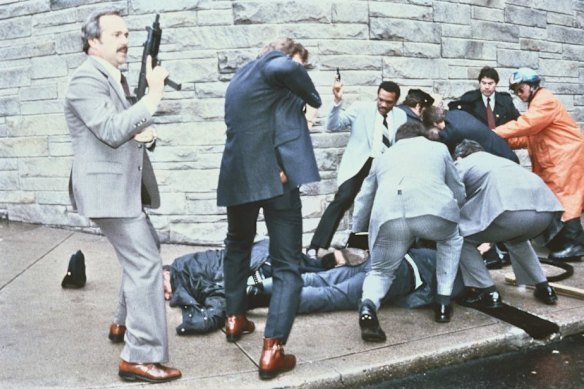
The closest we’ve come was on March 30, 1981, when president Ronald Reagan was shot by would-be assassin John Hinckley Jnr with a small-calibre bullet that punctured his left lung. His vice president, George H.W. Bush, in transit, heard early reports of the shooting but also heard that Reagan was OK, so deferred the decision to invoke the 25th until he changed plans and flew to Washington. Incommunicado in the air, nothing could change and by the time he landed, Reagan was out of surgery and conscious; crisis over.
Now to the messy bit: the president can write to Congress to say, sorry, no, I’m very much able to discharge my duties.
(A spot of housekeeping. The executive heads are often referred to as the Cabinet but that is not technically correct, says Harold Koh, a professor of law at Yale and former legal adviser in the US Department of State. “Not all ‘Cabinet’ members are qualified to vote under section 4. The Amendment’s text requires a majority of the ‘principal officers of the executive departments’.” These are defined by law as the heads of state, treasury, defence, justice, interior, agriculture, commerce, labor, health and human services, housing and urban development, transportation, energy, education, veterans affairs and homeland security.)
Now to the messy bit: if the president is not in a coma or being held by terrorists on Air Force One and doesn’t agree with the VP that they are unable to do their job, they can write to Congress to say, sorry, no, I’m very much able to discharge my duties, at which point the next part of the process triggers.
Now the vice president and their Cabinet colleagues have four days to write back to Congress to reiterate their claim. If they don’t, the president resumes their duties. If they do reply within the time limit, saying, no, we still think the president is unable to discharge their duties, it is now up to Congress to decide the matter. A two-thirds vote in both houses is required within 21 days. While Congress deliberates, the VP runs the show and the president presumably fumes.
How is it decided if a president is able to carry out their duties?
Central to the debate in Congress would be whether, as per the key wording of section 4, “the president is unable to discharge the powers and duties of his office”. There is no specific definition of what this might look like. “There is no precedent for what level of senility or erratic behaviour constitutes incapacity for the purpose of section 4,” says Laura E. Little. “The impetus for the amendment came from clear instances of physical incapacity or in the case of President Kennedy, assassination.”
As Brian Kalt, a US legal scholar, writes in his 2019 book about the 25th, Unable, section 4’s “unable” standard might seem very broad. “It sounds like it could cover presidents who are conscious and able to communicate but are just not up to the job. But even if tens of millions of people think the president is derelict in his duties, section 4 would not work well if the president can contest the action and is not truly and seriously incapacitated. In fact, using section 4 in such a situation could make matters worse.”
‘The presumption is that the actors around the president act in good faith, right? That the vice president does not use the 25th Amendment as a coup d’etat.’
Markus Wagner
The authors of the 25th deliberately left this wording flexible so that it could cover a wide range of contingencies. “You almost have to write it like this because you’re trying to capture a whole number of different situations,” says Markus Wagner. “The presumption is that the actors around the president act in good faith, that the vice president does not use the 25th Amendment as a coup d’etat.”
According to an authoritative study of the 25th by the Yale Law School, led by Harold Koh in 2018, “Once Congress comes to an understanding about what constitutes ‘unable’, it is forced to grapple with the issue of how to prove or disprove that the president is, in fact, unable.” There is nothing in the 25th that suggests medical evidence is required to make the determination, though the team from Yale suggested, “A president with no mental illness or disability could still be unfit to serve if his erratic behaviour indicates that he is incapable of making a rational decision.” This is what another framer of the amendment, congressman Richard Poff, then a leading Republican, argued in 1965.
“I think in the current moment, it’s a bit premature to be thinking about it,” says Rosalind Dixon, a professor of law at the University of NSW, “but it’s certainly something that we should be thinking about as an available tool.”
Had the 25th existed long into the past, Congress might have been asked to rule on the fitness of Franklin Pierce, who lost his son in a train derailment just before his inauguration in 1853 and spent his term in office deeply grieving; Calvin Coolidge, whose son died from an infected blister in 1924 and who subsequently flew into inexplicable rages; and Theodore Roosevelt, who lost both his first wife (from kidney failure) and mother (from typhoid) on Valentine’s Day, 1884, after which he battled chronic depression.
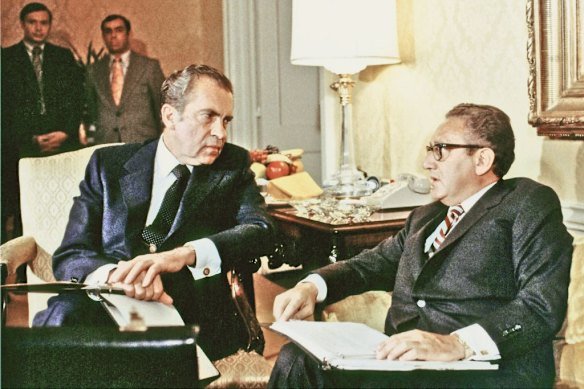
There is no shortage of presidents who acted “erratically”, meanwhile. Andrew Jackson, the 7th president, came into office with a reputation for duelling and brawling; when an assassin failed to shoot him in 1835, Jackson beat the man with his cane. Richard Nixon was frequently drunk as the Watergate scandal closed in, with secretary of state Henry Kissinger once describing him as “loaded”. (Nixon never faced the 25th, and resigned before he could be impeached, which would have led to his dismissal from office.)
‘In the deepest recesses of my heart and my mind, I know that Donald Trump is unfit to be president – but he is not unable.’
Jay Berman in The New York Times
Indeed, a 2006 study of the first 37 presidents by Duke University Medical Centre in North Carolina concluded that almost half of them had suffered from mental illness at one time or another in their lives. “The pressures of such a job can trigger issues in someone that have been latent,” Professor Jonathan Davidson told the BBC. “Being president is extremely stressful and nobody has unlimited capacity to take it forever and ever.”
Is Trump truly “unable”? Or do some people just not like how he governs? The 25th is not supposed to be a remedy for “someone you don’t like in office”, says Harry Melkonian, a lawyer and honorary associate at the United States Studies Centre.
As Jay Berman, a former aide to Senator Birch Bayh, told The New York Times in 2018: “The defining characteristic of section 4 was always the idea that there is a difference between unfit and unable. In the deepest recesses of my heart and my mind, I know that Donald Trump is unfit to be president – but he is not unable. In fact, he’s very able to carry out all of the terrible things he promised he would do.”

Could section 4 be used in relation to Trump?
It’s already been tried. In 2021, following the storming of Capitol Hill days before the end of Trump’s first term in office, the Democrat caucus claimed his actions rendered him “unfit” to serve and pleaded with vice president Mike Pence to trigger section 4. Nancy Pelosi, then-Democrat speaker of the House of Representatives, said there had been “growing momentum around the invocation of the 25th amendment”. Pence, who had already refused to do Trump’s bidding in Congress to help him overturn the election result, was not having a bar of it.
Pence wrote to Pelosi: “I did not yield to pressure to exert power beyond my constitutional authority to determine the outcome of the election, and I will not yield to efforts in the House of Representatives to play political games at a time so serious in the life of our nation.” He noted: “As you know full well, the 25th Amendment was designed to address presidential incapacity or disability … under our Constitution, the 25th Amendment is not a means of punishment or usurpation. Invoking the 25th Amendment in such a manner would set a terrible precedent.”
‘For President Trump, where personal loyalty is coin of the realm, it’s just not going to happen.’
Jeffrey Gordon, University of Sydney
Years later, on February 8, 2024, Republican congresswoman Claudia Tenney tried again, writing to the attorney-general claiming that then-president Biden was mentally unfit to hold office “because of his cognitive decline”, and urging him to “begin proceedings to remove the president pursuant to the 25th Amendment of the United States Constitution”. That went nowhere either, in no small part because it was not within the attorney-general’s power to trigger the 25th.
While section 4 requires the VP to make the declaration with the approval of Cabinet (shorthand here for “the principal officers of the executive departments”), there is an alternative method. Instead of a majority vote of the Cabinet, “such other body as Congress may by law provide” could instead be called upon. This is to account for a loyalist Cabinet such as Trump’s, which would be very unlikely to declare him unable. “For President Trump, where personal loyalty is coin of the realm, it’s just not going to happen,” says Jeffrey Gordon.
For now, no such body exists, and it would have to be brought into existence by Congress; section 4 gives no guidance as to what this body would consist of. Says Harold Koh: “The legislation would address questions like who serves on the body, who selects them, how long they serve, and so forth. Once established, the ‘other body’ would replace the role of the ‘principal officers’. So you would need the vice president and a majority of the ‘other body’ to activate section 4, and you would need them to vote again to continue the separation of the president from his powers should the president choose to contest it.”
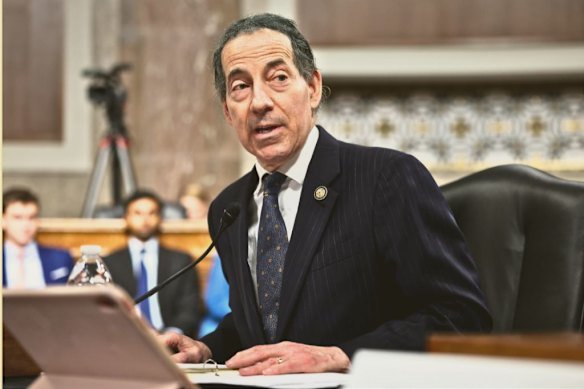
Democrat Congressman Jamie Raskin, a constitutional scholar, has introduced a bill to create what he calls an “independent commission on presidential capacity” that could be called on to report to Congress on the president’s fitness for office, consisting of eight retired statespeople including former presidents, four doctors and four psychiatrists. “It is now a matter of national security for Congress to fulfil its responsibilities under the 25th Amendment to protect the American people from an increasingly volatile and unstable situation,” he said this week.
The catch: such a bill would have to pass through both houses, currently both majority Republican, and would ultimately have to be signed into law by the president. As Brian Kalt explains, “Congress can designate another body to stand in for the cabinet to do the job, but it would need to do that designation through a statute, which would be subject to the president’s veto.”
And as Koh points out, that body would still need the vice president to issue proceedings. And why would they? It’s possible, says Rosalind Dixon. J.D. Vance, she says, is “highly ideological, very ambitious, but ultimately sane. And so it would come down to his judgement and persuading his colleagues. If he thought there was a genuine risk to the national interest based on mental illness, then I think that’s the only chance that you would realistically see the power being exercised.”
‘The only situation I could see would be something like a president who suddenly has a massive heart attack or a stroke and is still alive, but is incapable of handing it over to the vice president.’
Harry Melkonian, United States Studies Centre
For now, says Wagner, “You can think of Trump whatever you want, but I don’t think this current situation qualifies. It’s not a fitness for office test. It’s capacity to function, rather than a constitutional accountability mechanism.”
Harry Melkonian agrees. “The only situation I could see would be something like a president who suddenly has a massive heart attack or a stroke and is still alive, but is incapable of handing it over to the vice president. Then it might be used. I see it being very awkward in a case of, let’s just say, someone behaving erratically. I think the fourth works in obvious cases of physical impairment. It’s when you get into stuff about emotional stability and things like that, or cognitive ability, it gets more difficult.”
Politically, say the constitutional scholars we consulted for this article, impeachment is a more conventional option for Trump’s opponents than trying to get the Cabinet to trigger section 4.
As Kalt writes in Unable: “Reports of talk within the administration about section 4 never fail to make headlines. But these critics largely misunderstand section 4’s limits and do not realise how ill-suited it is for their purposes … If a president is doing deeply problematic things and the nation simply cannot wait until the next election to oust him, impeachment and removal is the proper and effective remedy.”
While impeachment takes a lot longer (the 25th is, in effect, an immediate transfer of power to the VP), it has a (relatively) lower bar: introduced in the House of Representatives, it would require a simple majority then two-thirds of the Senate for a conviction and removal from office, with no requirement that the vice president or Cabinet be involved. Trump has already been impeached twice but was acquitted by the Senate both times.
“The threshold for invoking the 25th amendment is really high,” says Jeffrey Gordon. “An erratic president really comes down to, why wouldn’t you go the impeachment route?” The 25th, while initially quicker, could end up dragging on for months if the president continued to assert their fitness for office, on one hand, and the vice president and a majority of Cabinet continued to declare otherwise, he says. Bottom line, he tells us: “The main mechanism of presidential accountability is at the ballot box.”
Get fascinating insights and explanations on the world’s most perplexing topics. Sign up for our weekly Explainer newsletter.
Read the full article here