





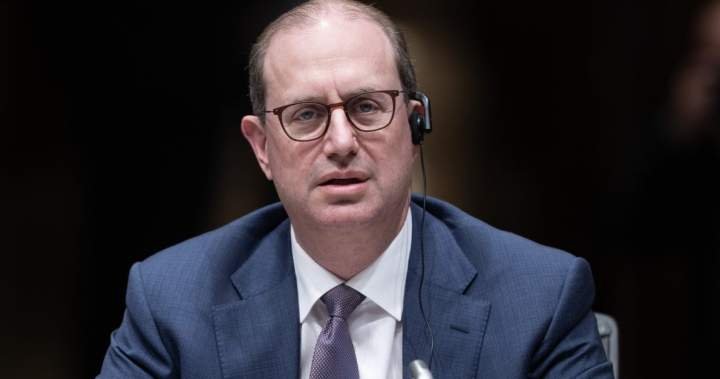
Canada’s new ambassador to the United States said the historic ties between the two countries are “too important” to abandon completely as trade tensions are pushing Ottawa to diversify its economic relationships.
Yet Ambassador Mark Wiseman was unable to say clearly when those tensions may be resolved, noting repeatedly that Canada remains ready to discuss deals to end sectoral tariffs and renew the Canada-U.S.-Mexico Agreement (CUSMA).
“No date has been set for any formal negotiating round as it relates to the review of CUSMA,” Wiseman told the the House of Commons foreign affairs committee after it was noted that the U.S. and Mexico have announced their formal talks will begin in late May.
All three countries have until July 1 to decide whether to renew the free trade pact as part of a scheduled review. But Trump administration officials have cast doubt a deal will be reached in time and have pointed to ongoing disputes and trade irritants with Canada.
Wiseman said that, although he’s not the lead negotiator on CUSMA and other trade issues, he was representing the government’s position that “North American integration must continue to support shared prosperity, but not at the expense of Canada’s autonomy.”
Prime Minister Mark Carney said earlier Thursday that U.S. tariffs on industries like steel, aluminum, autos and lumber “are more than irritants. Those are violations of our trade deal.”
He warned in a video message on Sunday that Canada’s historic strengths with the U.S. on trade and security ties have become “weaknesses we must correct” by looking to other markets and reducing reliance on the U.S. market.
Still, Wiseman told MPs that he was optimistic about the relationship overall, pointing to the “huge advantage” Canada has just from being next door to the U.S.
“Diversifying does not mean abandoning our relationship with the United States of America,” he said. “It is too big an advantage to us. It is too important to us.


Get breaking National news
Get breaking Canada news delivered to your inbox as it happens so you won’t miss a trending story.
“There is a lot of common ground between Canada and the United States, and I think it’s easy to forget that when we are having tough discussions, or when those discussions are are political in nature.”
The ambassador did not say if he agreed with Carney’s harsher rhetoric toward the U.S. or whether “anti-American sentiment” pushed by some Canadian public figures was making his job in Washington harder.
“Every meeting that I have had has been respectful, open and receptive. And I have to say, I wasn’t necessarily expecting that,” he said.
“I think at times we have to look below the bluster, the same as here in Canada … and get down to business. And my sense, based on my reasonably large sample in the first couple of months, is that people in the United States are also wanting to get down to business, not just on trade, but on all the aspects of the complex relationship between our two countries.”
Asked about the issue of supply management for Canada’s dairy sector — which U.S. President Donald Trump has raged against and that Carney has vowed won’t be touched in the CUSMA review — Wiseman said: “I don’t think I’ve ever been in agreement with President Trump’s position on this subject and many others.”
Wiseman took up the diplomatic role in the United States capital in February, replacing Kirsten Hillman, who helped negotiate CUSMA during U.S. President Donald Trump’s first term.
The new ambassador previously served as a global investment banker and pension fund manager at firms including BlackRock, and acknowledged he has no previous government or diplomatic experience.
“I do bring skills to the table, I think,” he said. “I think the prime minister believed this when he asked me to take on the role, whether it be in business negotiation, my legal background.
“To me, given the times that we are in (with) our relationship with the United States, those skills come to the fore: building relationships, finding win-win solutions, building bridges.”
He said he remains focused not just on resolving the trade disputes but also strengthening economic and defence partnerships with American government and businesses, noting Canada’s achievement of meeting two per cent of GDP on defence spending “has been welcomed in Washington, D.C.” and “is not going unnoticed.”
“Americans understand the importance of the alliance and economic relationship with Canada,” he said. “Do they wake up and think about us every day, the way that we wake up and think about them every day? No, that’s not the case. And we have to continually remind them of that.”
Near the end of his opening statement, Wiseman apologized for sending an English-only invitation to MPs on the committee to attend a reception in Washington next month.
He said not including French on the invitation “was an error, an unacceptable error, that has now been corrected” with a new bilingual invitation being re-sent.
Wiseman, who does not speak French, told the MPs that he takes his job seriously as a representative for “all Canadians” in Washington, including Quebecois and Francophone Canadians.
“I will faithfully represent the policies of the government of Canada as instructed in everything that I do, including as it relates to cultural and language matters,” he said.
Earlier Thursday, Carney said he was disappointed the invitation was English-only, calling it “unacceptable.”
Air Canada CEO Michael Rousseau was pushed to resign last month after releasing an English-only video sending condolences to the victims of the deadly Air Canada Jazz collision at New York’s LaGuardia Airport.
Rousseau subsequently announced he would be retiring later this year.
Read the full article here