






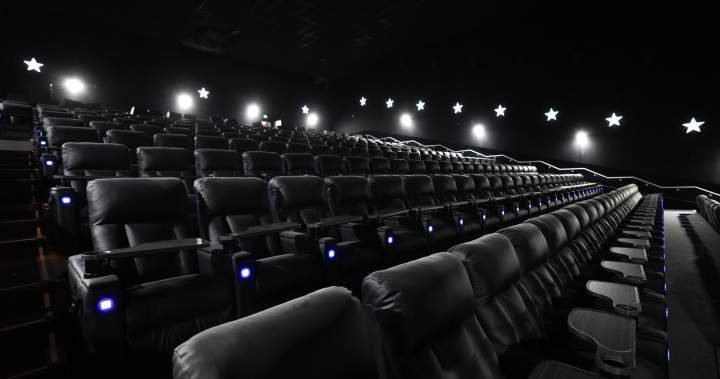
Cineplex Inc. has experienced its highest second quarter in the company’s history, in large part due to a rising number of movie-goers in recent months, according to the company.
Canada’s largest cinema chain reported a profit of $7.8 million in its second quarter in 2026, compared to a loss of $2.2 million a year earlier, posting its best revenues for the April through June period in the company’s history.
Theatre attendance also amounted to 12.7 million patrons, up from 11.6 million a year earlier at the same time of year.
“This quarter’s success was not dependent on a single blockbuster or a small number of tentpole releases. Instead, consumers embraced a broad range of compelling content across multiple genres and formats,” Cineplex CEO Ellis Jacob said on the company’s earnings call Tuesday.
Experts say the answer is simple: consumers feel the movies are worth going to the theatre for.
“There have been a series of very high-earning films over this quarter,” Charlie Keil, a professor at the University of Toronto’s Cinema Studies Institute said.
Some of those films include Michael, the Super Mario Galaxy World, Toy Story 5, A Great Awakening and The Drama, among others.
“These are blockbusters that are bringing in people in droves and probably people who were not normally going to films as often as they used to in the past.”
Keil also noted that movies such as Backrooms and Obsession that were released in the first quarter of the year continued unexpected success into the spring months of 2026.
“If people get in the habit of going to movies and there’s another appealing title just around the corner, that will keep that flow of patrons going.”
Most of the movies that have skyrocketed in popularity already have “existing properties” that draw consumers into seeing the film when it initially comes out, Martin Lefebvre, chair of the Mel Hoppenheim School of Cinema at Concordia University said.


Get breaking National news
Get breaking Canada news delivered to your inbox as it happens so you won’t miss a trending story.
“The Mario Brothers, there’s been movies before, and of course it’s a video game. The same thing with Toy Story, which is the fifth installment of the series, even The Odyssey to some extent, the story has been told many times,” he said.
“Even to some extent, a film like Backrooms had a following before the film came out in the theaters because it had a presence on the internet. If anyone had a surefire recipe to ensure box office hits, they would certainly use it.
Airing FIFA World Cup games at Cineplex locations during the tournament introduced viewers “to other events other than just movies,” Jacob stated.
Cineplex was the only company in Canada offering fans the opportunity to see matches on the big screen, and one of only a “handful” across North America providing the experience at scale, Jacob said on the earnings call, also adding that showing those FIFA matches “demonstrated the broader opportunity for Cineplex to be part of large cultural moments.”
This could be a move that garners more traction as more major non-film events occur.
“I think we’re going to continue to see, trying to kind of harness the special energy that comes with doing screenings of non- film product, concert films, they’re films, too,” Keil said. “What we see is the core business that still comes from successful movies that people want to see.”
According to Lefebvre, “platform fatigue” is contributing to the appeal to watch a movie in theatres.
“People are buying or renting films on several platforms at once, they’re paying for their Netflix, their Amazon Prime, their Disney, Paramount, and then they’re paying for their music platforms as well. Some people are getting a little bit fed up with that kind of economy, the platform economy.”
One-half of Canadians go at least two to three times a year or more often, according to a national Narrative Research study released in January 2025, with Gen Z and millennials more likely to go to a movie within the past three months.
March 2026 Pew Research Center data states that 53 per cent of U.S. adults reported seeing a movie in a theatre within the past year, with seven per cent of Americans say they have never seen a movie in a theatre at all.
Two long-awaited films, The Odyssey and Spider-Man: Brand New Day, came out within two weeks of one another in July, making significant impacts on the box office already with no signs of slowing down.
The end of 2026 is also slated to consist of major releases, with Avengers: Doomsday set to be released on Dec. 18, Dune: Part Three on Dec. 18 and Jumanji 3: Open World on Dec. 25.
Part of having films release at similar times to each other supports movie theatre “pipelines,” Keil said.
“As we see right now, if you have a couple of big films both playing at the same time, it really keeps the theaters full so you want a robust pipeline such that the people will keep coming and the money will keep flowing.”
The Odyssey has garnered a whopping $1.1 billion U.S. following its July 17 release and is set to release in China this Friday, with the country planning on dedicating most of its 800-Imax screen network to the film.
Spider-Man: Brand New Day has collected $1.67 billion U.S. worldwide since its July 31 release, earning $360 million U.S. in its debut weekend, surpassing Avengers: Endgame to become the film with the biggest opening weekend in history.
“With The Odyssey or the new Spider-Man film, all these films are huge event films,” said Keil. “The last time we can remember this happening, that it really landed with people was the Barbenheimer phenomenon. And that reminded people that going to movies can be its own experience.
“Having The Odyssey occur in such close proximity with Spider-Man, it just made it seem like you had to go to the movies this summer. Like that there was a social phenomenon at work, and you wanted to be part of it.”
Lefebvre also added that while going to movie theatres may be “not as big a phenomenon as it once was socially, it’s still something that happens.”
“It’s still a live art form. It is alive.”
Read the full article here