




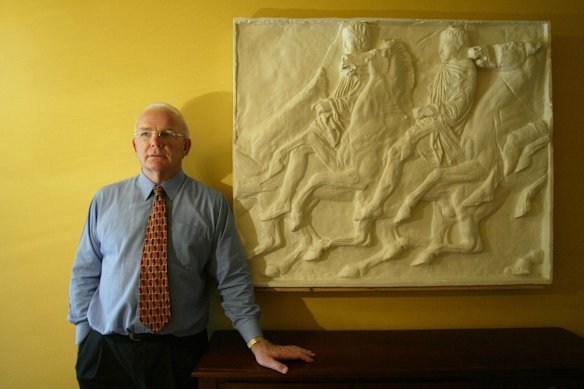
David Hill is the former managing director of the ABC, and a long-time advocate and activist for the Parthenon Marbles being returned to Greece from the British Museum.
Fitz: David, good to chat. I want to work our way towards the chances that the new British PM Andy Burnham will lead his government to returning the Parthenon Marbles to Greece from the British Museum, but let’s go first to your own involvement in the campaign.
DH: Sure. I have been heavily involved for three decades.
Fitz: Three decades! Hang on, I do hope you didn’t spend a single minute on it, while you were on the taxpayers’ dime, as managing director for the ABC, pushing your woke, lefty, Marxist, virtue-signalling progressive causes? I’ll have your guts for garters!
DH: [Laughing.] No! But there was a Greek-Australian bloke, Peter Cassimaty, who was a sound technician at the ABC, and after I left in 1995, he asked me to be on the committee of a group of Greek-Australians supporting Greece’s claim for the return of the Marbles, and so I got into it. I ended up living in London in the early 2000s as executive director of the British Committee for the Restitution of the Parthenon Marbles, which is around the time I first met Andy Burnham.
Fitz: How did the marbles get to Britain in the first place?
DH: Well, in the early 1800s, ancient Greece and ancient Rome were very romantic ideas, and the British ambassador to the Ottoman Empire in Constantinople, Lord Elgin, was taken by the idea of stripping the Parthenon, which is on the Acropolis in Athens, of about 100 beautiful classical sculptures to adorn his estates in the village of Elgin, near Fife in Scotland. The Ottoman Empire at the time encompassed Greece. He paid a nominal fee, and over several years the job was done.
Fitz: Bloody hell. Talk about “Stuff the British Stole!”
DH: Taking the statues was controversial at the time. A lot of people were critical, including Lord Byron, who wrote damning poems about the stripping of these marble statues. The Parthenon – the crowning achievement of ancient Greek temple architecture – was built at the height of classical Greek civilisation in the 5th century BC, and there’s no argument these sculptures are recognised as the ancient world’s most valuable and important artworks and here were over 100 of them transported to Britain, some of them on Royal Navy ships. But Elgin got divorced and went close to broke, so he sold them to the British government for £35,000, which gave them to the British Museum in 1816 – where instantly they were the jewel in the crown of their collection.
Fitz: I do hope the missing heads of some of those statues are not from divvying up the assets with Missus Elgin?
DH: [Earnestly.] No, no, she, she took nothing. But the complication of the subsequent dispute is of ownership. It’s alleged that Elgin bribed the Ottoman officials to allow him to do it, and there’s a dispute over a thing called a firman, which was alleged to have been the authorisation for Elgin to legally take the marbles. But whatever way he got them, the British Museum argues that it received them legally.
Fitz: And yet, David, without wishing to prove Godwin’s law – the longer an online discussion goes on, the higher the likelihood of a comparison involving the Nazis or Hitler – much of Hitler’s atrocities were “legal” in the sense that they were simply committed under horrific laws that the Nazis had passed. But it was still completely WRONG nevertheless. Surely it must be obvious to the Brits that they have no moral title to the Parthenon Marbles?
DH: Traditionally the British establishment have just said that “You Greeks can go and get stuffed and …”
Fitz: “… and we’ll even give you a whiff of the grape, if you keep complaining.” I know. It was the British way. When did the Greeks as a whole realise it was simply not right to have lost their Marbles, and begin concerted action to get them back?
DH: The real campaign took hold in the 1980s when the magnificent Melina Mercouri became the first female Greek minister for culture in 1982. She made noise about it and was the first to insist that they not be referred to as the “Elgin Marbles”, but the “Parthenon Marbles” to make the point where they truly belonged. She even debated at Oxford University in 1986, arguing they should be returned, and the chair of that debate was none other than Boris Johnson.
Fitz: A decade later, the big hope in 1997, was that the incoming British prime minister, Tony Blair – who I know had been noisy about the need to return them – would follow through?
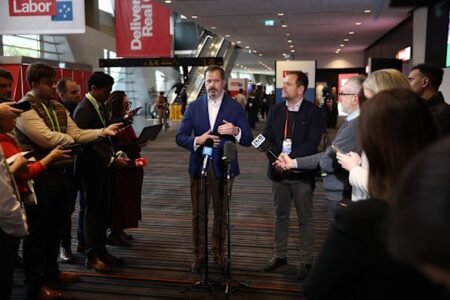
DH: Yes. But he squibbed it. The day after the election, despite everything he had said, it was announced they would stay put. After that election win, Blair had tremendous authority, but still didn’t want to take on the British establishment. And that’s the significant thing about Andy Burnham. He’s the first British prime minister that has a record of statements supporting the return of the Marbles, who also has a record of taking on the establishment.
Fitz: And you’ve already met with him on the subject?
DH: Yes, I first met with him in the late ’90s, when he was a staffer in the new Blair government, and he worked for the (then) minister for culture Chris Smith and he was all for their return then. And then he got elected as an MP in 2001, and publicly supported their return. In April 2000, The Economist surveyed all members of the House of Commons, and 80 per cent of the Tories said they should not go back, but 80 per cent of the now-government Labor members said they should go back. Andy Burnham was one of those.
Fitz: So you met with him again?
DH: Yes, I went to the Labor Party conference at Blackpool in 2002 to try and gee up the Labor MPs to make Blair do something, and Burnham was great.
Fitz: Did you feel like, when meeting him, “I might be in the presence of a future British PM”?
DH: No. He was just a good MP, with a passionate view on the need to return the Marbles, and he put his name to a backbencher motion that the government should give them back, and co-introduced a private member’s bill that sought to amend the British Museum Act 1963, which among other things forbids Britain’s four largest museums from repatriating cultural artefacts. The bill got nowhere. Tony Blair would not take on the establishment.
Fitz: But what would the Blair people say? What argument could they offer against something that was so obviously the right thing to do?
DH: They never articulated. I dealt with the ministry for culture, the British Museum, the secretary of state for culture, the minister for arts, and they just said the museum acquired them legally, and they’re an important part of a collection. The government of Blair’s successor Gordon Brown was no better even though, for a brief period Burnham was culture minister and agitated for it. Later on, when Boris Johnson was PM, he released a statement saying the Marbles should never have been taken, but he didn’t actually do anything.
Fitz: But now, it might happen!
DH: Look, he might squib it like Blair, but yes, he really might do it. He’s never wavered in his position. In 2020, he said, “now is the time to return the marbles” and in 2023, his position was clearly stated: “Send them back, no strings attached. And let’s use culture to change how Britain is seen around the world.”
Fitz: Let’s say the new prime minister with a new broom does the right thing and returns the Parthenon Marbles. There is surely significance for us Australians in that? As you know, our own Gweagal Shield, dropped by one of the two brave warriors defending the shores of Botany Bay when Captain Cook fired upon them, is now in Cabinet 198 of the British Museum. It is one of the three most sacred relics of Australia and it’s not theirs, it is ours. If they give back the Parthenon Marbles, surely they can give that back to us?
DH: Quite possibly. There is an interesting precedent for the return of important cultural property to Australia, even within the limitations of the British Museum Act and, of all people, it was affected by John Howard. When he, as prime minister, was in London for the Centenary of Federation celebrations, I couldn’t get him to support us on the Parthenon Marbles. But the Aboriginal community were at the time campaigning for the return of sacred Aboriginal human remains to Tasmania from the British Museum and the Natural History Museum, despite the British Museums Act forbidding it – and Howard acted.
Fitz: What did he do?
DH: He raised it with Tony Blair and the British PM released a statement saying that it was desirable that these human remains should be returned to Australia. So with the weight of the British PM behind it, the Blair government established a working party that found a way around the British Museum Act, by passing the Human Tissues Act, which allowed the museums to return human remains less than 1000 years old. They thus found a way to limit the precedent to “bones, not stones” and the Aboriginal remains were eventually returned to Australia.
Fitz: Good ’ol John Howard. Perhaps he could be helpful right now to Indigenous Australians trying to get the Gweagal Shield back?
DH: Quite possibly. If Andy Burnham has his way, and the Parthenon Marbles are returned to Greece, I think this is a game changer for all of us.
Start the day with a summary of the day’s most important and interesting stories, analysis and insights. Sign up for our Morning Edition newsletter.


From our partners
Read the full article here