





Victoria’s tobacco licensing scheme has been branded a farce, with no one criminally charged and accusations the agency has been ignoring requests for assistance from Victoria Police.
The state government promised a wide-ranging crackdown on the multi-billion dollar illicit tobacco black market would begin on February 1 with the deployment of 14 inspectors and a new licensing regime.
At the time, there were an estimated 8000 tobacco retailers in the state, including more than 1300 shops that were connected to the illicit tobacco trade run by serious and violent organised crime groups.
But three months in, less than half a shipping container’s worth of illegal cigarettes have been seized and Magistrates’ Court records show not a single prosecution has been launched.
”We are cracking down on illicit tobacco and helping to disrupt the organised crime gangs it finances,” a Tobacco Licensing Victoria spokesperson said.
“There have been 27 infringements totalling almost $250,000 issued by inspectors.
“Investigations are underway in relation to other regulatory action.”
Under the government crackdown, legislation allows individuals to face fines of up to $370,000 or 15 years’ jail, while businesses face penalties of more than $1.8 million.
Two law enforcement sources, familiar with the operations of TLV but not authorised to speak publicly, said the licensing regime had been a dismal failure due to poor planning and lacklustre enforcement.
They said the 14 inspectors were devoting most of their efforts towards checking the licences of supermarkets, chain convenience stores and petrol stations rather than the ‘specialty’ tobacco shops that were known distributors of illicit products.
Claims that TLV and Victoria Police work in close cooperation were also branded as misleading amid allegations that TLV had ignored requests to participate in joint operations or seize tobacco uncovered during police investigations.
TLV, while declining to say how many legal and illicit tobacco retailers it had inspected, said the agency had seized “more than $6 million” in illicit tobacco products. It represents about 4 million cigarettes.
In contrast, Victoria Police seized a single truck carrying $5 million worth of tobacco in one operation in mid-2025.
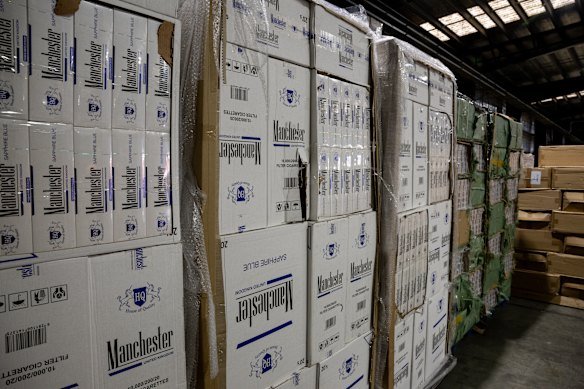
Shipping records obtained by The Age show more than 4.4 billion illicit Manchester cigarettes were sent to Australia from 2023-25.
Manchester, which is manufactured in Dubai and has close links to Australian organised crime, is now the most popular cigarette brand – legal or illegal – in the country.
TLV declined to comment on allegations it had been ignoring requests for assistance from law enforcement.
“The upcoming budget invests $13.4 million to triple the number of Tobacco Licensing Victoria inspectors, support tough new shop‑closure powers and the ability for landlords to evict businesses selling illicit tobacco,” a spokesperson said.
A Victoria Police spokesperson declined to comment on the existence of any dispute or provide an assessment of TLV’s work.
“Victoria Police will continue to support TLV in the exercise of their tobacco licensing functions, while Crime Command continue to target serious and organised crime figures linked to the illicit tobacco trade.”
Victoria is one of the only states in Australia where inspectors still do not have the power to shut down operators permanently.
Victoria has been in the grip of a violent turf war over control of the illicit tobacco market for three years, which has seen more than 150 firebombings, several murders, and numerous shootings.
One industry insider said the market had been so warped by the influence of organised crime that underworld boss Kazem “Kaz” Hamad – who established a nationwide illicit tobacco cartel in 2025 that controls prices and distribution, enforced by violence – “might as well be appointed Minister for Health”.
“It’s Hamad who controls the tobacco market in Australia, not the government,” the source said.
Hamad’s arrest in his native Iraq in January and the closure of the Strait of Hormuz has caused the greatest disruption to the supply of illicit tobacco in years.
Meanwhile, on Monday, the federal parliamentary “inquiry into the tobacco crisis in Australia” is set to begin public hearings into government policy and law enforcement activities in the $8.5 billion black market.
The subject of the federal excise tax on cigarettes is expected to be a major focus as numerous submissions to the inquiry have focused on it as a driving force in the infiltration of organised crime into the sector.
The Australia Border Force and the Illicit Tobacco and E-Cigarette Commissioner are the first agencies to testify and will likely face thorny questions about their apparent divergence on whether excise tax cuts should be considered as a possible solution to the crisis.
The ABF have advocated for “demand reduction measures” but has stopped short of openly calling for a reduction in the excise, which would run contrary to government policy.
“The ABF notes that absent demand reduction measures, enforcement activity alone will continue to be offset by sustained consumer willingness to purchase illicit product,” its written submission said.
“Understanding consumer motivations, substitution behaviours and price sensitivity is therefore important in informing complementary policy responses aimed at reducing the demand pull that sustains the market.”
ABF refused to clarify to this masthead on the record whether cutting the tax was an option it was advocating.
ITEC, the nation’s coordinating office for tobacco enforcement, has repeatedly stated there was no evidence that a tax cut would disrupt the illicit market. Both AFB and ITEC are part of the Department of Home Affairs.
Be the first to know when major news happens. Sign up for breaking news alerts on email or turn on notifications in the app.
From our partners
Read the full article here