






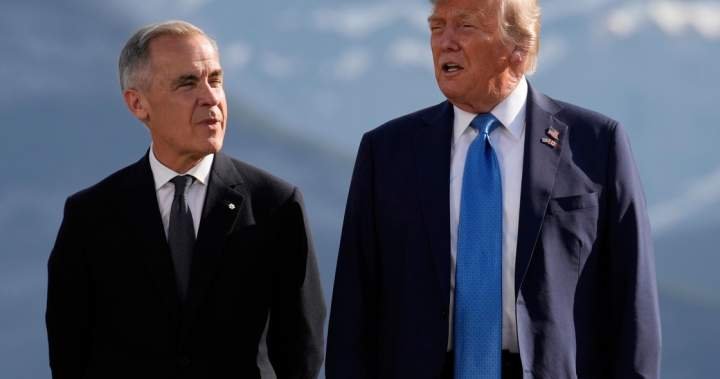
Representatives of Canada, Mexico and the United States are set to meet virtually Wednesday to discuss the Canada-U.S..-Mexico Agreement on trade, better known as CUSMA, and all indications are the Trump administration will not sign on for a 16-year extension.
Wednesday is the deadline for all three partners in the trade pact to indicate whether they want the deal renewed.
While the U.S. is expected to blow past that deadline without renewing the deal, the trade pact will remain in place and subject to annual rolling reviews for up to a decade — at which point it will expire if an extension isn’t agreed upon.
Carlo Dade, director of international policy and the New North America Initiative at the University of Calgary’s School of Public Policy, said the blown deadline doesn’t mean much to the future of CUSMA “as long as there is constructive work and dialogue occurring.”
“I think the market is adjusting to a new normal of uncertainty with the U.S.,” Dade said in an email. “That said, awareness of the reality also means greater awareness of the cost.”
CUSMA was negotiated during the first Trump administration to replace the North American Free Trade Agreement. The sometimes tumultuous negotiations served as an early test of Ottawa’s approach to the Trump administration but ultimately all three countries hailed the agreement as a success.


Get daily National news
Get daily Canada news delivered to your inbox so you’ll never miss the day’s top stories.
But U.S. President Donald Trump has continued to cast doubt on CUSMA’s future since his return to the White House and his embrace of a sweeping tariff campaign. He has called the agreement “irrelevant” and has said it may have served its purpose.
CUSMA remains in place unless one of the partner countries gives six months’ notice that it is pulling out. Canada and Mexico both have indicated they want to keep the deal in place.
Trade negotiations between Mexico and the United States have launched but Ottawa and Washington have not started official talks yet.
Prime Minister Mark Carney said Tuesday he doesn’t expect “drama” during this week’s meeting on CUSMA’s future.
Andrew Hale, a fellow at Advancing American Freedom — a conservative advocacy group founded by former U.S. vice-president Mike Pence — said CUSMA was a major achievement during the first Trump administration and he credits former United States trade representative Robert Lighthizer for following the law while being a tough negotiator.
Trump’s trade actions are now sowing “chaos” and many people in the administration “don’t get Canada,” Hale said.
“They’re so unpredictable and it’s so chaotic. If I knew what their strategy was, I could make a gold mine. It’s like asking me if I have a crystal ball.”
While trade talks will continue, the uncertainty discourages long-term investment because of the deep integration among all three countries, Hale added. If negotiations continue for a long time, he said, it could diminish North America’s global competitiveness.
Annual consultations could also bring increased trade frictions, Hale said, because they “are never usually harmonious with the Trump administration.”
“They push people right to the edge of the cliff every time they have these negotiations,” he said.
Dade said some members of the Trump administration have indicated that the U.S. still values the trade agreement.
United States Trade Representative Jamieson Greer has said there are “pillars” of the continental trade pact that work well. Commerce Secretary Howard Lutnick and senior Trump adviser Peter Navarro have been much more critical.
“Trump is negotiating in public, so we have to discount, heavily discount, what he says, view it through the lens of his seeking leverage,” Dade said.
Dade agreed that dragging out the review process could become problematic for the Trump administration if it stifles investment.
Polling also shows sustained public support for the agreement on both sides of the border.
Recent polling for the New North America Initiative by Ipsos Public Affairs and Nanos Research found just eight per cent of Americans described Canada as a major economic challenge. Most Canadians — 77 per cent — said they viewed the U.S. as an economic challenge.
Majorities on both sides of the border supported bilateral economic co-operation, with 88 per cent of Canadians and 56 per cent of Americans supporting the trilateral free trade agreement.
Ipsos Public Affairs surveyed 1,022 adults in the United States from March 27 to 29 and another 1,022 adults in the U.S. from April 24 to April 26. Nanos Research surveyed 1,047 adults in Canada from March 31 to April 3 and another 1,039 adults from April 25 to April 27 by phone and online.
Read the full article here