



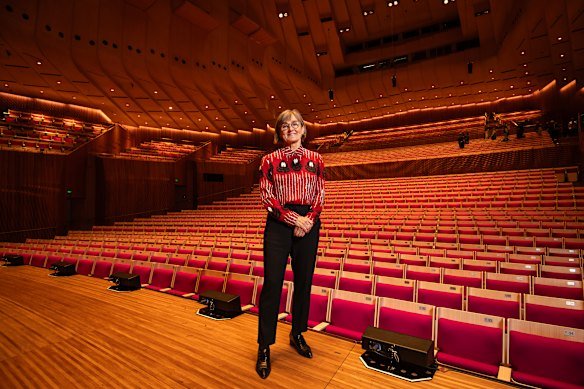
After 14 years in the role, Louise Herron AM stepped down on Thursday as CEO of the Sydney Opera House. She will soon take up a role as a vice-chancellor’s fellow at Sydney University, to help advance the university’s focus on “leadership for good”.
Fitz: Ah, sing it Frank Sinatra! So now, the end is near, and so you face the final curtain in the Opera House Concert Hall. We may get to regrets you’ve had a few, but right now, what are your primary emotions on the day of leaving?
LH: My primary emotion is that it is the perfect moment for me to leave. Over that time as an organisation, we have achieved so much together. Building projects have been a constant since the time I arrived. The construction of the new loading dock was under way. That massive project involved removing 25 Olympic swimming pools’ worth of sandstone from under the building without it moving a centimetre. That feels like a long time ago. And as I leave, the NSW government has generously announced further funding of $120 million to do what’s needed to fix under the northern boardwalk and in the three smaller western venues: the Drama Theatre, Studio and Playhouse. In between, we’ve done some incredible projects – renewing the Concert Hall, working on the Joan Sutherland Theatre, creating the Yallamundi Rooms and Centre for Creativity, clearing the forecourt. So many wonderful things.
Fitz: Ah, so when we walk towards the Opera House, we see this architectural jewel that we’re so lucky to have, but you see the state of play of a dozen projects?
LH: I see a thing of beauty as I walk towards or around it. But within this, I see a lot of machinery and maintenance. I also see all the love and passion and care from all the artists and people who work here. I see the challenges of creating programs to make this place more accessible. I see all of that. I think of the Opera House as a 3D jigsaw puzzle in every respect. And it takes a couple of years to find your way around.
Fitz: On that subject, on the occasion of you kindly launching my own book on the Opera House at the venue, you might recall me noting there were no fewer than 1000 rooms in the whole building and it was an honour and a privilege to stand in any of them, let alone the Utzon Room. Do you think by now you’ve stood in all 1000 of them, bar the men’s toilets?
LH: Most of them! Every door is numbered according to a system that denotes the level it’s on, being the number of feet above the mean tide level.
Fitz: So when the days grow old and we grow cold, and we talk about Louise Herron’s time running the show, at the place of shows, what do you want us to say of you?
LH: That she loved this place. She loved the people. She loved everything that happened here and . . .
Fitz: And she worked like stink to make it an even better place.
LH: [Laughing gaily.] Your words not mine, but yeah.
Fitz: And when we run the highlights package of things you achieved, what do you want us to include?
LH: All the building projects; creating an increasingly inclusive culture in the organisation; working towards our ambition to make the Opera House, “Everyone’s House”. There’s still a way to go, but we’re fully committed to advancing this ambition. On that, I particularly love programming for children – seeing the delight in their eyes and their raw emotion, especially if it’s their first performance, that’s something you never forget.
Fitz: As a biographer of a few people, I love seminal moments. Was there a moment for you, sitting in the darkness of the stalls or at the end of a performance or even sitting at the traffic lights, when you truly reached the decision: “I’m done. I’m really going to leave.”
LH: Yes. It was following a conversation with the wonderful Ann Sherry, who, among many things, is chancellor of Queensland University of Technology. I was speaking to her about my passion for helping emerging leaders, and telling her that an opportunity had arisen for me to do this at Sydney University. She’s always been a fabulous mentor to me and so many other women. And I said, “How am I going to decide when to move from one to the other?” Without a moment’s hesitation she said, “You move when you feel that you can have more impact at Sydney Uni than at the Opera House.”
Fitz: Bingo!
LH: That moment came a few months ago when I was pretty sure we had secured the new $120 million funding, the board had agreed to extend our “Everyone’s House” strategy for a further two years and the executive team is humming along. So I felt the Ann Sherry moment. I can have more impact elsewhere now.
Fitz: At the Opera House’s 50th anniversary in 2023, four substantial bronze interpretation panels were installed on the box office podium, honouring the genius who designed it, Jorn Utzon; the architect who saw it through, Peter Hall; the great engineer Ove Arup; and the construction workers and craftspeople who actually built it. In my humble view, there’s one person missing, and that is Joe Cahill, the premier from the late 1950s and early 1960s, who was such a visionary in providing the government grunt to get the whole extraordinary project off the ground.
LH: Joe Cahill’s name, image and a quote are on a bronze plinth that also includes Utzon’s spherical solution. The new panels were positioned to speak to the plinth. It’s a beautiful thing.
Fitz: No one knows it’s there! I think his name should be up in lights with the other four plaques on the wall. The irony is that Cahill’s name is all over the ugliest thing in the city, the Cahill Expressway, which Paul Keating described as “. . . the eyesore that mars the most significant precinct in Sydney . . .” while it’s in tiny print on the Opera House itself, which never would have been built without him seeing what it could become, and overcoming all opposition.
LH: At the Opera House, we acknowledge him all the time, including the minister’s acknowledgment of Cahill in his speech at my farewell on Tuesday night. We often say that Joe Cahill was the Labor premier who said, “We need the Opera House to mould a better and more enlightened society.” Culture and creativity are a core part of our society, and must be supported.
Fitz: You can call this a hard question if you like, but are you ever bemused or outraged at how easily sport gets government funding – I refer to things like the NSW government giving $300 million to build pokie-palace rugby league club Penrith a new stadium to replace an old one that was already fine – while you have to scratch and claw and bite to get $120 million to redo parts of a global cultural icon that has replaced kangaroos and boomerangs as the symbol of our nation?
LH: Yes, sport often outpaces the arts in its ability to get funding, but research shows that people value cultural events … going to a performance has a lasting impact of up to six months on their sense of connection and wellbeing.
Fitz: In the 14 years you’ve been there, is there one performance that stands out? Or that you’re proud that we staged a particular event?
LH: Yes. The most memorable moment was when I first heard the trombone playing in the renewed Concert Hall in mid-2022, after we’d done all the work to fix the longstanding acoustics problem. Simone Young, who was conducting the orchestra, turned around, caught my eye and mouthed the word “Wow!” It was amazing. She and I had walked around the Concert Hall several times during construction. She was incredibly supportive, and she was just so thrilled with the result.
Fitz: You will know better than me, but I can only think of one major controversy in your time. That was when Alan Jones outrageously threatened to have you sacked by Premier Gladys Berejiklian for declining to have the sails of the Opera House turned into a billboard for that wretched Everest racing thingummy. Was that your absolute worst time?
LH: I actually thought the Alan Jones thing was great because it showed all the public support for the Opera House. It comprehensively demonstrated that people really care about this place. So, thanks Alan. More than 310,000 people signed a petition to say the Opera House matters. It was very valuable.
Fitz: And yet, the whole thing was so out of hand. I’ll never forget that Friday morning, listening against my will, when he more or less said in an interview with you, “I’ve got Gladys Berejiklian on the line next, and I can have you sacked if you don’t cave.” Was there no anger in you?
LH: There wasn’t any anger in me about it because all I was saying was: “This is the policy of the Opera House, and if we don’t want to enforce the policy, we shouldn’t have the policy.” I believe in this policy. And if you are a woman in a position like this, you are used to being belittled by other people who believe they hold more power. We just have to stand firm. So I was very used to it. It’s just not usually as public as that!
Fitz: Do you think the study and performance of music is much more, or much less, valuable in the world of AI?
LH: Much, much more. Because the study of music, of anything that stimulates your creativity, is essential for the future. It’s essential to critical thinking, and children learning music every day are more stimulated, more attentive, more inclined to attend school. And I believe that the critical thinking and creativity that you learn through music and all forms of creative expression are going to be essential in the future generations, in the age of AI – creativity and critical thinking are the essential difference between humans and non-humans.
Fitz: OK, and now to “regrets, I’ve had a few . . .” Surely there must be some? Some things where you think, “Geez, I wish I’d got that one done”, or “I pulled the wrong rein on that”?
LH: I guess there must be, but it’s honestly been such a positive whirlwind of fabulousness that I can’t think right now. In the beginning, I was probably too combative. I quickly realised that is not an effective way of achieving the right outcome. Collaboration wins every time.
Fitz: All right. When the new person comes in, I imagine there’ll be the handing over the baton, where just the two of you will have a lunch or dinner, and you’ll say ‘this is what you need to know?’
LH: Absolutely, absolutely.
Fitz: What will you say?
LH: It will be about the people and the relationships that I have found most wonderful and useful and rewarding. Because everything only happens because of the people.
Fitz: OK, well, on behalf of all the people who love the Opera House like no other building on earth, allow me to say, “Well done, you had a great dig.”
LH: [Softly.] Thank you, thank you so much. I really appreciate it.
Get a weekly wrap of views that will challenge, champion and inform your own. Sign up for our Opinion newsletter.


From our partners
Read the full article here